Bihar Board Class 12th हिन्दी भाषा और साहित्य की कथा

Bihar Board Class 12th Hindi Book Solutions

Bihar Board Class 12th हिन्दी भाषा और साहित्य की कथा

Bihar Board Class 12th हिन्दी भाषा और साहित्य की कथा

प्रश्न 1.

हिन्दी साहित्य के इतिहास का संक्षिप्त परिचय दीजिए।
उत्तर-
हिन्दी साहित्य का प्रारंभ सन् 1050 से माना जाता है। यद्यपि इस विषय में अनेक विद्वानों ने भिन्न मत भी दिए हैं तो भी साधारणतः आज इसी मत को मान्यता दी जा रही है। हिन्दी साहित्य को चार भागों में विभाजित किया जाता है-आदिकाल, भक्तिकाल, रीतिकाल और आधुनिक काल।

आदिकाल-सन् 1050 से सन् 1350 तक के कालखंड को आदिकाल की संज्ञा दी जाती है। आचार्य शुकल ने इसे ‘वीरगाथाकाल’ की संज्ञा दो। इस काल में रचा गया साहित्य संदेह और अप्रामाणिकता के कुहरे से ढका रहा। इस काल की कोई साहित्यिक प्रवृत्ति मुख्य रूप से उद्घाटित नहीं हुई, इसीलिए इसे निर्विशेष नामकरण ‘आदिकाल’ से ही जाना जाता रहा।

भक्तिकाल-सन् 1350 से सन् 1700 तक के काल को निर्विवाद रूप से सभी विद्वान् ‘भक्तिकाल’ की संज्ञा देते हैं। इस काल को हिन्दी साहित्य का स्वर्ण युग कहा जाता है। इस समय में कबीर, सूर, तुलसी, जायसी, मीरा, नानक आदि एक से एक बढ़कर रत्न हुए। इस काल में जो साहित्य रचा गया, उसे जन-मन की वाणी को किस प्रकार प्रभावित किया, इसके लिए यही पर्याप्त प्रमाण है कि आज भी तुलसी की चौपाइयाँ और सूर के छंद गायकों को कंठहार बने हुए हैं।

रीतिकाल-सन् 1700 से सन् 1900 तक के कालखण्ड को “रीतिकाल” की संज्ञा दी जाती है। इस काल के अधिकांश कवि राजाश्रय प्राप्त थे। अतः आश्रयदाताओं की श्रृंगारिकता को सन्तुष्ट करना उनका व्यवसाय बन चुका था। इस काव्य में ‘तंत्री नाद, कवित्तर रस, सरस राग, रति-रंग’ का प्राधान्य था। कवियों में आचार्य बनने की होड़ थी। इस काल में काव्य-लेखन की परिपाटी पर विपुल साहित्य रचा गया।

Bihar Board Class 12th हिन्दी भाषा और साहित्य की कथा

आधुनिक काल-सन् 1900 से आज तक का साहित्य “आधुनिक काल” के नाम से जाना जाता है। इसके प्रवर्तक भारतेन्दु हरिश्चन्द्र माने जाते हैं। आधुनिक काल में पहली बार जन-चेतना से जुड़ा। इस काल में काव्य के साथ-साथ विपुल गद्य-साहित्य की भी रचना हुई। नाटक, एकांकी, कहानी, निबन्ध, उपन्यास आदि क्षेत्रों में क्रान्ति उपस्थित हो गई। राष्ट्रीयता, समसामयिकता, सामाजिकता आदि इस काल की प्रमुख विशेषताएँ हैं।

इस प्रकार हिन्दी साहित्य अपने प्रारंभ से लेकर अब तक विभिन्न काव्य-धाराओं में से गुजरता हुआ आज भी गतिशील है।

प्रश्न 2.
आदिकाल की विशेषताओं पर प्रकाश डालिए।
उत्तर-
आदिकाल की सर्जना अनेक आंतरिक भाव, संकल्पों एवं बाह्य प्रतिक्रियाओं के माध्यम से हुई है। आदिकाल के वास्तविक रूप को जान लेना सहज नहीं है। यह काल भारतीय चिन्ताधारा का वह स्थल है जहाँ एक साथ विरोधी तत्व साहित्य के क्षेत्र में नजर आते हैं। इस काल का साहित्य समस्त साहित्य के लिए पूर्व पाठिका का कार्य करता है। इस युग की प्रमुख प्रवृत्तियाँ इस प्रकार हैं

1. धार्मिक साहित्य-इसके अन्तर्गत कतिपय बौद्ध सिद्धों, नाथयोगियों और जैन मुनियों की रचनाएँ आती हैं। इनमें धार्मिक अनुचेतना के साथ-साथ साहित्यिक संदर्भ भी है।
(क) सिद्ध साहित्य-“बौद्ध धर्म से विकसित महायान सम्पद्राय की विभिन्न अनुचेतनाओं पर जनभाषा में रचित साहित्य को ‘सिद्ध साहित्य’ की संज्ञा मिली है।” राहुल सांकृत्यायन ने 84 सिद्धों के नामों का उल्लेख किया है जिनमें सिद्ध सरहपा से यह साहित्य आरम्भ होता है। शब्द-साधना इनके सम्प्रदाय का महत्वपूर्ण अंग थी। इन्होंने ‘महाराग’ की कल्पना की है।

(ख) नाथ साहित्य-सिद्धों की वाममार्गी भोग-प्रधान साधना की प्रतिक्रिया के रूप में आदिकाल में नाच-पंथियों की हठायोग साधना प्रारम्भ हुई। नाथ साहित्य में गुरु महिमा, इन्द्रियनिग्रह, प्राणसाधना, नीति, आचार, संयम, कुंडलिनी-जागरण, शून्य समाधि आदि प्रधान विषय रहे। गुरु गोरखनाथ नाथसाहित्य के आरम्भकर्ता माने जाते हैं।

(ग) जैन साहित्य-जिस प्रकार हिन्दी के पूर्वी क्षेत्र में सिखों ने बौद्ध धर्म के वज्रयान मत का प्रचार हिन्दी कविता के माध्यम से किया उसी प्रकार पश्चिमी क्षेत्र में जैन साधुओं ने भी अपने मत का प्रचार हिन्दी कविता के माध्यम से किया। इनकी रचनाएँ आधार रास, फागु, चरित आदि विभिन्न शैलियों में मिलती है। पद्मचरित्र, जयकुमार चरित्र, जसहार चरित्र, बाहुबली रास, संदेश रासक आदि जैन साहित्य के प्रसिद्ध ग्रन्थ हैं।

Bihar Board Class 12th हिन्दी भाषा और साहित्य की कथा

2. शृंगारिक काव्य-आदिकाल में जहाँ धार्मिक व वीरगाथात्मक साहित्य का प्रणयन हो रहा था वहीं शृंगारिक काव्य भी लिखा जा रहा था। ये कवि जीवन के सामान्य विषयों को लेकर भी उद्गार व्यक्त करते थे जिनसे उनकी मधुरता व्यक्त होती थी। ‘बीसलदेव रासो’ ऐसा ग्रन्थ है जिसमें श्रृंगार के संयोग और वियोग दोनों रूपों की प्रधानता है। ‘ढोला मारूरा दूहा’ एक लोकसभा काव्य है। यह दोहों में रचित है। इन शृंगारिक रचनाओं में संदेश प्रेषण की परम्परा भी मिलती है। इसके अतिरिक्त नखशिख वर्णन भी किया गया है।

3. मनोरंजक साहित्य-इस कोटि के कवियों के साहित्य के लिए एक नवीन मार्ग का अन्वेषण किया और वह था जीवन को संग्राम और आत्मशासन की सुदृढ़ तथा कठोर श्रृंखला से मुक्त करके आनन्द और विनोद के स्वच्छन्द वायुमंडल में विहार की स्वतन्त्रता देना। इस प्रकार के रचनाकारों में अमीर खुसरो का नाम प्रमुख है। इन्होंने ‘खालिकबारी’, ‘किस्सा चहार दरवेश, पहेलियों’, ‘मुकरियों’ आदि की रचना की।

4. गद्य साहित्य-आदिकाल में इस दिशा में कुछ प्रयास हुआ। राजस्थानी में रचित ‘राउरवेल’, दामोदरन शर्मा द्वारा रचित ‘वर्ण रत्नाकार’ आदि है। इस युग के साहित्य की कुछ
अन्य विशेषताएं भी हैं।

5. संदिग्य रचनाएँ-इस काल में उपलब्ध होनेवाली प्रायः रचनाओं की प्रमाणिकता संदेह की दृष्टि से देखी जाती है। इन काव्यों में प्रक्षिप्त अंश बहुत है। अतिशयोक्तिपूर्ण चित्रण से इतिहास दब-सा गया है। फिर भी इनका साहित्यिक और ऐतिहासिक महत्व है।

6.ऐतिहासिकता का अभाव-आदिकाल की रचनाओं में इतिहास प्रसिद्ध नायकों को लिया गया है, पर उनका वर्णन इतिहास की कसौटी पर खरा नहीं उतरता। संवत्, तिथियाँ इतिहास में मेल नहीं खाती। इतिहास की अपेक्षा इन रचनाओं में कल्पना का बाहुल्य है।

7. भाषा-वीर कवियों ने राजस्थान की साहित्यिक भाषा डिंगल भाषा में रचना की। इन पर संस्कृत, फारसी, अरबी का भी पर्याप्त प्रभाव पड़ा है।

Bihar Board Class 12th हिन्दी भाषा और साहित्य की कथा

8. छन्दवैविध्य-छन्दों का जितना वैविध्य इस साहित्य में है उतना परवर्ती साहित्य में नहीं। दोहा, तोरक, तोमर, गाथा, पद्धति, आर्या, रोला, छप्पय आदि छन्दों की भरमार है। आचार्य हजारी प्रसाद द्विवेदी कहते हैं-रासो के छन्द जब बदलते हैं तो श्रोता की चित्त में प्रसंगानुकूल नवीन कम्पन उत्पन्न करते हैं।

प्रश्न 3.
आदिकाल अथवा वीरगाथा काल के काव्य की प्रमुख प्रवृत्तियों का परिचय दीजिए।
उत्तर-
वीरगाथाकाल की परिस्थितियों के अध्ययन से यह स्पष्ट हो जाता है कि यह काल राजनीतिक दृष्टि से उथल-पुथल का युग था। सबल केन्द्रीय सत्ता के अभाव में समस्त छोटे-छोटे रजवाड़ों में बँट गया था। देशी नरेश आपस में ही लड़-लड़कर अपनी शक्ति को क्षीण कर रहे थे। जर, जोरू और जमीन को प्रायः लड़ाई-झगड़ों का कारण जाना जाता था। वीरगाथा काल में यह बात पूरी घटित हो रही थी। सत्ता के विस्तार के लिए तथा किसी सुन्दरी की प्राप्ति के लिए आए दिन युद्धों का नगाड़ा बजता रहता था।

इस काल के अधिकांश कवि चारा या भाट थे, जो राज्याश्रय में रहकर अतिशयोक्ति पूर्ण रचनाओं के माध्यम से या तो आश्रयदाता का यशगान करते थे अथवा जनता में युद्ध का उन्माद जगाते थे। इन परिस्थितियों में उत्पन्न वीरगाथा काव्य में जो प्रवृत्तियाँ उभरकर आयी वे इस प्रकार हैं वीरगाथा की प्रधानता-वीरगाथा काव्य में वीरगाथाओं की प्रधानता है। जैसा कि ऊपर कहा गया है कि इस युग का कवि राज्याश्रित था। अतः वह अपने आश्रयदाता का वर्णन अतिशयोक्तिपूर्ण ढंग से एक अप्रतिम वीर नायक के रूप में करता था। खमाणरासो, पृथ्वीराज रासो, विजयपाल रासो, परमाल रासो आदि ग्रन्थों में यही प्रवृत्ति स्पष्ट रूप से दिखाई देती है। किसी भी वीरगाथा परक रचना का नायक कोई साधारण पात्र नहीं है।

वीर रस की प्रधानता-‘बीसलदेव रासो’ के अतिरिक्त प्रायः सभी वीरगाथा काव्यों में वीर रस की प्रधानता है। रासो ग्रन्थ के अतिरिक्त इस काल में जो अन्य रचनाएँ लिखी गई, वे भी इस प्रवृत्ति से अछूती नहीं है। अनेक जैन प्रबन्ध काव्यों में तथा विद्यापति जैसे शृंगारी और भक्त कवि की रचनाओं में वीर रस की प्रधानता उपलब्ध होती है। विद्यापतिकृत ‘कीर्तिलता’ इसका मुख्य उदाहरण है। इस ग्रन्थ में विद्यापति ने राजा कीर्तिसिंह के यश और पराक्रम का वर्णन किया है।

युद्ध-वर्णन-युद्धों का वर्णन वीरगाथा काव्य की एक प्रमुख प्रवृत्ति है। राज्याश्रित कवि प्रायः अपने राजा के साथ युद्धों में जाते थे, जहाँ वे लड़ने वाले सैनिकों का मनोबल बढ़ाने के साथ ही साथ स्वयं भी युद्ध में सक्रिय भूमिका निभाते थे। युद्धों के प्रत्यक्ष द्रष्टा होने के कारण इस काल के कवियों ने अपनी रचनाओं में युद्धों के सजीव चित्र उतारे हैं।

Bihar Board Class 12th हिन्दी भाषा और साहित्य की कथा

श्रृंगार रस-वीरगाथा काव्य में शृंगार रस की प्रवृत्ति भी है, लेकिन श्रृंगार रस का चित्रण जहाँ कहीं भी हुआ है वह वीर रस के सहायक रस के रूप में हुआ है। दरबारी कवि अपने आश्रयदाता के हृदय में युद्ध का उन्माद बनाये रखने के लिए प्रायः किसी अन्य राज्य की सुन्दरी (राज कन्या) के नख-शिख सौन्दर्य का ऐसा मादक चित्र उपस्थित करते थे कि राजा उस सुन्दरी को पाने के लिए आतुर हो उठता था। यह आतुरता अनिवार्य रूप से युद्ध का एक महत्वपूर्ण कारण बनकर उपस्थित होती थी। इस प्रकार हम देखते हैं कि इस काल के ग्रन्थों में श्रृंगार रस का स्वतन्त्र रूप से चित्रण नहीं हुआ, अपितु वीर रस के सहयोगी रस के रूप में चित्रण हुआ है।

संकुचित राष्ट्रीयता-वीरगाथा काल में संपूर्ण देश छोटे-छोटे राज्यों में विभक्त थे। अतएव इस काल के कवियों में भी राष्ट्रीयता का कोई व्यापक भाव दिखाई नहीं देता। इस काल में कवियों की राष्ट्रीयता अपने आश्रयदाताओं की सीमाओं तक ही सीमित थी। उनकी दृष्टि में बाहरी आक्रमणकारी और अपने सीमावर्ती राज्यों में कोई भेद नहीं था। अपने पड़ोसी राज्य से बदला लेने के लिए उस समय राजा बाहरी शक्तियों से सहायता लेने में नहीं सकुचाते थे। अजमेर पर आक्रमण होने की स्थिति में जयपुर वाले चैन की नींद सोते थे तथा दिल्ली पर आक्रमण होने की स्थिति में अन्य सीमावर्ती राज्यों के राजा निश्चिन्त बने रहते थे। यह संकुचित राष्ट्रीयता की प्रवृत्ति वीरगाथा काव्य में प्रतिफलित होती देखी जा सकती है।

अतिशयोक्तिपूर्ण वर्णन-वीरगाथा काल के कवि दरबारों में रहकर जीवन व्यतीत करते थे। अतः वे अपने आश्रयदाताओं के वंश, वीरता तथा वैभव आदि का वर्णन अत्यन्त बढ़ा-चढ़ा कर करते थे। इस युग के कवियों का उद्देश्य धनोपार्जन था, यशोपार्जन नहीं। अपने उद्देश्य की पूर्ति के लिए वे अपने आश्रयदाताओं को दैवी गुणों से मण्डित करने में भी संकोच नहीं करते थे। यही कारण है कि वीरगाथाओं के अतिशयोक्तिपूर्ण वर्णन में वास्तविकता की खोज निकालना भी कठिन हो जाता था।

ऐतिहासिकता का अभाव-वीरगाथा काल के काव्यों में ऐतिहासिकता का अभाव पर्याप्त मात्रा में देखा जाता है। सम्पूर्ण वीरगाथा साहित्य किसी-न-किसी प्रख्यात ऐतिहासिक पुरुष से सम्बद्ध है, लेकिन इन इतिहास पुरुषों के जीवन की घटनाएँ इतनी अधिक काल्पनिकता लिये हुए है कि वास्तविकता का पता नहीं लगता। उदाहरण के लिए ‘पृथ्वीराज रासो’ में पृथ्वीराज का ऐसे-ऐसे राजाओं के साथ युद्ध वर्णित किया गया है जो पृथ्वीराज के जन्म से पूर्व के हैं अथवा मृत्यु के बाद के। सभी वीरगाथा काव्यों में ये ऐतिहासिक विसंगतियाँ उपलब्ध होती हैं।

Bihar Board Class 12th हिन्दी भाषा और साहित्य की कथा

रासो ग्रन्थों का बाहुल्य-वीरगाथा काल में रचित काव्य में रासो ग्रन्थों की अधिकता है। इस काल की प्रमुख काव्यकृतियाँ, ‘खुमाण रासो’, ‘पृथ्वीराज रासो’, ‘परमाल रासो’, ‘विजयपाल रासो’, ‘हम्मीर रासो’, इसी प्रवृत्ति की साक्षी हैं।

भाषा के विविध रूप-वीरगाथा काल के काव्य में भाषा के विविध रूपों के दर्शन होते हैं। इस युग में रचित काव्यों में अपभ्रंश, डिंगल, पिंगल, मैथिली तथा खड़ी बोली के प्रारंभिक रूप के दर्शन होते हैं।

विविध अलंकारों एवं शब्दों का प्रयोग-वीरगाथा काव्य में अपने समय में प्रचलित प्रायः सभी अलंकारों एवं छन्दों का प्रयोग मिलता है। वीररगाथा-काव्य में उत्प्रेक्षा, उपमा, रूपक, अतिशयोक्ति, अनुप्रास, पुनरुक्तिप्रकाश, वीप्सा आदि अर्थालंकारों तथा शब्दालंकारों का प्रयोग हुआ है। दोहा, त्रोटक, छप्पय, तोमर, गाहा, अरिल्ल, पद्धरिका आदि वीरगाथा काल के प्रमुख छंद है।

प्रश्न 4.
भक्तिकालीन काव्य की प्रमुख प्रवृत्तियों पर प्रकाश डालिए। अथवा, निर्गुण भक्ति काव्य की विशेषताओं पर प्रकाश डालिए।
उत्तर-
1350 से संवत् 1700 तक के कालखंड की हिन्दी साहित्य में ‘भक्तिकाल’ नाम से पुकारा जाता है। इस काल में राजनैतिक दृष्टि से परास्त भारतीय जनमानस धर्म और ईश्वर-साधना की ओर उन्मुख हो रहा था। तत्वयुगीन भक्ति-आन्दोलन ने उनके इस झुकाव को तरंगित किया। अतः साहित्य में जहाँ सुरा, सुन्दरी और असि की झंकार झंकृत हो रही थी, वहाँ कृष्ण की वंशी और राम के तूणीर प्रवेश पाने लगे।।

Bihar Board Class 12th हिन्दी भाषा और साहित्य की कथा

1. भक्ति-भावना-भक्तिकालीन काव्य की सबसे प्रमुख प्रवृत्ति है-भक्तिभावना। यह भक्ति-भावना चारा, काव्यधाराओं में समान तीव्रता से व्याप्त है। इन कविया का उद्देश्य था-भक्ति के माध्यम से परमात्मा को प्राप्त करना। निर्गुणवादी कविया ने आपने ब्रह्म को निराकार माना। अतः उन्होंने निर्गुण ईश्वर की उपासना की तथा सगुणवादी कविया ने राम, कृष्ण, विष्णु आदि आराध्य देवताओं की भक्ति में रचनाएँ की। सभी कवि अपनी-अपनी आस्थाओं के प्रति गहराई से जुड़े हुए थे। कबीर की प्रबल मान्यता थी-“साथ संगति, हरि भक्ति बिन, कुछ न आवहिं हाथ।

“इसी प्रकार जायसी आदि सूफी कविया ने अपनी लौकिक गाथाओं में प्रेम और भक्ति को व्यक्त किया। इधर सूर, तुलसी, रसखान आदि तो अपने आराध्य पर न्योछावर ही हैं। सूर अपने कृष्ण के बिना ‘अनत कहाँ सुख पावै’ वाली स्थिति में हैं. तो रसखान अपने गोपाल पर अपना सर्वस्व न्योछावर करने को तैयार है। इस प्रकार भक्ति के माध्यम से ईश्वर-आराधना करना इस काल का मूत्र मंत्र था।

2. नाम-स्मरण की महत्ता-सभी कविया. ने अपने आराध्य के नाम-स्मरण पर बल दिया है। नाम-स्मरण म. जप, भजन, प्रभु-कीर्तन आ जाते हैं। कबीर ने स्पष्ट कहा है-

‘हरि को भजे सो हरि का होई।’

जायसी भी लिखते हैं-सुमिरौं आदि एक करतारन। जेहि जिउ दीन्ह कीन्ह संसारू।’ तुलसी ने नाम-स्मरण पर बल देते हुए लिखा है-

तुलसी अलखहि का लखे, राम नाम जपु नीच।’

3. गुरु-महिमा का ज्ञान-सगुण-निर्गुण-सभी भक्त कविया. ने गुरु को अपनी ईश्वर साधना में, महत्वपूर्ण स्थान दिया है। कबीर ने तो गुरु की ईश्वर से भी अधिक महत्व दिया है। उसके लिए तर्कपूर्ण कारण बतलाते हुए उन्होंने कहा है

‘हरि रूठै तो ठौर है, गुरु रूढ़ नहीं ठौर।’

Bihar Board Class 12th हिन्दी भाषा और साहित्य की कथा

इसी प्रकार जायसी और तुलसी ने भी गुरु के अंधकार-विनाशक एवं ईश्वर का दर्शन कराने वाला प्रकाशपुंज माना है।

4. अहंकार-विसर्जन पर बल-सभी कविया. ने प्रभु-प्राप्ति के लिए अहं-त्याग पर बल दिया है। भक्ति में. अंहकार सबसे बड़ा बाधक है। भक्ति की म्यान में. या मैं रह सकता हूँ, या ‘तू’। इसलिए कबीर लिखते हैं

‘जब मैं था तब हरि नहीं, अब हरि है “मैं” नाहिं।
सब अंधियारा मिटि गया, जब दीपक देख्या माहिं॥

इसी प्रकार सूरदास स्वयं को ‘पतितन की टीकौ’ कहते हुए इसी अहंकार-विसर्जन पर बल देते हैं। तुलसीदास भी भक्ति के आवेग में स्वयं को ‘दीन मलीन अघी अघाई’ कहते हैं। सभी कविया की मान्यता है कि ईश्वर की प्राप्ति अहंकार को छोड़ने पर ही संभव है।

5. संसार की असारता पर विश्वास-भक्तिकालीन कविया. ने संसार को क्षणभंगुर असार तथा नश्वर माना है। इसी तर्क के आधार पर उन्होंने भक्ता, को संसार का त्याग करने तथा प्रभु-शरण में आने की सलाह दी है। कबीर कहते हैं

‘पानी केरा बुदबुदा अस मानस की जात।
देखत ही छिप जाएगा, ज्यों तारा परभात।’

6. भाषा-शैली-भक्तिकाल की प्रमुख भाषाएँ हैं-अवधी और ब्रज। तुलसी ने अवधी और ब्रज दोनों भाषाओं में श्रेष्ठ काव्य लिखा। जायसी ने अवधी को अपनाया जबकि सूर और रसखान ने ब्रज को उत्कर्ष प्रदान किया। कबीर की काव्य-भाषा सधुक्कड़ी थी। इस काल में प्रबंध काव्या की प्रधानता रही। संत काव्य को छोड़कर शेष सभी काव्या में प्रबंध-काव्या की प्रमुखता रही। दोहा, चौपाई, कवित्त, सवैया आदि इस काल के प्रसिद्ध छंद थे। रस की दृष्टि से इस युग का अधिकांश साहित्य भक्ति रस की कोटि में आता है। शांत रस तथा वात्सल्य की भी मार्मिक अभिव्यक्ति इस काल में हुई है।

Bihar Board Class 12th हिन्दी भाषा और साहित्य की कथा

प्रश्न 5.
भक्तिकालीन सगुण भक्ति धारा की सामान्य विशेषताओं का उल्लेख कीजिए।
उत्तर-
भक्तिकाल को हिन्दी साहित्य का ‘स्वर्ण युग’ कहा जाता है। जिस साहित्य की श्री-समृद्धि के कारण भक्तिकाल को स्वर्ण युग कहा जाता है वह है सगुण भक्ति साहित्य। भक्तिकालीन सगुण साहित्य अत्यन्त श्रेष्ठ कोटि का काव्य है। अपनी श्रेष्ठता के कारण ही यह साहित्य आज भी साहित्य प्रेमियों का कंठहार बना हुआ है।

परिचय-सगुण साहित्य के अन्तर्गत राम भक्तिधारा तथा कृष्ण भक्तिधारा के भक्तिकालीन कवि आ जाते हैं। इन कवियों ने ईश्वर के साकार रूप-राम या कृष्ण की लीलाओं का गान किया। राम-कृष्ण की लीलाओं के कुछ अमर गायक हैं-महाकवि तुलसीदास, सूरदास, रसखान, मीराबाई आदि। “रामचरितमानस” और “सूरसागर” इस साहित्य के यशस्वी ग्रन्थ हैं जो आज भी बहुत रुचिपूर्वक पढ़े और सुने जाते हैं। इस साहित्य की सामान्य विशेषताएँ इस प्रकार हैं ईश्वर के साकार रूप की उपासना-सगुण भक्ति के कवि ईश्वर के साकार रूप की आराधना करते थे।

ये कवि विष्णु के भक्त थे। इन वैष्णव कवियों ने विष्णु भगवान के ही अवतारों-राम और कृष्ण की उपासना की। ये कवि अपने देवों की ब्रह्म से भी ऊपर मानते थे। इन्होंने निराकार ब्रह्म की जगह उसके साकार रूप की प्रतिष्ठा की। सूरदास का भ्रमरगीत हो या नन्ददास का भ्रमरगीत दोनों निर्गुण पर सगुण की विजय घोषित करते हैं।

लीलागान-सगुण भक्त कवियों ने अपने इष्टदेवों की लीलाओं का गुणगान किया। लीला-वर्णन के माध्यम से उन्होंने इष्टदेवताओं की आराधना की। उनके ये लीलावर्णन अत्यन्त मार्मिक बन पड़े हैं। तुलसीदास ने मर्यादा पुरुषोत्तम राम का अत्यन्त भव्य, शालीन ओर मर्यादित वर्णन किया है। वे शील, शक्ति और सौन्दर्य के अवतार हैं। सूरदास ने अपने इष्टदेव कृष्ण को नटखट बालक, रसिक युवक और प्रेमी ब्रजेश के रूप में प्रकट किया है। उनका यह वर्णन अत्यन्त मनोरम, सुन्दर तथा आकर्षक बन पड़ा है। वात्सल्य, भक्ति और शृंगार रस के वर्णन में ये कवि अद्भुत सिद्ध हुए हैं। आज भी इनकी रचनाएँ हिन्दुस्तान के घर-घर में गाई जाती है।

Bihar Board Class 12th हिन्दी भाषा और साहित्य की कथा

अवतारवाद-सगुण कवियों ने अवतारवाद को माना। उनके अनुसार ईश्वर निर्गुण होते हुए भी धरती को कष्टों से मुक्त करने के लिए यदा-कदा अवतार धारण करता है-

जब-जब होहिं धर्म की हानि। बाढ़ असुर महा अभिमानी।
तब तब प्रभु धरि विविध शरीरा। हरहिं कृपानिधि सज्जन पीरा ॥

काव्य प्रयोजन-इन भक्त कवियों ने न तो रीतिकाल की भाँति अपने राजाओं को खुश करने के लिए कविता लिखी, न आदिकाल की भाँति युद्धोन्माद को बढ़ाने के लिए अपितु इन्होंने अपने आंतरिक सुख के लिए कविता लिखी। कविता लिखना इनका लक्ष्य नहीं था। इनका लक्ष्य था-अपने प्रभु की लीलाओं का गुणगान करना। कविता इनके लिए स्वांतः सुखाय थी। . आत्मनिवेदन-इन कवियों ने अपने काव्य में प्रभु को महत्व दिया है तथा स्वयं को उनके चरणों में झुकाया है। सूरदास का यह भाव देखिए

प्रभु जी सब पतितन को टीकौ।

समन्वयवाद-इन कवियों में खंडन की प्रवृत्ति न के बराबर है। इन्होंने किसी अन्य पक्ष को काटने की बजाय अपने पक्ष की मनोरम ओर भावमय रूप में प्रस्तुत किया है। तुलसीदास ने राम के भक्त होते हुए भी शिव या अन्य देवताओं के प्रति सम्मान प्रकट किया है। इनमें कट्टरता न होकर तालमेल की प्रवृत्ति अधिक प्रबल दिखाई देती है।

कलागत विशेषताएँ-सगुण कवि सुशिक्षित थे। इसलिए इनके काव्य का कला-पक्ष भी अत्यन्त समृद्ध है। वे कला के भंडार हैं। तुलसी और सूर के काव्य की कला का स्थान सर्वोपरि है। भाव और कला का ऐसा सुन्दर संयोग हिन्दी साहित्य में अन्यत्र दुर्लभ है।

Bihar Board Class 12th हिन्दी भाषा और साहित्य की कथा

प्रबंध-मुक्तक-इन कवियों ने प्रबंध और मुक्तक दोनों शैलियों में अपना काव्य लिखा। तुलसी का रामचरितमानस हिन्दी का सर्वश्रेष्ठ महाकाव्य है। सूरदास के पद, तुलसी के सवैये, कवित्त, रसखान के सवैये मीरा के पद सब मुक्तक हैं। इनमें भावना के साथ-साथ संगीत की बहार भी दिखलाई पड़ती है।

भाषा-इन कवियों ने ब्रज और अवधी भाषा में काव्य रचा। ब्रज इन कवियों की प्रिय भाषा थी। ब्रज की समस्त कोमलता और मधुरता इस काव्य में देखी जा सकती है। तुलसी ने अपना रामचरितमानस अवधी भाषा में लिखा।

गुण-अलंकार-इन कवियों की भाषा में अलंकारों का सहज प्रयोग हुआ है। ऐसा लगता है कि ‘भाव’ की सरिता में अलंकार खुद-व-खुद बहते चले आए हैं। एक उदाहरण देखिए-

लट लटकनि मनु मत्त मधुप गन मादक मदहिं पिए।

सूरदास की इस पंक्ति में अलंकारों और काव्य-गुणों का मेला सा लग गया है। इस प्रकार यह काव्य हिन्दी साहित्य का सर्वश्रेष्ठ काव्य ठहराता है।।

प्रश्न 6.
भक्ति के उदय की पृष्ठभूमि पर प्रकाश डालिए।
उत्तर-
भक्ति आन्दोलन का प्रारंभ आदिकाल के पश्चात् हुआ। कई विज्ञान भक्ति के विकास को राजनीतिक घटनाओं का परिणाम मानते हैं तथा कुछ विद्वान इसे दक्षिण भारत की भक्ति परंपरा का स्वाभाविक विकास मानते हैं। इस आन्दोलन के विकास में जिन-जिन परिस्थितियों ने योगदान दिया वे निम्नलिखित हैं-

राजनीतिक विवशता-जॉर्ज ग्रियर्सन का मत है कि सन् 1300 तक आते-आते हिन्दू राजा मुस्लिम आक्रमणकारियों से लड़ते-लड़ते सब कुछ गँवा बैठे थे। मुसलमानों का शासन सुदृढ़ हो चला था। हिन्दू दरबार समाप्त हो चुके थे। इसलिए कवियों को राजदरबार छोड़कर ईश्वर के दरबार में जाना पड़ा। परन्तु एकाएक कवि लोग ईश्वर-दरबार की ओर क्या, उन्मुख हो गए इसका कारण बताते हुए ग्रियर्सन लिखते हैं कि यह भक्ति धारा ईसाई धर्म के प्रभाव से आई। परन्तु इस तर्क का अब खंडन हो चुका है। हाँ, यह बात सही है कि हिन्दू राजदरबार तब खंडित हो चुके थे। अतः हिन्द कवियों को वहाँ से जाना पड़ा।

Bihar Board Class 12th हिन्दी भाषा और साहित्य की कथा

राजनीतिक निराशा का परिणाम-कुछ विद्वानों का विचार है. कि हिन्दू जाति मुसलमान शासकों के सामने लड़-लड़कर थक-हार गई थी। अतः पराजित कवि आत्मरक्षा के लिए प्रभु के दरबार की ओर प्रवृत्त हुआ। हारे हुए व्यक्ति के मन को कुछ तसल्ली प्रभु के दरबार से ही मिलनी संभव थी। अतः भक्ति का उदय भारतीयों की निराशा का परिणाम था।

संस्कृति की सुरक्षा का कवच-कई विद्वान यह भी मानते हैं कि उस समय मुसलमान शासकों द्वारा हिन्दू धर्म को मिटाने का प्रयास किया जा रहा था। हिन्दू मन्दिरों को तोड़ा जा रहा था उनके विश्वासों पर प्रहार किया जा रहा था। अतः देश को राजनीतिक मोर्चा छोड़कर धार्मिक मोर्चा सुदृढ़ करना पड़ा। अत: उन्होंने धर्म के प्रति अपनी आस्था बढ़ाकर अपनी संस्कृति की रक्षा की। इसीलिए राम का मर्यादा पुरुषोत्तम रूप सामने आया, जिसने भारतीय जनमानस को कुछ उत्साह प्रदान किया। उन्हें राजनीतिक हर्ष तो न हुआ, किन्तु आध्यात्मिक संतोष की अनुभूति हुई। इसी प्रकार धार्मिक समन्वय की शुरूआत संत काव्य के रूप में हुई।

दक्षिण की भक्ति-परंपरा-आज जिस मत को सर्वाधिक मान्यता मिल रही है, वह यह है कि हिन्दी भक्ति आन्दोलन निराशा या पराजय या ईसाईयत का परिणाम नहीं है, अपितु यह भारत की निरंतर चली आ रही भक्ति परंपरा का ही सहज विकास है। यह ध्यान देने योग्य है कि जिस समय उत्तर भारत में मुसलमानों के अत्याचार चल रहे थे उस समय दक्षिण भारत में शान्तिपूर्वक भक्ति-आन्दोलन भी चल रहा था। अतः भक्ति आन्दोलन को केवल राजनीतिक निराशा का परिणाम नहीं कहा जा सकता।

सातवीं शताब्दी से ही दक्षिण में आलवार संतों का बोलवाला था। उन संतों ने अपनी-अपनी मान्यताओं द्वारा ईश्वर-भक्ति का मार्ग ढूँढ़ा था। यही संत अपने-अपने मार्ग का प्रचार करने के लिए उत्तर भारत में आए। शंकराचार्य, माधवाचार्य, वल्लभाचार्य, रामानुजाचार्य आदि धर्मप्रचारका ने दक्षिण में चल रही भक्ति की लहर को उत्तर भारत में भी लहराया। यदि उत्तर भारत में आक्रमण की लहर न होती।

राजनीतिक निराशा न होती तो भी भक्ति की लहर से उसे कोई बचा नहीं सकता था। इस भक्ति की लहर का प्रवाहित होना स्वाभाविक ही था। हाँ, इतना जरूर हो सकता है कि राजनीतिक निराशा और मजबूरी ने सारे उत्तर भारत को भक्ति की लहरों में एकदम झोंक दिया, जिससे यह काव्य-आन्दोलन के रूप में उभरा। सारा कवि समुदाय जो अभी कुछ समय पहले तलवार और श्रृंगार में मस्त था एकाएक प्रभु की मुरली के स्वर में राग अलापने लगा।

रामानुजाचार्य उत्तर भारत में आए। वे राम-भक्त थे। चैतन्य महाप्रभु बंगाल में प्रचारार्थ आए। वल्लभाचार्य ने ब्रज प्रदेश में कृष्ण भक्ति का प्रचार किया। तुलसी, सूर, मीरा, रसखान ने इन्हीं की भक्तिधाराओं को वाणी दी। इस प्रकार दक्षिण के आलवार संतों द्वारा बहाई गई भक्ति की धारा उत्तर भारत में फैली। इसे ईसाई पादरियों का प्रभाव नहीं कहा जा सकता।

निर्गुण-भक्ति-भारत में जिस निर्गुण भक्ति की शुरूआत हुई उसके बीज प्राचीन धार्मिक साहित्य में देखे जा सकते हैं। अत: कबीर, दादू आदि संत कवियों का साहित्य भी परंपरा का स्वाभाविक विकास है।

Bihar Board Class 12th हिन्दी भाषा और साहित्य की कथा

समन्वय का वातावरण-तत्कालीन हिन्दू समाज मुस्लिम संस्कृति के साथ तालमेल चाहता था। यह प्रयास हिन्दुओं और मुसलमानों दोनों के द्वारा हुआ। सूफी कवि अधिकतर मुसलमान थे। उन्होंने अपने साहित्य द्वारा हिन्दू-मुसलमान के भेद को मिटाने का प्रयास भक्ति के माध्यम से किया।

निष्कर्ष-निष्कर्ष में कह सकते हैं कि हिन्दी काव्य की भक्तिधारा दक्षिण की भक्ति धारा का स्वाभाविक विकास है, जिसे तत्कालीन राजनीतिक निराशा से बल मिला।

प्रश्न 7.
संत काव्य अथवा ज्ञानमार्गी साहित्य की सामान्य विशेषताओं पर प्रकाश ‘डालिए।
अथवा,
भक्तिकाल की ज्ञानाश्रयी शाखा की प्रमुख विशेषताओं पर प्रकाश डालिए।
उत्तर-
भक्तिकाल की चार काव्यधाराओं में संत काव्य का महत्वपूर्ण स्थान है। ज्ञान के आधार पर ईश्वर-आराधना करने के कारण इस काव्य को ज्ञानमार्गी काव्य भी कहते हैं। इस काव्य पर आदिकालीन सिद्ध, नाथ साहित्य का व्यापक प्रभाव था। संत कवि निर्गुण ईश्वर के उपासक थे। कबीर इस काव्यधारा के सर्वश्रेष्ठ कवि हुए। इस काव्य की सामान्य विशेषताएँ इस प्रकार हैं

1. निर्गुण ईश्वर पर विश्वास-संत कवि निराकार ईश्वर को मानते थे। कहीं-कहीं उन्होंने ‘राम’ अन्य किसी देवी-देवता का भी नाम लिया है, किन्तु उन्होंने उसे निराकार ब्रह्म का प्रतीक ही माना है। कबीर के ‘राम’ दशरथ पुत्र न होकर ब्रह्मरूप है। उनका कहना है

“निर्गुण राम जपहु रे भाई, अविगत की गति लखी न जाई”।।

Bihar Board Class 12th हिन्दी भाषा और साहित्य की कथा

2. एकेश्वरवाद पर आस्था-संत कवि अवतारवाद या बहुदेववाद के प्रबल विरोधी थे। उनके अनुसार राम और रहीम में, हिन्दू और मुसलमान में, जड़ और चेतन में, प्रकृति के कण-कण में एक ही ब्रह्म की ज्योति विद्यमान है। वह ब्रह्म आजन्म है सर्वव्यापक हैं तथा हमारे हृदय में स्थित है। अतः मन की साधना से ही उसे प्राप्त किया जा सकता है।

3. नाम-स्मरण पर बल-संत कवियों ने प्रभु के नाम-स्मरण पर बल दिया है। यह नाम-स्मरण मात्र अंधविश्वास नहीं अपितु मनोविज्ञान पर आधारित है। उनके अनुसार नाम-स्मरण से भक्त की चित्रवृतियाँ प्रभु की ओर केन्द्रित होती है जिससे उसे सायना में बल मिलता है।

4. गुरु की महिमा-संत कवियों ने गुरु को महत्वपूर्ण स्थान दिया है। उनकी मान्यता है कि गुरु ही साधक को मायामुक्त कर ईश्वर के पथ पर अग्रसर करता है। वह साधक के बंधनों को काटता है। अत: उसका स्थान तो ईश्वर से भी अधिक है क्योंकि-‘हरि रूठे तो ठौर है गुरु रूठे नहीं ठौर।’

5.ज्ञान और प्रेम-संत कवियों को ज्ञानमार्गी माना जाता है। उनका ज्ञान पुस्तकीय ज्ञान से भिन्न है। पुस्तकीय ज्ञान के तो वे घोर विरोधी है। कबीर लिखते हैं-

“पोथी पढ़ि-पढ़ि जग मुआ, पंडित भया न कोय।
ढाई आखर प्रेम का, पढ़े सो पंडित होय ॥”

उनका ज्ञान ‘अनुभूति’ से भिन्न नहीं है। वे प्रेमानुभूति को ही ईश्वर का ज्ञान, बोध या अनुभव मानते हैं। वही उनके लिए ईश्वर-प्राप्ति का संबल है। सतगुरु द्वारा साधक के हाथ में, दिया हुआ दीपक ‘प्रभु ज्ञान’ का ही दीपक है।।

6. रहस्यानुभूतियों की अभिव्यक्ति-संत कवियों के काव्य में ईश्वर-प्रेम की मार्मिक अनुभूतियाँ व्यक्त हुई हैं। सर्वाधिक मार्मिकता उन काव्यांशों में है जहाँ आत्मा रूपी प्रेमिका परमात्मा रूपी प्रियतम के विरह में तड़पती हुई प्राण देने को तैयार हो जाती हैं। एक उदाहरण देखिए

“के विरहनि कू मीच दै, के आपा दिखलाइ।
आठ पहर का दांझणा मो पै सह्या न जाइ॥”

Bihar Board Class 12th हिन्दी भाषा और साहित्य की कथा

इसी प्रकार जिज्ञासा, प्रभु-मिलन, विरह, मिलन-आनन्द आदि की मार्मिक अनुभूतियाँ इस काव्य में उपलब्ध है।

7. अहं-विसर्जन पर बल-संत कवियों ने साधक को अहंकार छोड़ने के लिए प्रेरित किया है। उनके अनुसार-अपने ‘स्व’ का अपने ‘मैं, या ‘अपने’ का त्याग किए बिना प्रभु की प्राप्ति नहीं हो सकती।

8. माया तथा नारी का विरोध-संत कवियों ने माया को महाठगिनी माना है, तो साधक को ईश्वर-साधना के मार्ग से भटका देती है इसलिए उन्होंने माया का कडे शब्दों में विरोध किया है। उन्होंने नारी को भी माया जगाने वाली, सांसारिक भोग में लिप्त करने वाली मान कर उसका बहिष्कार किया है। परन्तु स्मरण रहे, उन्होंने मायावी जाल से मुक्त पतिव्रता नारी को समुचित सम्मान दिया है।

संत कवियों ने प्रायः गेय मुक्तक शैली को अपनाया है। दोहा, साखी, चौपाई उनके प्रमुख छंद हैं। इस प्रकार संत काव्य शिल्प की दृष्टि से चाहे श्रेष्ठ न हो, भावसंपदा की दृष्टि से इसकी श्रेष्ठता से इनकार नहीं किया जा सकता।

प्रश्न 8.
प्रेममार्गी अथवा सूफी काव्य की सामान्य प्रवृत्तियों पर प्रकाश डालिए। अथवा, भक्तिकालीन प्रेमाश्रयी शाखा की प्रमुख विशेषताओं का परिचय दीजिए।
उत्तर-
भक्ति काल में सूफी काव्य का महत्वपूर्ण स्थान है। इसे प्रेममार्गी काव्यधारा भी कहा जाता है। इस काव्यधारा का मूल तत्व है-‘प्रेम’। सूफी कवि संत कवियों के समान निर्गुण ईश्वर पर विश्वास रखते थे। इनमें से अधिकांश कवि मुसलमान थे। इनमें धार्मिक कट्टरता नहीं थी। ये लोग संत स्वभाव के थे उदार और उदात्त थे। उनका उद्देश्य धार्मिक समन्वय करते हुए ‘प्रेम’ तत्त्व का निरूपण करना था। इन्होंने हिन्दू लोक-गाथाओं के आधार पर अपना काव्य रचा। इस काव्य की सामान्य प्रवृत्तियाँ इस प्रकार है-

Bihar Board Class 12th हिन्दी भाषा और साहित्य की कथा

1. मसनवी काव्य-परंपरा का प्रभाव-सूफी कवियों के काव्य पर मसनवी काव्य-शैली का प्रभाव दृष्टिगोचर होता है। उन्होंने मसनबी पद्धति के अनुसार काव्य के आरम्भ में ईश्वर-वंदना, मुहम्मद साहब की स्तुति, तत्कालीन बादशाह की प्रशंसा तथा आत्म-परिचय आदि दिया है। इसके अतिरिक्त उन्होंने भारतीय गाथाओं में वर्णित काव्य-रूढ़ियों का भी वर्णन किया है। उनके प्रबंध-काव्य मसनवी तथा भारतीय शैली के मिले-जुले रूप है।

2. प्रबंध काव्य की परंपरा-प्रायः सूफी कवियों ने प्रबंध-काव्य की रचना की है। उन्होंने हिन्दू लोक-गाथाओं को आधार बनाया है। ‘पद्मावत’ में रत्नसेन और पद्मावती की लौकिक प्रेम-गाथा व्यक्त हुई है। प्रायः सभी कवियों ने परंपरा के कारण प्रबंध-रचना को अपनाया है। उनकी प्रबंध-रचनाएँ यांत्रिकता लिए हुए हैं। प्रायः सभी में एक-सी घटनाएँ, एक-से वर्णन एक-सी बाधाएँ दृष्टिगोचर होती हैं। उनमें मौलिकता का अभाव है। कथानक में गति और प्रवाह का अभाव है।

3. धार्मिक समन्वय की प्रवृत्ति-प्रायः सभी सूफी कवि मुसलमान थे। फिर भी उन्होंने हिन्दू लोक-गाथाओं को आधार बनाया। इसका कारण था उनका धार्मिक समन्वय। वे हिन्दू-मुस्लिम के भेद को समाप्त करना चाहते थे। उन्होंने अपने काव्य में व्यापक रूप से हिन्दू संस्कृति, हिन्दू आचार-विचार और हिन्दू आदर्शों को व्यक्त किया।

4. अलौकिक ‘प्रेम’ की व्यंजना-इन कवियों ने लौकिक गाथाओं के माध्यम से अलौकिक प्रेम की व्यंजना की। उनके नायक-नायिका आत्मा परमात्मा के रूप में अवतरित हुए हैं। पद्मावत में पद्मावती परमात्मा की रत्नसेन आत्मा का तथा सुआ गुरु’ का प्रतीक है। इन कवियों ने नारी को परमात्मा तथा पुरुष को आत्मा मानकर प्रबंध-रचना की है। इन्होंने प्रेम के वियोग पक्ष को अधिक महत्व दिया है।

संयोग के चित्रण में कहीं-कहीं अश्लीलता आ गई है। वियोग-चित्रण में सूफी कवि अधिक सफल हैं। उसमें भी जहाँ अतिशयोक्तिपूर्ण उक्तियाँ आ गई हैं, वहाँ वर्णन हास्यास्पद बन गया है।

5.हिन्दू-संस्कृति और लोक-संग्रह-इन कवियों ने अपनी काव्य-रचनाओं में हिन्दू संस्कृति, आचार-विचार, मत-रूढ़ियों का विस्तृत वर्णन किया है। ऐसा करके उन्होंने युग-युग से चले आते हिन्दू-मुस्लिम वैमनस्य को समाप्त कर उन्हें नजदीक लाने का प्रयास किए।

Bihar Board Class 12th हिन्दी भाषा और साहित्य की कथा

6. गुरु की महत्ता-सूफी काव्य में संत काव्य की तरह सद्गुरु को महत्वपूर्ण स्थान दिया गया है। गुरु आपत्ति-विपत्ति के समय साधक को मुक्ति का मंत्र बताता है तथा परमात्मा का मार्ग प्रशस्त करता है।

7. शैतान-सूफी कवियों ने शैतान को माया का प्रतीक मानते हुए उसे अपनी हर लोकगाथा में उपस्थिति किया है। वह कबीर की माया की भाँति साधक को साधना से पथभ्रष्ट करता है। गुरु की सहायता से साधक शैतान के पंजे से मुक्त हो सकता है।

8. नारी की प्रतिष्ठा-प्रेममार्गी कवियों ने नारी को परमात्मा का प्रतीक मानकर पुरुष से अधिक महत्व प्रदान किया। उनके अनुसार नारी वह नूर है जिसके बिना विश्व सूना है। .

9. रस-वर्णन-मूल तत्व ‘प्रेम’ होने के कारण सूफी कवियों का प्रमुख वर्ण रस श्रृंगार’ है। उन्होंने श्रृंगार के वियोग पक्ष का मार्मिक एवं अनुभूतिपूर्ण चित्रण किया है। पदमावली-नागमती वियोग वर्णन में कवि के अंतर्मन की पीड़ा को सरस अभिव्यक्ति मिली है। संयोग पक्ष के वर्णन में भी इन कवियों ने गहरी रुचि ली है। इसके अतिरिक्त करुण वीर तथा शांत रस की अभिव्यक्ति सुन्दर बन पड़ी है।

10. भाषा-शैली-इन कवियों ने मुख्यतः अवधी भाषा में काव्य-रचना की। कुछ कवियों ने ब्रज का प्रयोग किया। उनकी भाषा सरल, स्वाभाविक, अनुभूतिपूर्ण लोक भाषा है। मुहावरे-लोकोक्तियों तथा सहज अलंकार के प्रयोग से उत्तम, साहित्यिकता तथा अर्धगौरव आ गया है। जायसी इस काल के सर्वश्रेष्ठ कवि हैं। अतः उनके ‘पद्मावत’ में इन सभी गुणों को देखा जा सकता है। दोहा-चौपाई इस काव्य के प्रिय छंद हैं। इस प्रकार सूफी काव्य हिन्दी साहित्य में महत्वपूर्ण स्थान का अधिकारी है।

Bihar Board Class 12th हिन्दी भाषा और साहित्य की कथा

प्रश्न 9.
रामभक्ति काव्य की सामान्य विशेषताओं पर प्रकाश डालिए। अथवा, भक्तिकाल की राम काव्य-धारा की सामान्य विशेषताओं का परिचय दीजिए।
उत्तर-
हिन्दी साहित्य के इतिहास में रामभक्ति काव्य का स्थान सर्वोपरि है। यदि हिन्दी साहित्य के किसी एक उत्कृष्टतम महाकाव्य का नाम लेना हो तो निर्विवाद रूप से ‘रामचरितमानस’ का नाम लिया जाएगा। यह ग्रन्थ हिन्दी साहित्य की ही नहीं, सम्पूर्ण भारतवर्ष की अमूल्य निधि है। इसे लिखने का श्रेय रामभक्ति शाखा के प्रवर्तक गोस्वामी तुलसीदास को जाता है। रामभक्ति काव्य की सामान्य विशेषताएँ निम्नलिखित हैं-

1. राम के प्रति भक्ति-भावना-रामभक्त कवियों ने विष्णु के अवतार तथा दशरथ के पुत्र राम की आराधना में काव्य-रचना की है। उनके राम ब्रह्मस्वरूप है। पापों का विनाश तथा धर्म का उद्धार करने के लिए उन्होंने अवतार धारण किया है। वे शील, शक्ति और सौन्दर्य के पूँज हैं। अपने शील से वे त्रिभुवन को लोक-व्यवहार की शिक्षा देने वाले हैं। वे मर्यादा-पुरुषोत्तम हैं आदर्शों के प्रतिस्थापक हैं। उनका लोकरक्षक रूप रामभक्ति काव्य में उजागर हुआ है।

2. समन्वय की भावना-रामभक्त कवियों का दृष्टिकोण समन्वयवादी है। उन्होंने राम के अतिरिक्त कृष्ण, शिव, गणेश आदि देवताओं की भी समान श्रद्धा से आराधना की है। रामचरितमानस में राम स्वयं शिव की भक्ति करते दिखाई देते हैं। उन्होंने सगुण-निर्गुण का भी. वबंडर खड़ा नहीं किया बल्कि वे सूक्ष्म रूप से राम को निर्गुण ही मानते हैं। यह अलग बात है कि भक्ति के लिए वे संगुण रूप की उपासना करते हैं। उन्होंने ज्ञान, भक्ति और कर्म का भी समन्वय किया है।।

3. लोक-संग्रह की भावना-इन कवियों ने लोक संस्कार के लिए राम तथा अन्य पात्रों को उच्च भावभूमियों पर प्रतिष्ठित किया। राम आदर्श पुत्र और राजा हैं लक्ष्मण और भरत आदर्श भाई हैं। सीता आदर्श पत्नी हैं, हनुमान आदर्श सेवक हैं। इसी प्रकार रामभक्त कवियों ने अपने पात्रों के माध्यम से लोक व्यवहार का आदर्श स्थापित किया है।

4. भक्ति का स्वरूप-इन कवियों ने दास्य-भक्ति को अपनाया है। उन्होंने राम को अपना स्वामी तथा स्वयं को उनका दास माना है।

सेवक सेव्य भाव बिन भव न तरिव उरगारि। -तुलसीदास

Bihar Board Class 12th हिन्दी भाषा और साहित्य की कथा

राम के आदर्श और उदात्त चरित्र के कारण इन कवियों को मधुर अथवा सख्य भाव की भक्ति का अवसर नहीं मिला, जो कृष्णभक्ति में संभव हो पाया।भक्ति में संभवयों को मधुर अथवा

5. पात्र तथा चरित्र-चित्रण-रामभक्त कवियों ने अपने काव्य में महान चरित्रों की प्रतिष्ठा को। उन्होंने छोटे से छोटे पात्र को अपनी महत्ता से अनुपम बना दिया। इन कवियों की विशेषतः तुलसीदास की लेखनी में ऐसा आकर्षक जादू था कि जो भी पात्र उनकी लेखनी का स्पर्श पाकर निकला, वह जन-जन का हृदयाहार बन गया। शवरी, जटायु, केवट आदि पात्रों को महिमामय बनाने में तुलसीदास की चरित्र-चित्रण शैली को श्रेय जाता है। उनके पात्रों में सत्वगुणी भी है रजोगुणी भी है, तथा तमोगुणी भी; किन्तु कवि का प्रयास तमोगुण पर सत्त्वगुण की विजय दिखलाने का रहा है। असत्य पर सत्य की विजय दिखाकर रामभक्ति काव्य ने पाठक को कर्म की प्रेरणा दी है।

6. रस-राम-कथा अत्यन्त व्यापक है। उस कथा में सभी रसों का समावेश हो सकने की जगह है। रामभक्त कवियों ने मार्मिक स्थलों की पहचान करके रस-सृष्टि की है। दास्य भक्ति के कारण मुख्यतः शांत रस को अभिव्यक्ति मिली है। प्रारम्भ में श्रृंगार रस को स्थान नहीं मिला। तुलसी ने भी श्रृंगार का निषेध किया क्योंकि वह राम के उदार चरित्र के अनुकूल नहीं बैठता था। परवर्ती रामभक्त कवियों ने अवश्य शृंगार-भक्ति की प्रस्तावना की। लक्ष्मण-मूर्छा दशरथ-मरण आदि प्रसंगों पर करुण रस को तथा लंका-दहन और युद्ध-प्रसंगों पर वीर तथा रौद्र रस को अभिव्यक्ति मिली है। हास्य को अपेक्षाकृत कम अवसर मिला है।।

7. अलंकार और छन्द-इस काल के कवि काव्य-मर्मज्ञ थे। उन्हें अलंकार और छंद विद्या का ज्ञान था। इसलिए अलंकार और छंद की दृष्टि से यह काव्य समृद्ध है। उपमा, रूपक, उत्प्रेक्षा आदि अलंकारों का कुशलतापूर्वक प्रयोग किया गया है। तुलसी ने अनुप्रास के प्रयोग में अद्भुत कुशलता दिखलाई है। इस काल के कवियों ने दोहा, चौपाई, सोरठा, छप्पय, सवैया, धनाक्षरी, कवित्त आदि छंदों का सफलतापूर्वक प्रयोग किया है।

8. भाषा-इन कवियों ने प्रमुखत: अवधी का प्रयोग किया। केशव ने ब्रज में रचना की। इनकी भाषा रसपूर्ण, सरस तथा साहित्यिक है। वह लोकजीवन के निकट होते हुए भी साहित्यिकता के रस से ओत-प्रोत है। उनका शब्द-चयन पांडित्यपूर्ण एवं भावपूर्ण हैं। इस प्रकार रामभक्ति काव्य सम्पूर्ण हिन्दी साहित्य में गरिमापूर्ण स्थान रखता है।

Bihar Board Class 12th हिन्दी भाषा और साहित्य की कथा

प्रश्न 10.
कृष्णभक्ति काव्य की विशेषताएँ बतलाइए।
अथवा,
भक्तिकालीन कृष्णभक्ति काव्य की प्रमुख प्रवृत्तियों का संक्षिप्त परिचय दीजिए।
उत्तर-
भक्तिकालीन साहित्य में कृष्ण-भक्ति धारा का महत्वपूर्ण स्थान है। सूर, मीरा, नन्ददास, रसखान आदि कवि इस काव्यधारा के प्रमुख आधार स्तम्भ है। इन कवियों ने ऐसी रसपूर्ण काव्य सृष्टि की जो भाषा के अवरोध के बावजूद आज भी भक्तों और पाठकों की रसमग्न करती चली आ रही है। इस काव्य की सामान्य प्रवृत्तियाँ इस प्रकार हैं

1. कृष्ण-लीला वर्णन-कृष्णभक्त कवियों ने अपने काव्य में कृष्ण की लीलाओं का गान किया है। उन्होंने दार्शनिक आधार पर चाहे कृष्ण को परम ब्रह्म माना है, किन्तु उनकी रुचि कृष्ण के लोकरंजक एवं लीलामय स्वरूप में रही है। उन्होंने कृष्ण के शिशु-बाल स्वरूप से लेकर किशोर और तरुण स्वरूप का क्रीड़ामय चित्रण किया है। उनकी रुचि कृष्ण के नीति-विशारद या चक्रधारी रूप में नहीं रमी है। ऐसी प्रसंगों को वे चलता कर गए हैं। कृष्ण के नटखट, . माखनचोर और नटवर नरेश रूप में उन्होंने अधिक रुचि ली है।

2. वात्सल्य और श्रृंगार चित्रण-कृष्ण-भक्ति काव्य अपने वात्सल्य रस और श्रृंगार भक्ति के लिए सदा स्मरण किया जाता रहेगा। सूर ने कृष्ण की बाल-लीलाओं का ऐसा मनोरम चित्रण किया कि वात्सल्य को अलग से रस की श्रेणी में रखना पड़ा। इसी प्रकार शृंगार-भक्ति का वर्णन अधिकांशतः प्रेमाभक्ति का समावेश है। शृंगार के संयोग और वियोग दोनों पक्षों का चित्रण मार्मिकता से हुआ है। एक उदाहरण देखिए

निसि दिन बरसत नैन हमारे
सदा रहति पावस ऋतु हम पै जब तै स्याम सियारे।

Bihar Board Class 12th हिन्दी भाषा और साहित्य की कथा

3. भक्ति की अनन्यता-इन कवियों की अपने आराध्य कृष्ण के प्रति अनन्य भक्ति है। मीरा-कृष्ण के प्रेम में दीवानी हो गई है। रसखान कृष्ण की एक-एक वस्तु पर अपना सर्वस्व न्योछावर करने को तैयार हैं। सूर का मन ‘अनत नहीं सुख पावै’ की स्थिति में है। अन्य कवियों ने भी कृष्ण के प्रति अनन्य समर्पण का भाव प्रकट किया है। रसखान या सूर. आदि कवियों ने गोपियों के माध्यम से अपनी अनन्य भक्ति प्रकट की है। भ्रमरगीत-सार गोपियों की अगाध आस्था के लिए प्रमाण है।

4. भक्ति का स्वरूप-कृष्ण-भक्त कवियों ने दैन्य भक्ति, मथुरा भक्ति, वात्सल्य भक्ति तथा सख्य भक्ति का आश्रय लिया है। सूरदास के प्रारंभिक छंद दैन्य भक्ति से युक्त है। ‘प्रभु, ही पतितनि की टीकौ’ दैन्य भक्ति का उत्कृष्ट उदाहरण है। शैन्य भक्ति को इस काव्य में प्रमुखता नहीं मिली। कृष्ण का नटखट व्यक्तित्व और सख्य भक्ति में सूरदास को ही सफलता मिली है।

5. प्रकृति चित्रण-कृष्णभक्ति काव्य में प्रकृति के उद्दीपन रूप में चित्रण देखने को मिलता है। यह चित्रण अद्भुत कौशल से पूर्ण है। डॉ. ब्रजेश्वर के शब्दों में दृश्यमान जगत का कोई भी सौन्दर्य उनही आँखों से छुट नहीं सका।’

6. अनुभूति की मार्मिकता-यह काव्य अनुभूति के मार्मिकता की दृष्टि से सर्वश्रेष्ठ ठहराता है। रसखान के सवैये अपनी अनुभूति की तीव्रता से पाठक को रसमग्न कर देते हैं। मीरा के पद पढ़कर हृदय संवेदनशील हो उठता है। सूर की भाव-विह्वल गोपियाँ ज्ञानमार्गी ऊधो को ज्ञानमार्ग से डिगा कर प्रेम-मार्ग पर ले आती है। यह अब अनुभूति की मार्मिकता के कारण है। ‘भ्रमरगीत’ की गोपियाँ उपहास, खीझ, करुणा, प्रार्थना, क्रोध, खिल्ली या कटाक्ष के स्वर में जब बोलती है तो उनका अंतहृदय ही चीत्कार कर रोता दिखाई पड़ता है। अनुभूति की गहनता का एक उदाहरण देखिए

Bihar Board Class 12th हिन्दी भाषा और साहित्य की कथा

“विहनी बावरी सी भई।।
ऊँची चढ़ि अपने भवन में टेरत हाय दई।
मीरा के प्रभु गिरधर नागर बिछुरत कछु न कहीं”।।

7. भाषा-शैली-ब्रजराज की आराधना में लिखे काव्य की भाषा ब्रज को छोड़कर और कौन-सी हो सकती है? कृष्णभक्त कवियों की भाषा में ब्रज की मधुरता, रसमयता और भावुकता का उत्कर्ष देखने को मिलता है। उनकी भाषा में कहीं प्रयास नहीं, अपितु सहज स्वाभाविकता विद्यमान है। इन कवियों ने लोक-भाषा को ही साहित्यिक गरिमा प्रदान की है।

यह काव्य गीत शैली में लिखा गया है। अतः गीत काव्य के सभी. गुण-अनुभूति की मार्मिकता, संगीतात्मकता, संक्षिप्तता, वैयक्तिकता, कोमलता आदि इसमें मिल जाते हैं। वचन-वक्रता, उक्ति वैचित्र्य और भाव-विदग्धकता, में इस काव्य का कोई सानी नहीं है। संगीत, लय और अर्थगौरव का ऐसा मंजुल समन्वय अन्यत्र दुर्लभ है। इस प्रकार कृष्णभक्ति काव्य में विषय, भाव, रस, विचार और शिल्प की दृष्टि से ऐसा उत्कर्ष पाया जाता है कि इसी के आधार पर हम हिन्दी साहित्य पर गर्व कर सकते हैं।

Bihar Board Class 12th हिन्दी भाषा और साहित्य की कथा

Bihar Board 12th Chemistry Objective Answers Chapter 15 Polymers

Bihar Board 12th Chemistry Objective Questions and Answers

Bihar Board 12th Chemistry Objective Answers Chapter 15 Polymers

Question 1.
Glycogen, a naturally occuring polymert stored in animals is a
(a) monosaccharide
(b) disaccharide
(c) trisaccharide
(d) polysaccharide
Answer:
(d) polysaccharide

Question 2.
Which of the following is a homopolymer ?
(a) Bakelite
(b) Nylon 6,6
(c) Neoprene
(d) Buna-S
Answer:
(c) Neoprene

Question 3.
Which of the following sets contain only addition homopolymers ?
(a) Polythene natual rubber, cellulose
(b) Nylon polyester, melamine resin
(c) Teflon, bakelite, orlon
(d) Neoprene, PVC, polythene
Answer:
(d) Neoprene, PVC, polythene

Bihar Board 12th Chemistry Objective Answers Chapter 15 Polymers

Question 4.
Teflon and neoprene are the examples of
(a) copolymers
(b) monomers
(c) homopolymers
(d) condensation polymers
Answer:
(c) homopolymers

Question 5.
The correct structure of monomers of buna-S is
Bihar Board 12th Chemistry Objective Answers Chapter 15 Polymers 1
Answer:
(c)

Question 6.
The S in buna-S refers to
(a) sulphur
(b) styrene
(c) sodium
(d) salicylate
Answer:
(b) styrene

Bihar Board 12th Chemistry Objective Answers Chapter 15 Polymers

Question 7.
Arrange the following polymes in an increasing order of intermolecular forces; fibre, plastic, elastomer.
(a) Elastomer < Fibre < Plastic
(b) Elastomer < Plastic < Fibre
(c) Plastic < Elastomer < Fibre
(d) Fibre < Elastomer < Plastic
Answer:
(b) Elastomer < Plastic < Fibre

Question 8.
Which of the following are thermoplastic polymers ?
(a) Polythene, urea-formaldehyde, polyvinyls
(b) Bakelite, polythene, polystyrene
(c) Polythene, polystyrene, polyvinyls
(d) Urea-f ormaldehydc, polystyrene, bakelite
Answer:
(c) Polythene, polystyrene, polyvinyls

Question 9.
Bakelite is an example of
(a) elastomer
(b) fibre
(c) thermoplastic
(d) thermosetting
Answer:
(d) thermosetting

Question 10.
Which of the following is not an example of addition polymer ?
(a) Polythene
(b) Polystyrene
(c) Neoprene
(d) Nylon 6,6
Answer:
(d) Nylon 6,6

Bihar Board 12th Chemistry Objective Answers Chapter 15 Polymers

Question 11.
Which of the following sets contains only addition polymers ?
(a) Polythelene, polypropylene, terylene
(b) Polyethylene, PVC, acrilan
(c) Buna-S, nylon, polybutadiene
(d) Bakelite, PVC, polyethylene.
Answer:
(b) Polyethylene, PVC, acrilan

Question 12.
Which of the following polymers does not have vinylic monomer units ?
(a) Acrilan
(b) Nylon
(c) Polystyrene
(d) Neoprene
Answer:
(b) Nylon

Question 13.
Which of the following is not true about high density polythene ?
(a) Tough
(b) Hard
(c) Inert
(d) Highly branched
Answer:
(d) Highly branched

Bihar Board 12th Chemistry Objective Answers Chapter 15 Polymers

Question 14.
Composition of Ziegler-Natta catalyst is
(a) (Et3)3Al-TiCl2
(b) (Me)3AI TiCl2
(c) (Et)3Al-TiCl4
(d) (Et)3Al-PtCl4
Answer:
(c) (Et)3Al-TiCl4

Question 15.
Nylon 6,6 is obtained by condensation polymerisation of
(a) adipic acid and ethlene glycol
(b) adipic acid and hexamethylenediamine
(c) terephthalic acid and ethlene glycol
(d) adipic acid and phenol
Answer:
(b) adipic acid and hexamethylenediamine

Question 16.
Synthetic polymer prepared by using caprolactam is known as
(a) terylene
(b) teflon
(c) nylon 6
(d) neoprene
Answer:
(c) nylon 6

Question 17.
Which of the following is a condensation polymer ?
(a) Teflon
(b) PVC
(c) Polyester
(d) Neoprene
Answer:
(c) Polyester

Question 18.
Polymer which has amide linkage is
(a) nylon-6,6
(b) terylene
(c) teflon
(d) bakelite
Answer:
(a) nylon-6,6

Question 19.
Dacron is an example of
(a) polyamides
(b) polypropenes
(c) polyacrylonitrile
(d) polyesters
Answer:
(d) polyesters

Bihar Board 12th Chemistry Objective Answers Chapter 15 Polymers

Question 20.
Which of the following polymes does not involve cross­linkages ?
(a) Vulcanised rubber
(b) Bakelite
(c) Melamine
(d) Teflon
Answer:
(d) Teflon

Question 21.
Which among the following is a cross-linked polymer ?
(a) Polyesters
(b) Glycogens
(c) Melamine-formaldehde
(d) Polyvinyl chloride
Answer:
(c) Melamine-formaldehde

Question 22.
Natural rubber is a polymer of
(a) 1,1-dimethylbutadiene
(b) 2-methyl-1 3-butadiene
(c) 2-chlorobuta-1,3-diene
(d) 2-chiorobut-2-ene
Answer:
(b) 2-methyl-1 3-butadiene

Question 23.
Which of the following is not an example of rubber?
(a) Polychloroprene
(b) Buna-N
(c) Butadiene-styrene copolymer
(d) Polyacrylonitrile
Answer:
(d) Polyacrylonitrile

Question 24.
Heating rubber with sulphur is known as
(a) galvanisation
(b) bessemerisation
(c) vulcanisation
(d) sulphonation
Answer:
(c) vulcanisation

Bihar Board 12th Chemistry Objective Answers Chapter 15 Polymers

Question 25.
In vulcanization of rubber
(a) sulphur reacts to form a new compound
(b) sulphur cross-links are introduced
(c) sulphur forms a very thin protective layer over rubber
(d) all statements are correct.
Answer:
(b) sulphur cross-links are introduced

Question 26.
Which of the following represents chloroprene, the monomer of neoprene ?
Bihar Board 12th Chemistry Objective Answers Chapter 15 Polymers 2
Answer:
(c)

Question 27.
Buna-N is used in making oil seals and tank linings, etc. because
(a) it is resistant to the action of lubricating oil and organic solvents
(b) it is more elastic than natural rubber
(c) it can be stretched twice its length
(d) it does not melt at high temperatures.
Answer:
(a) it is resistant to the action of lubricating oil and organic solvents

Question 28.
Synthetic biopolymer, PHB V is made up of the following monomers,
(a) 3-hydroxybutanoic acid +3-hydroxypentanoic acid
(b) 2-hydroxybutanoic acid + 2-hydroxypropanoic acid
(c) 3-chlorobutanoic acid + 3-chloropentanoic acid
(d) 2-chlorobutanoic acid + 3-methlpentanoic acid.
Answer:
(a) 3-hydroxybutanoic acid +3-hydroxypentanoic acid

Bihar Board 12th Chemistry Objective Answers Chapter 15 Polymers

Question 29.
Which of the following is a biodegradable synthetic polymer ?
(a) Aliphatic polyesters
(b) PHBV
(c) Nylon-2-nylon-2
(d) All of these
Answer:
(a) Aliphatic polyesters

Question 30.
The monomers of biodegradable polymer, nylon 2-nylon 6 are
(a) glycine + adipic acid
(b) glycol + phthalic acid
(c) phenol + urea
(d) glycine + amino caproic acid.
Answer:
(d) glycine + amino caproic acid.

Question 31.
Few polymers are matched with their uses. Point out the wrong match.
(a) Polyesters – Fabric, tyre cords, safety belts
(b) Nylon 6 – Ropes, tyree cords, fabrics
(c) Bakelite – Packaging industry, lubricant
(d) Teflon – Oil seals, gaskets, non-stick utensils
Answer:
(c) Bakelite – Packaging industry, lubricant

Question 32.
Glyptal polymer is obtained by the following monomers,
(a) malonic acid + ethylene glycol
(b) phthalic acid + ethylene glycol
(c) maleic acid + formaldehyde
(d) acetic acid + phenol.
Answer:
(b) phthalic acid + ethylene glycol

Bihar Board 12th Chemistry Objective Answers Chapter 15 Polymers

Question 33.
Mark the incorrect use of the polymer.
(a) High density – Buckets, pipes, polythene
(b) Nylon 6,6 – Ropes, bristles for brushes
(c) Orion – Synthetic wool, carpets
(d) Glyptal – Electrical swithches, combs
Answer:
(d) Glyptal – Electrical swithches, combs

Question 34.
Which of the following polymers of glucose is stored by animals ?
(a) Cellulose
(b) Amylose
(c) Amylopectin
(d) Glycogen
Answer:
(d) Glycogen

Question 35.
Which of the following is not a semi-synthetic polymer ?
(a) Cis-Polyisoprene
(b) Cellulose nitrate
(c) Cellulose acetate
(d) Vulcanised rubber
Answer:
(a) Cis-Polyisoprene

Question 36.
The commercial name of polyacrylonitrile is
(a) dacron
(b) orlon (acrilan)
(c) PVC
(d) bakelite
Answer:
(c) PVC

Bihar Board 12th Chemistry Objective Answers Chapter 15 Polymers

Question 37.
Which of the following statements is not true about low density polythene ?
(a) Tough
(b) Hard
(c) Poor conductor of electricity
(d) Highly branched structure
Answer:
(b) Hard

Question 38.
Bihar Board 12th Chemistry Objective Answers Chapter 15 Polymers 3
is a polymer having monomer units________
Bihar Board 12th Chemistry Objective Answers Chapter 15 Polymers 4
Answer:
(a)

Question 39.
Which of the following polymers can be formed by using the following monomer unit ?
Bihar Board 12th Chemistry Objective Answers Chapter 15 Polymers 5
(a) Nylon-6,6
(b) Nylon-2-nylon-6
(c) Melamine polymer
(d) Nylon-6
Answer:
(d) Nylon-6

Question 40.
Which of the following polymers, need atleast one diene monomer for their preparation ?
(a) Dacron
(b) Novolac
(c) Neoprene
(d) Teflon
Answer:
(c) Neoprene

Bihar Board 12th Chemistry Objective Answers Chapter 15 Polymers

Question 41.
Which of the following polymers are used as fibre ?
(a) Nylon
(b) Polytetrafluoroethane
(c) Terylene
(d) Buna – S
Answer:
(a) Nylon

Bihar Board 12th Maths Model Question Paper 4 in English Medium

Bihar Board 12th Maths Model Papers

Bihar Board 12th Maths Model Question Paper 4 in English Medium

Time : 3 Hours 15 Min
Full Marks: 100

Instructions for the candidates :

  1. Candidates are required to give their answers in their own words as far as practicable.
  2. Figure in the right-hand margin indicates full marks.
  3. While answering the questions, the candidate should adhere to the word limit as far as practicable.
  4. 15 Minutes of extra time has been allotted for the candidate to read the questions carefully.
  5. This question paper is divided into two sections. Section-A and Section-B
  6. In Section A, there are 1-50 objective type questions which are compulsory, each carrying 1 mark. Darken the circle with blue/black ball pen against the correct option on the OMR Sheet provided to you. Do not use Whitener/Liquid/ Blade/Nail on OMR Sheet otherwise result will be invalid.
  7. In section-B, there are 25 short answer type questions (each carrying 2 marks), out of which only 15 (fifteen) questions are to be answered.
    A part from this there is 08 Long Answer Type questions (each carrying 5 marks), out of which 4 questions are to be answered.
  8. Use of any electronic device is prohibited.

Objective Type Questions

There are 1 to 50 objective type questions with 4 options, choose the correct option which is to be answered on OMR Sheet (50 × 1 = 50)

Question 1.
What type of relation on the set A = {1,2,3,4} given by R = {(1,3), (4,2), (2,4), (2,3), (3,1)} is
(a) Reflexive
(b) Transitive
(c) Symmetric
(d) None of these
Answer:
(d) None of these

Bihar Board 12th Maths Model Question Paper 4 in English Medium

Question 2.
If the operation * defined as (a * b) = a2 + b2 then the value of (3 * 4) * 5 is
(a) 650
(b) 125
(c) 625
(d) 3125
Answer:
(a) 650

Question 3.
If f: R → R defined as f(x) = 3x. Then the function is
(a) one-one into
(b) one-one onto
(c) Manyone into
(d) Many one onto
Answer:
(b) one-one onto

Question 4.
\(\tan ^{-1} \frac{2 x}{1-x^{2}}=\)
(a) 2sin-1x
(b) sin-12x
(c) tan-12x
(d) 2tan-1x
Answer:
(d) 2tan-1x

Bihar Board 12th Maths Model Question Paper 4 in English Medium

Question 5.
The value of \(\cos ^{-1}\left(-\frac{1}{2}\right)\) is
(a) \(\frac{\pi}{3}\)
(b) \(\frac{\pi}{6}\)
(c) \(\frac{2 \pi}{3}\)
(d) \(\frac{3 \pi}{4}\)
Answer:
(c) \(\frac{2 \pi}{3}\)

Question 6.
tan-1x + cot-1x = :
(a) π
(b) \(\frac{\pi}{2}\)
(c) \(\frac{2 \pi}{3}\)
(d) \(\frac{3 \pi}{4}\)
Answer:
(b) \(\frac{\pi}{2}\)

Question 7.
\(\left[\begin{array}{ccc}
b c & 1 & 1 / a \\
c a & 1 & 1 / b \\
a b & 1 & 1 / c
\end{array}\right]=?\)
(a) 1/abc
(b) 0
(c) abc
(d) None of these
Answer:
(b) 0

Question 8.
\(\left|\begin{array}{cc}
\cos 15^{\circ} & \sin 15^{\circ} \\
\sin 75^{\circ} & \cos 75^{\circ}
\end{array}\right|=?\)
(a) 1
(b) π/2
(c) 0
(d) None of these
Answer:
(c) 0

Bihar Board 12th Maths Model Question Paper 4 in English Medium

Question 9.
If λ ∈ R and ∆ = \(\left|\begin{array}{ll}
\mathbf{a} & \mathbf{b} \\
\mathbf{c} & \mathbf{d}
\end{array}\right|\)
Bihar Board 12th Maths Model Question Paper 4 in English Medium - 1
Answer:
(c) \(\left|\begin{array}{ll}
\lambda a & \lambda b \\
\lambda c & \lambda d
\end{array}\right|\)

Question 10.
If A = \(\left[\begin{array}{lll}
1 & 2 & 3 \\
4 & 5 & 6
\end{array}\right]\) Then which of following is A’
Bihar Board 12th Maths Model Question Paper 4 in English Medium - 2
Answer:
(c) \(\left[\begin{array}{ll}
1 & 4 \\
2 & 5 \\
3 & 6
\end{array}\right]\)

Question 11.
If y = sin (log x) then \(\frac{\mathrm{dy}}{\mathrm{dx}}=?\)
Bihar Board 12th Maths Model Question Paper 4 in English Medium - 3
Answer:
\(\frac{\cos (\log x)}{x}\)

Question 12.
If y = x3 + 4x + 6 then \(\frac{d^{2} \cdot y}{d x^{2}}=?\)
(a) 3x3 + 4
(b) 3x2
(c) 6x
(d) 3x
Answer:
(c) 6x

Bihar Board 12th Maths Model Question Paper 4 in English Medium

Question 13.
If y = log√x then the value of \(\frac{d y}{d x}\) is
Bihar Board 12th Maths Model Question Paper 4 in English Medium - 4
Answer:
(a) \(\frac{1}{2 x}\)

Question 14.
If y = sin2x then the value of \(\frac{d^{2} y}{d x^{2}}\) is
(a) 2 sin 4x
(b) -4 sin 2x
(c) 4 sin 2A
(d) 4 cos2 2x
Answer:
(b) -4 sin 2x

Question 15.
The ratio of rate of change x2 and log x is
(a) 2x
(b) 2x2
(c) 2
(d) 2/3
Answer:
(b) 2x2

Question 16.
If \(y=\sec ^{-1}\left[\frac{\sqrt{x}+1}{\sqrt{x}-1}\right]+\sin ^{-1}\left[\frac{\sqrt{x}-1}{\sqrt{x}+1}\right]\) then \(\frac{d y}{d x}\) = :
(a) 1
(b) π
(c) π/2
(d) 0
Answer:
(d) 0

Question 17.
The vectors a1î + a2 ĵ + a3k̂ and b1î + b2 ĵ + b3 ĵ perpendicular to each other if
(a) \(\frac{a_{1}}{b_{1}}=\frac{a_{2}}{b_{2}}=\frac{a_{3}}{a_{3}}\)
(b) a1b1 + a2b2 + a3b3
(c) a1b2 + b2a1 + a3b2 = 0
(d) None of these
Answer:
(b) a1b1 + a2b2 + a3b3
Question 18.
k̂ × k̂ =
(a) 0
(b) 1
(c) |k|2
(d) None of these
Answer:
(a) 0

Question 19.
The scalar product of the vectors 5î + yĵ – 3k̂ and 3î – 4ĵ + 7k̂is
(a) 10
(b) -10
(c) 15
(d) -15
Answer:
(b) -10

Bihar Board 12th Maths Model Question Paper 4 in English Medium

Question 20.
The vector equation of the line which passes through the points A(3,4, -7) and B(l, -1,6) is
Bihar Board 12th Maths Model Question Paper 4 in English Medium - 5
Answer:
(a) \(\vec{r}=(3 \hat{i}+4 \hat{j}-7 \hat{k})+\lambda(\hat{i}-\hat{j}+6 \hat{k})\)

Question 21.
For what value of x, î + ĵ + k̂ is a unit vector ?
Bihar Board 12th Maths Model Question Paper 4 in English Medium - 6
Answer:
(b) \(\frac{1}{\sqrt{3}}\)

Question 22.
Distance between the planes r̂. n̂ = p1 and r̂. n̂ = p2 is
(a) p1 – p2
(b) |p1-p2|
(c) \(\frac{\left|p_{1}-p_{1}\right|}{2}\)
(d) None of these
Answer:
b) |p1-p2|

Question 23.
\(\int_{0}^{2 / 3} \frac{d x}{4+9 x^{2}}\) is equal to
(a) \(\frac{\pi}{6}\)
(b) \(\frac{\pi}{12}\)
(c) \(\frac{\pi}{24}\)
(d) \(\frac{\pi}{4}\)
Answer:
(c) \(\frac{\pi}{24}\)

Question 24.
\(\int_{0}^{\pi / 2} \frac{\sin x}{\sin x+\cos x} d x\) dx is equal to
(a) \(\frac{\pi}{2}\)
(b) \(\frac{\pi}{4}\)
(c) π
(d) None of these
Answer:
(b) \(\frac{\pi}{4}\)

Bihar Board 12th Maths Model Question Paper 4 in English Medium

Question 25.
\(\int x^{2} e^{x^{3}} d x=\)
Bihar Board 12th Maths Model Question Paper 4 in English Medium - 7
Answer:
(a) \(\frac{1}{3} e^{x^{3}}+C\)

Question 26.
The value of \(\int_{0}^{\pi / 4} \sin 2 x d x\) is
(a) 1
(b) 1/2
(c) 1/3
(d) 1/4
Answer:
(b) 1/2

Question 27.
Area lying in the first quadrant and bounded by the circle x2 + y2 = 4 and x = 0, x = 2 is
(a) π
(b) \(\frac{\pi}{2}\)
(c) \(\frac{\pi}{3}\)
(d) \(\frac{\pi}{4}\)
Answer:
(a) π

Question 28.
The order of differentied equation
\(\left(\frac{d^{2} y}{d x^{2}}\right)+2\left(\frac{d y}{d x}\right)^{3}+9 y=0\) is
(a) 2
(b) 3
(c) 4
(d) None of these
Answer:
(a) 2

Question 29.
The differential equation of the family of straight line which passes through the origin is
Bihar Board 12th Maths Model Question Paper 4 in English Medium - 8
Answer:
(b) \(y \frac{d y}{d x}=x\)

Question 30.
The solution of \(\frac{d y}{d x}\) = 1 + x + y + xy is
(a) x – y = k(1 + xy)
(b) log(1 + y)=x + \(\frac{x^{2}}{2}\) + k
(c) log (1 + x) = y + \(\frac{y^{2}}{2}\) + k
(d) None of these
Answer:
(b) log(1 + y)=x + \(\frac{x^{2}}{2}\) + k

Bihar Board 12th Maths Model Question Paper 4 in English Medium

Question 31.
If \(\vec{a}=2 \vec{i}-5 \vec{\jmath}+\vec{k}\) and \(\vec{b}=4 \vec{i}+2 \vec{\jmath}+\vec{k}\) then \(\vec{a} \cdot \vec{b}=:\)
(a) 0
(b) -1
(c) 1
(d) 2
Answer:
(b) -1

Question 32.
If \(2 \vec{i}+\vec{j}+\vec{k}, 6 \vec{i}-\vec{j}+2 \vec{k}\) and \(14 \vec{i}-5 \vec{\jmath}+4 \vec{k}\) are the position vectors of the point A, B, C respectively, then
(a) A, B, C are collinear
(b) A, B, C are non-collinear
(c) \(\overrightarrow{A B} \perp \overrightarrow{B C}\)
(d) None of these
Answer:
(a) A, B, C are collinear

Question 33.
If \(|\vec{a} \times \vec{b}|=|\vec{a} \cdot \vec{b}|\) then angle between \(\vec{a}\) and \(\vec{b}\) is n
(a) 0
(b) \(\frac{\pi}{2}\)
(c) \(\frac{\pi}{4}\)
(d) π
Answer:
(c) \(\frac{\pi}{4}\)

Question 34.
Angle between the vectors 2î + 3ĵ + 2k̂ and î + 4ĵ + 5k̂ is
(a) 30°
(b) 90°
(c) 45°
(d) 60°
Answer:
(b) 90°

Question 35.
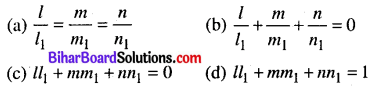
l, m, n and l1 m1 n1 are the direction cosines of two lines are perpendicular to each other if:
Bihar Board 12th Maths Model Question Paper 4 in English Medium - 9
Answer:
(c) ll1 + mm1 + nn1 = 0

Question 36.
A straight line passes through (2, -1,3) and its direction ratio’s are 3, -1,2. Then the equation of the line is
Bihar Board 12th Maths Model Question Paper 4 in English Medium - 10
Answer:
(b) \(\frac{x-2}{3}=\frac{y+1}{-1}=\frac{z-3}{2}\)

Question 37.
The direction ratio’s of the normal to the plane 7x + 4y – 2z + 5 = 0 is
(a) (7,4,5)
(b) (7,4,-2)
(c) (7,4,2)
(d) (0,0,0)
Answer:
(b) (7,4,-2)

Bihar Board 12th Maths Model Question Paper 4 in English Medium

Question 38.
Angle between the lines \(\vec{r}=(4 \hat{i}-\hat{j})+s(2 \hat{i}+\hat{j}-3 k)\) and
\(\vec{r}=(\hat{i}-\hat{j}+2 \hat{k})+t(\hat{i}-3 \hat{j}+2 \hat{k})[latex] is
3n n 2n n
(a) [latex]\frac{3 \pi}{2}\)
(b) \(\frac{\pi}{3}\)
(c) \(\frac{2 \pi}{3}\)
(d) \(\frac{\pi}{6}\)
Answer:
(b) \(\frac{\pi}{3}\)

Question 39.
The vectors î + ĵ and ĵ + k̂ are perpendicular then unit vectors is equal to
Bihar Board 12th Maths Model Question Paper 4 in English Medium - 11
Answer:
(c) \(\begin{aligned}
&\wedge \wedge \quad \wedge\\
&\frac{i+j+k}{3}
\end{aligned}\)

Question 40.
Which of the following is value of constant c of Rolle’s theorem when fix) = 2x3 – 5x2 – 4x + 3, x ∈\(\left[\frac{1}{3}, 3\right]\)
(a) \(-\frac{1}{3}\)
(b) \(\frac{2}{3}\)
(c) -2
(d) 2
Answer:
(d) 2

Question 41.
The modulus of the vector \(2 \vec{i}-7 \vec{j}-3 \vec{k}\) is
(a) √61
(b) √62
(c) √64
(d) √32
Answer:
(b) √62

Question 42.
The projection of the vector î – 2ĵ + k̂ on 2î – ĵ + k̂ is
Bihar Board 12th Maths Model Question Paper 4 in English Medium - 12
Answer:
(b) \(\frac{5}{\sqrt{6}}\)

Question 43.
If \(|\vec{a}|=\sqrt{26}|\vec{b}|=7\) and \(|\vec{a} \times \vec{b}|=35\) then \(\vec{a} \cdot \vec{b}=\)
(a) 8
(b) 7
(c) 9
(d) 12
Answer:
(b) 7

Question 44.
The function Z = ax + by in Linear programming problem is called
(a) objective Function
(b) constraints
(c) Feasible solution
(d) corner point
Answer:
(a) objective Function

Question 45.
If P(A) = \(\frac{1}{2}\) ,P(B) = 0 then P\(\frac{A}{B}\) is
(a) 0
(b) 1/2
(c) 1
(d) Not defined
Answer:
(d) Not defined

Bihar Board 12th Maths Model Question Paper 4 in English Medium

Question 46.
If P( A) = 0.8, P(B) = 0.5 and P(B/A) = 0.4 then P(A∪B) equal to :
(a) 0.78
(b) 0.88
(c) 0.98
(d) 1.08
Answer:
(c) 0.98

Question 47.
Two events A and B are mutually independent if
(a) P(A’ B’) = [1 – P(A)][1 – P(B)]
(b) P(A) = P(B)
(c) P(A) + P(B) = 1
(d) A and B are muttually exclusive
Answer:
(a) P(A’ B’) = [1 – P(A)][1 – P(B)]

Question 48.
The probability of getting doublet with one die is
(a) \(\frac{2}{3}\)
(b) \(\frac{1}{6}\)
(c) \(\frac{5}{6}\)
(d) \(\frac{5}{36}\)
Answer:
(b) \(\frac{1}{6}\)

Question 49.
If A and B are two events such that if P(A∪B) = P(a) Then
(a) P(A/B)= 1
(b) P(B/A)= 1
(c) P(A/B) = 0
(d) P(A/B) = 0
Answer:
(d) P(A/B) = 0

Question 50.
If A and B are imitualy exclusive events, then
(a) P (A/B) = 0
(b) P (B/A) = 0
(c) P(A∪B) = 0
(d) P (A ∩ B) = 0
Answer:
(d) P (A ∩ B) = 0

Bihar Board 12th Maths Model Question Paper 4 in English Medium

Non-Objective Type Questions

Short Answer Type Questions

Q. No. 1 to 25 are of Short Answer type carry of 2 marks each. Answer any 15 questions. (15 × 2 = 30)

Question 1.
Let a function f: R→R defined as \(f(x)=\frac{x^{2}}{x^{2}+1}\) ∀ x ∈ R . Then find f-1.
Answer:
Let f: R→R \( defined as f(x)=\frac{x^{2}}{x^{2}+1}\)
Taking 1, 1, ∈ R, we get, Clearly f(1) = f(-1) = 1/2
So, f is manyone function. Thus f-1 is not exists.

Question 2.
If \(\tan ^{-1}\left(\frac{1-x}{1+x}\right)=\frac{1}{2} \tan ^{-1} x\) , then find x.
Answer:
Bihar Board 12th Maths Model Question Paper 4 in English Medium - 13

Question 3.
Applying properties of determinant, prove that:
\(\left|\begin{array}{lll}
1 & 1 & 1 \\
a & b & c \\
b c & c a & a b
\end{array}\right|=(a-b)(b-c)(c-a)\)
Answer:
Bihar Board 12th Maths Model Question Paper 4 in English Medium - 14
Bihar Board 12th Maths Model Question Paper 4 in English Medium - 15

Bihar Board 12th Maths Model Question Paper 4 in English Medium

Question 4.
If \(\left[\begin{array}{cc}
a-b & 2 a+c \\
2 a-b & 3 c+a
\end{array}\right]=\left[\begin{array}{cc}
-1 & 5 \\
0 & 13
\end{array}\right]\) then find a,b,c and d
Answer:
\(\left[\begin{array}{cc}
a-b & 2 a+c \\
2 a-b & 3 c+a
\end{array}\right]=\left[\begin{array}{cc}
-1 & 5 \\
0 & 13
\end{array}\right]\)
a – b = -1 …………(1)
2a – b = 0 …………(2)
2a + c = 5…….(3)
3c + d = 13……(4)
Subtract (1) from (2), we get
2a – b – a + b = 0 + 1 ⇒ a = 1
Frorn (2), 2a – b = 0 ⇒ 2.1 – b ⇒ b = 2
Putting the value ofa in(3), we get 2a + c = 5 ⇒ 2.1 +c = 5
⇒ c = 5 – 2=3 , Lastly putting the value of c in (4), we get
3c + d = 13 ⇒ 3 x 3 + d = 13 ⇒ d= 13 – 9 = 4
Thus a= 1,b=2,c=3and d=4

Question 5.
If y = ex(sin x + cos x) then prove that
\(\frac{d^{2} y}{d x^{2}}-2 \frac{d y}{d x}+2 y=0\) we have
Answer:
Bihar Board 12th Maths Model Question Paper 4 in English Medium - 16

Question 6.
Verify the continuity at x = 0 of the function \(f(x)=\left\{\begin{aligned}
\frac{|\sin x|}{x}, & x \neq 0 \\
1, & x=0
\end{aligned}\right.\)
Answer:
Bihar Board 12th Maths Model Question Paper 4 in English Medium - 17

Bihar Board 12th Maths Model Question Paper 4 in English Medium

Question 7.
Differentiate: sec {tan ( √x)} with respect to x.
Answer:
Bihar Board 12th Maths Model Question Paper 4 in English Medium - 18

Question 8.
Find the projection of the vector î + ĵ + k̂) in the direction ĵ
Answer:
Bihar Board 12th Maths Model Question Paper 4 in English Medium - 19

Question 9.
Show that the tangents to the curve y = 7x3 +11 at the points where x = 2 and x= 2 are parallel.
Answer:
Bihar Board 12th Maths Model Question Paper 4 in English Medium - 20

Bihar Board 12th Maths Model Question Paper 4 in English Medium

Question 10.
Integrate: \(\int \frac{(\log x)^{2}}{x} d x\)
Answer:
Bihar Board 12th Maths Model Question Paper 4 in English Medium - 21

Question 11.
Find the value of \(\int_{0}^{\pi / 4} \tan ^{2} x d x\)
Answer:
Bihar Board 12th Maths Model Question Paper 4 in English Medium - 22

Question 12.
Solve the differential equation \(\frac{d y}{d x}\) = 1 + x + y + xy
Answer:
We have, \(\frac{d y}{d x}\) = (1 + x) + y(1 + x) = (1 + x)(1 + y)
\(\int \frac{d y}{1+y}\) = (1 + x)dx = ∫dx + ∫ xdx
log(1 + y) = x + \(\frac{x^{2}}{2}+c\)

Question 13.
Form the differential equation of the family of circles toucingthey-axis at Origin
Answer:
The equation of circle of radius a and centre (a, 0) and which passes through the origin with y-axis is
(x – a)2 + y2 = a2
or x2 + y2 = 2ax …(1)
Differentiating w.r.t. x, we get
2x + 2yy’= 2a
or, x + yy’ = a ……(2)
Bihar Board 12th Maths Model Question Paper 4 in English Medium - 23
Putting the value of a from (2) in (1), we get
x2 + y2 = 2x(x + yy’) = 2x2 + 2 xy y’
or \(2 x y \frac{d y}{d x}+x^{2}-y^{2}=0\)
Which is the required differential equation

Question 14.
Show that the lines \(\vec{r}=(\hat{i}+\hat{j}-\hat{k})+\lambda(3 \hat{i}-\hat{j})\) and
\(\vec{r}=(4 \hat{i}-\hat{k})+\mu(2 \hat{i}+3 \hat{k})\) intersect each other. Find their point of intersection.
Answer:
Since the lines intersects for the any value of λ and μ the refore the value of \(\vec{r}\) is equal for them
Then (î + ĵ – k̂) + λ(3î – ĵ) =(4î – k̂) + µ(2î+3k)
⇒ (î + 3λ)î+(1 – λ)ĵ – k̂= (4 + 2µ)î + (3µ – 1)k̂)
⇒ 1 + 3λ = 4 + 2µ, 1 – λ = 0 and 3µ – 1 = -1
⇒ 3λ – 2µ = 3 …………(1)
λ = 1 ………….. (2)
and µ = 0 …(3)
clearly, λ = 1 and µ = O are sastis fled
Putting λ = 1. we get r̂ = (î + ĵ – k̂) + λ(3î – ĵ)
r̂ = (4î + 0ĵ – k̂)
Thus point of intersection of line is (4, 0, -1)

Bihar Board 12th Maths Model Question Paper 4 in English Medium

Question 15.
Find the equation of the through the point (5, -2, 4) and which is parallell to (2î – ĵ + 3k̂)
Answer:
Bihar Board 12th Maths Model Question Paper 4 in English Medium - 24
Bihar Board 12th Maths Model Question Paper 4 in English Medium - 25
Question 16.
What is the maximum value of the function sin x + cos x
Answer:
Let the interval be [0, 2π] is given
Then f(x) = sin A’ + cos x
f'(x) = cos x – sin x
For maximum and minimum value,f'(A) = 0
Bihar Board 12th Maths Model Question Paper 4 in English Medium - 26

Question 17.
Prove that : \(\overrightarrow{(\vec{a}-\vec{b})} \times(\vec{a}+\vec{b})=2(\vec{a} \times \vec{b})\)
Answer:
Bihar Board 12th Maths Model Question Paper 4 in English Medium - 27

Question 18.
Solve : \(\frac{d y}{d x}+2 y \tan x=\sin x, y=0\) when x = π/3
Answer:
We have \(\frac{d y}{d x}\) + 2ytan x = sin x
This is linear differential equation, where P = 2tanx and Q = sin.x
Bihar Board 12th Maths Model Question Paper 4 in English Medium - 28

Bihar Board 12th Maths Model Question Paper 4 in English Medium

Question 19.
If A and B are independent events, then prove that A and B’ are independent events.
Answer:
Given, A and B are independent then
P(A∩B) = P(A).P(B)
Now, A = (A∩B) ∪ (A∩B’)
⇒ P(A) = P(A∩B) + P(A∩B’)
P(A) = P(A).P(B) +P(A∩B’)
⇒ P(A∩B’) = P(A)-P(A) P(B)
⇒ P(A∩B’) = P(A) [ 1 -P(B) ]
⇒ P(A∩B’)= P(A).P(B’)
Thus A and B’ are independent.

Question 20.
If \(|\overrightarrow{\mathbf{a}}+\overrightarrow{\mathbf{b}}|=|\overrightarrow{\mathbf{a}}-\overrightarrow{\mathbf{b}}|\) the prove that \(\overrightarrow{\mathbf{a}} \perp \overrightarrow{\mathbf{b}}\)
Answer:
Bihar Board 12th Maths Model Question Paper 4 in English Medium - 29

Question 21.
Solve the differential equation \(\frac{d y}{d x}\)= 1 – x + y – xy
Answer:
Bihar Board 12th Maths Model Question Paper 4 in English Medium - 30

Question 22.
If P(A) = 0.8, P(B) = 0.5 and P(B/A) =0.4, then find
P(A ∩ B)
Answer:
Bihar Board 12th Maths Model Question Paper 4 in English Medium - 31

Question 23.
Show that the relation R in the set Z of integers given by R = {(a, b): 3 divides a – b} is an equivalence relation.
Answer:
Let a,b,c ∈ Z
(i) (a, a) ∈ R ⇒ aRa ⇒ a – a = O ∈ Z, divisible by 3 since 0∈Z, which is divisible by 3, so R is reflexive relation.
(ii) (a, b) ∈ R ⇒ (b, a) ∈ R ⇒ (a – b) is divisible by ⇒ (b – a) is divisible by 3. Since (a – b) is divisible by 3 so (b- a) is also divisible by 3, ∀ a, b ∈ Z. so R is symmetric relation.
(iii) (a, b) ∈ R, (b, c) ∈ R ⇒ (a, c) ∈ R ⇒ (a – b) is divisible by 3, (b – c) is divisible by 3
⇒ a – b + b – c = (a – c) is divisible by 3.
Since (a – b) is divisible by 3, (b – c) is divisible by 3
⇒ (a – c) is divisible by 3, ∀ a, b, c ∈ Z. SO R is transitive relation.
Since R is reflexsive, symmetric and transitive relations. Therefore R is an equivalence relation.

Question 24.
Solve tan-12x + tan -13x = π/4
Answer:
Bihar Board 12th Maths Model Question Paper 4 in English Medium - 32
or, 5x = 1 – 6x2
or, 6x2+ 5x – 1 = 0
or, 6x2 + 6x – x – 1 = 0
or, 6x (x + 1) – 1(x+ 1) = 0 – or,
(6x- 1)(x+ 1) = 0
∴ 6x – 1 = 0
or x + 1 = 0
i.e, x = 1/6 or, x = -1
Since x ≠ -1 so x = 1/6

Bihar Board 12th Maths Model Question Paper 4 in English Medium

Question 25.
Find X and Y if X + Y = \(\)
Answer:
Bihar Board 12th Maths Model Question Paper 4 in English Medium - 33

Long Answer Type Questions

Questions No. 26 to 33 are Long Answer Type Questions. Each question carry 5 marks. Answer any 4 question. (4 × 5 = 20)

Question 26.
Show that semi-vertical angle of right circular cone of given surface are anf maximum value is sin -1(1/3)
Answer:
Let r be the radius, Z be sland height and h be height of the cone. Then s = πr2 + πrl
or \(l=\frac{s-\pi r^{2}}{\pi r}\)
Bihar Board 12th Maths Model Question Paper 4 in English Medium - 34
Bihar Board 12th Maths Model Question Paper 4 in English Medium - 35
Bihar Board 12th Maths Model Question Paper 4 in English Medium - 36

Question 27.
Prove that the function sinx(1 + cosx),x ∈ [0,π] is maximum at x = \(\frac{\pi}{3}\)
Answer:
Let f(x) = sinx(1 + cosx)
⇒ f'(x) = -sin x + cosx(1 + cosx)
⇒ f'(x) = 2cos2x + cosx – 1 = (2cosx – 1)(cosx + 1)
and f”(x) = -4cosx sin x – sin x
= -sinx(1 + 4cosx)
Now f'(x) = 0 ⇒ (2cosx – 1)(cosx + 1) = 0
⇒ 2cos x = 1 or, cos x = – 1
Bihar Board 12th Maths Model Question Paper 4 in English Medium - 37

Question 28.
Find the area of the parabola’s enclosed by the region y2 = 4ax and x2 = 4ay, where a
Answer:
Given parabola’s y2 = 4ax …(1)
and x2 = 4ay …(2)
On solving (1) and (2), we get point of intersection So, substituting the value of x from (1) in (2), we get
Bihar Board 12th Maths Model Question Paper 4 in English Medium - 38
Bihar Board 12th Maths Model Question Paper 4 in English Medium - 39

Bihar Board 12th Maths Model Question Paper 4 in English Medium

Question 29.
Find the value at \(\int_{0}^{\pi / 4} \log (1+\tan x) d x\)
Answer:
Bihar Board 12th Maths Model Question Paper 4 in English Medium - 40

Question 30.
Find the vector equation of plane which pases through the points A(3, -5, -1); B(-1, 5,7) and parallel to the
vector 3î – ĵ + 7k̂
Answer:
Let the position vector of given points A and B are (3î – 5ĵ – k̂) and -î + 5ĵ + 7k̂
Let P be any point on the plane with position vector x
xî + yĵ + zk̂
AP=(x — 3)î + (y + 5)ĵ + (z +1)k̂
and AB = -4î + 10ĵ+ 8k̂
Clearly AP, AB and 3î – ĵ + 7k̂ are coplanar . So the equation of plane is
\(\left|\begin{array}{ccc}
x-3 & y+5 & z+1 \\
-4 & 10 & 8 \\
3 & -1 & 7
\end{array}\right|=0\)
⇒(x – 3) (70 + 8) – (y + 5)(-28 – 24) + (z +1)(4 – 30)= 0
⇒ 78 (x-3) + 52(y + 5)-26(z + l) = 0
⇒ 78x – 234 + 52y + 260 – 26z – 26 = 0
⇒ 78x + 52y-26z = 0
⇒ 3x + 2y-z = 0
The vector equation of plane is r. (3î – 5ĵ – k̂) = 0

Question 31.
Prove that the lines \(\frac{x+3}{-3}=\frac{y-1}{1}=\frac{z-5}{5}\) are \(\frac{x+1}{-1}=\frac{y-2}{2}=\frac{z-5}{5}\) coplanar.
Answer:
Here x1 = -3, y1 = 1, z1 = 5, a1 = -3, b1 = 1, c1 =5
and x2 = -1 y2= 2, z2 = 5,a2 = -1 b2 = 2, c2 = 5
Given lines are copalanar if
Bihar Board 12th Maths Model Question Paper 4 in English Medium - 41
=2(5 – 10) – 1 (-15 + 5) + 0(-6 + 1)
= 2 x (-5) + 10 + 0 = 0
Hence the given lines are coplanar.

Bihar Board 12th Maths Model Question Paper 4 in English Medium

Question 32.
Using LPP method, maximize Z = 10x + 6y subject to
constraints 3x +y ≤ 12,2x + 5y ≤ 34, x ≥ 0,y ≥ 0.
Answer:
Maximize objeftive function Z = 10x + 6y
Subject to constraints
3x + y≤ 12 ⇒ 3x + y = 12 -..(1)
2x + 5y ≤ 34 ⇒ 2x + 5y = 34 …(2)
x ≥ 0, y ≥ 0 ⇒ x = 0,y = 0 …(3)
First of all draw graph of equations (1) to (3) corTes ponds to the inequations, we see from figure, the feasible, region OAPD be form, which is bounded also.
Bihar Board 12th Maths Model Question Paper 4 in English Medium - 42
The co-ordinate of the comer point of the feasible region, are 0(0, 0), A(4, 0), P(2, 6) and D(0, 34/5). Lastly, by using comer point method to find the maximum value of Z are as follows :
Bihar Board 12th Maths Model Question Paper 4 in English Medium - 43
It is obvious from the above table that maximum value of Z is 56 at the point (2,6). Thus the maximum value of Z is 56.

Bihar Board 12th Maths Model Question Paper 4 in English Medium

Question 33.
A manufacturer produces nuts and bolts. It takes 1 hour of work on machine A and 3 hours on machine B to produce a package of nuts. It takes 3 hours on machine A and 1 hour on machine B to produce a package of bolts. He earns a profit of Rs. 17.50 per packages on nuts and Rs. 7.00 per package on bolts. How many package of each should be produced each day so as to maximise his profit, if he operates his machines for at the most 12 hours a day ?
Answer:
Let x nuts and y bolts are produced. We have the given data, as follows:
Bihar Board 12th Maths Model Question Paper 4 in English Medium - 44
Now, the time of machine A is used. = (x + 3y) hours Avilable time = 12 hours,
So, x + 3y ≤ 12 ⇒ x + 3y = 12 …(1)
The time of machine B is used = (3x + y) hours
Available time = 12 hours, So 3x + y ≤ 12
⇒ 3x + y = 12 …. (2)
Profit function Z = 17.5x + 7y is objective function
Bihar Board 12th Maths Model Question Paper 4 in English Medium - 45
Also, non-negative constraints
x ≥ 0, y ≥ 0 ⇒ x = 0, y = 0 …(3)
Now, linear equation (1) corresponds to inequation passes through the points A( 12, 0) and B(0, 4)
Putting x = 0, y = 0 in x + 3y ≤ 12,
we get 0 ≤ 12, which is true
So x + 3y ≤ 12 lies on and below AB The linear equation (2) corresponds to inequation passes through C(4, 0) and D(0. 12)
Putting x = 0, v = 0 in 3x + y ≤ 12,
we get 0 ≤ 12 which is true
So, 3x + y ≤ 12 lies on and below CD.
x ≥ 0 is the region which lies on and to the right on y-axis
y ≥ 0 is the region which lies on and above the x-axis
The line AB and CD intersects at the point P(3,3) Clearly it is obvious from figure the region OCPB is feasible region and is bounded. Lastly, calculate the value of Z= 17.5x + 7y as follows.
Bihar Board 12th Maths Model Question Paper 4 in English Medium - 46
From above table, it is clear that the maximum profit is Rs. 73.50 when 3 nuts and 3 bolts packages are produced.

Bihar Board 12th Chemistry Objective Answers Chapter 5 Surface Chemistry

Bihar Board 12th Chemistry Objective Questions and Answers

Bihar Board 12th Chemistry Objective Answers Chapter 5 Surface Chemistry

Question 1.
Which of the following is less than zero during adsorption ?
(a) ΔG
(b) ΔS
(c) ΔH
(d) All of these
Answer:
(d) All of these

Question 2.
Which of the following is a property of physisorption ?
(a) High specificity
(b) Irreversibility
(c) Non-specificity
(d) None of these
Answer:
(c) Non-specificity

Bihar Board 12th Chemistry Objective Answers Chapter 5 Surface Chemistry

Question 3.
Which of the following statement is not correct about physisorption ?
(a) It is a reversible process
(b) It requires less heat of adsorption
(c) It requires activation energy
(d) It takes place at low temperature
Answer:
(c) It requires activation energy

Question 4.
The incorrect statement about physical adsorption is
(a) it lacks specificity
(b) it is generally reversible
(c) porous surfaces are good adsorbent
(d) heat of adsorption is quite high
Answer:
(d) heat of adsorption is quite high

Question 5.
Which is correct in case of van der Waals adsorptions ?
(a) High temperature, low pressure
(b) High temperature, high pressure
(c) Low temperature, low pressure
(d) Low temperature, high pressure
Answer:
(d) Low temperature, high pressure

Question 6.
Which, of the following gases is least absorbed on charcoal ?
(a)HCl
(b) NH3
(c) O2
(d) CO2
Answer:
(c) O2

Bihar Board 12th Chemistry Objective Answers Chapter 5 Surface Chemistry

Question 7.
Which of the following is not characteristic of chemisorption ?
(a) Adsorption is specific
(b) Heat of adsorption is of the order of 200 kJ mol-1
(c) Adsorption is irreversible
(d) Adsorption may be multimolecular layers
Answer:
(d) Adsorption may be multimolecular layers

Question 8.
Which of the following is not correct regarding the adsorption of a gas on the surface of solid ?
(a) On increasing pressure, adsorption keeps on increasing
(b) Enthalpy and entropy changes are negative
(c) Chemisorption is more specific than physisorption
(d) It is a reversible reaction
Answer:
(a) On increasing pressure, adsorption keeps on increasing

Question 9.
Which of the plots is adsorption isobar for chemisorption?
Bihar Board 12th Chemistry Objective Answers Chapter 5 Surface Chemistry 1
Answer:
(b)

Question 10.
Which of the following graphs would yield a stright line ?
(a) x/m vs p
(b) log x/m vs p
(c) x/m vs log p
(d) log x/m vs log p
Answer:
(d) log x/m vs log p

Question 11.
At low pressure, the fraction of the surface covered follows
(a) zero-order kinetics
(b) first order kinetics
(c) second order kinetics
(d) fractional  order kinetics
Answer:
(b) first order kinetics

Bihar Board 12th Chemistry Objective Answers Chapter 5 Surface Chemistry

Question 12.
Which of the following gases present in a polluted area will be adsorbed most easily on the charcoal gas mask ?
(a) H2
(b) O3
(c) N2
(d) SO2
Answer:
(d) SO2

Question 13.
Which of the following is application of adsorption in chemical analysis
(a) Adsorption indicators
(b) Thin layer chromatography
(c) Qualitative analysis
(d) All of these
Answer:
(d) All of these

Question 14.
What is the role of adsorption in froth floatation process used especially for concentration of sulphide ores ?
(a) Shape selective catalysts
(b) Adsorption of pine oil on sulphide ore particles
(c) Adsorption of pine oil on impurities
(d) Production of heat in the process of exothermic reaction
Answer:
(b) Adsorption of pine oil on sulphide ore particles

Question 15.
Which of the following can adsorb larger volume of hydrogen gas ?
(a) Finely divided platinum
(b) Colloidal solution of palladium
(c) Small pieces of palladium
(d) A single metal surface of platinum
Answer:
(b) Colloidal solution of palladium

Question 16.
Which kind of catalysis can be explained on the basis of adsorption theory ?
(a) Homogeneous catalysis
(b) Heterogeneous catalysis
(c) Negative catalysis
(d) Auto catalysis
Answer:
(b) Heterogeneous catalysis

Bihar Board 12th Chemistry Objective Answers Chapter 5 Surface Chemistry

Question 17.
The oxide of nitrogen which acts as a catalyst in lead chamber proces is …………
(a) NO
(b) NO2
(c) N2O4
(d) N2O5
Answer:
(a) NO

Question 18.
Shape-selective catalysis is a reaction catalysed by …………….
(a) zeolites
(b) enzymes
(c) platinum
(d) Ziegler-Natta catalyst
Answer:
(a) zeolites

Question 19.
The activity of an enzyme becomes ineffective ……….
(a) at low temperature
(b) at atmospheric pressure
(c) at high temperature
(d) in aqueous medium
Answer:
(c) at high temperature

Question 20.
The size of colloidal particles ranges between ………….
(a) 10-7 – 10-9cm
(b) 10-9 -101 cm
(c) 10-5 – 10-7cm
(d) 10-2 – 10-3cm
Answer:
(c) 10-5 – 10-7cm

Bihar Board 12th Chemistry Objective Answers Chapter 5 Surface Chemistry

Question 21.
Which of the following will not form a colloidal system ?
(a) Solid-gas
(b) Liquid-gas
(c) Gas-gas
(d) Gas-liquid
Answer:
(c) Gas-gas

Question 22.
Fog is an example of colloidal system of ………….
(a) liquid in gas
(b) gas in liquid
(c) solid in gas
(d) gas in solid
Answer:
(a) liquid in gas

Question 23.
A colloidal system in which liquid is dispersed phase and solid is dispersion medium is classified as ………….
(a) gel
(b) sol
(c) emulsion
(d) aerosol
Answer:
(a) gel

Question 24.
Which of the following example is correctly matched ?
(a) Butter – gel
(b) Smoke – emulsion
(c) Paint – foam
(d) Milk – aerosol
Answer:
(a) Butter – gel

Bihar Board 12th Chemistry Objective Answers Chapter 5 Surface Chemistry

Question 25.
Which of the following factors contribute towards higher stability of lyophilic colloid ?
(a) Charge on their particles
(b) Attractive forces between particles
(c) Small size of their particles
(d) High solvation due to a layer of dispersion medium
Answer:
(d) High solvation due to a layer of dispersion medium

Question 26.
A lyophobic colloid cannot be formed by ………….
(a) mixing dispersed phase and dispersion medium
(b) chemical reactions like hydrolysis
(c) exchange of solvent
(d) geptisation
Answer:
(a) mixing dispersed phase and dispersion medium

Question 27.
Which of the following is not correctly matched ?
(a) Gelatin – Lyophilic colloid
(b) Gold sol – Lyophilic colloid
(c) Arsenious sulphide – Lyophobic colloid
(d) Ferric hydroxide – Lyophobic colloid
Answer:
(b) Gold sol – Lyophilic colloid

Question 28.
The substances which behave as colloidal solutions at higher concentration are called ………….
(a) associated colloids
(b) multimolecular colloids
(c) macromolecular colloids
(d) protective colloids
Answer:
(a) associated colloids

Bihar Board 12th Chemistry Objective Answers Chapter 5 Surface Chemistry

Question 29.
The formation of micelles takes place only above …………..
(a) critical temperature
(b) Kraft temperature
(c) inversion temperature
(d) absolute temperature
Answer:
(b) Kraft temperature

Question 30.
The critical micelle concentration (CMC) is defined as…………….
(a) the concentration at which micellization starts
(b) the concentration at which micelle starts behaving like an electrolyte
(c) the concentration at which dispersed phase is separated from dispersion medium
(d) the concentration at which a colloid is converted to suspension
Answer:
(a) the concentration at which micellization starts

Question 31.
At CMC (critical micelle concentration) the surface molecules
(a) dissociate
(b) associate
(c) become bigger in size due to adsorption
(d) become smaller in size due to decomposition
Answer:
(b) associate

Question 32.
Soap mixed with water below critical micelle concentration behaves as
(a) associated colloid
(b) macromolecular colloid
(c) normal electrolytic solution
(d) multimolecular colloid
Answer:
(c) normal electrolytic solution

Question 33.
White of an egg whipped with water acts as …………………
(a) macromolecular colloid
(b) associated colloid
(c) molecular colloid
(d) normal electrolytic solution
Answer:
(a) macromolecular colloid

Bihar Board 12th Chemistry Objective Answers Chapter 5 Surface Chemistry

Question 34.
Which of the processes is being shown in the figure ?
Bihar Board 12th Chemistry Objective Answers Chapter 5 Surface Chemistry 2
(a) Electrodialysis
(b) Dialysis
(c) Electroosmosis
(d) Eelctrophoresis
Answer:
(a) Electrodialysis

Question 35.
Which of the following is not a method of removing impurities from a colloidal sol ?
(a) Electrodialysis
(b) Ultrafiltration
(c) Ultra centrifugation
(d) Distillation
Answer:
(d) Distillation

Question 36.
Tyndall effect is not observed in ………………
(a) smoke
(b) emulsions
(c) sugar solution
(d) gold sol
Answer:
(c) sugar solution

Question 37.
Which of the following systems will show Tyndall effect ?
(a) Aqueous solution of sodium chloride
(b) Aqueous solution of aluminium hydroxide
(c) Aqueous solution of glucose
(d) Aqueous solution of urea
Answer:
(b) Aqueous solution of aluminium hydroxide

Question 38.
Which of the following is not an explanation for the origin of charge on the colloidal particles ?
(a) Due to frictional electrification
(b) Due to dissociation of surface molecules
(c) Due to electrophoresis
(d) Due to selective adsorption of ions
Answer:
(c) Due to electrophoresis

Bihar Board 12th Chemistry Objective Answers Chapter 5 Surface Chemistry

Question 39.
Movement of dispersion medium under the influence of electric field is known as ……………
(a) electrodialysis
(b) electrophoresis
(c) electroosmosis
(d) cataphoresis
Answer:
(c) electroosmosis

Question 40.
Why is alum added to water containing suspended impurities ?
(a) To make a colloidal solution
(b) To coagulate the suspended impurities
(c) To remove impurities of calcium and magnesium
(d) To protect the colloidal solution from getting precipitated
Answer:
(b) To coagulate the suspended impurities

Question 41.
Which of the following acts as the best coagulating agent for ferric hydroxide sol ?
(a) Potassium ferrocyanide
(b) Potassium chloride
(c) Potassium oxalate
(d) Aluminium chloride
Answer:
(a) Potassium ferrocyanide

Question 42.
Why is gelatin mixed with gold sol ?
(a) Gold sol is lyophobic sol, gelatin acts as stabilising agent
(b) Gold sol is lyophilic sol, gelatin acts as stabilising agent
(c) Gelatin produces negative charge on gold particles in gold sol
(d) Gelatin helps gold sol to get its critical micelle concentration
Answer:
(a) Gold sol is lyophobic sol, gelatin acts as stabilising agent

Question 43.
Which of the following is not a method for coagulation of lyophobic sols ?
(a) By electrophoresis
(b) By mixing oppositely charged sols
(c) By adding electrolyte
(d) By adding a protective colloid
Answer:
(d) By adding a protective colloid

Question 44.
What happens when a lyophilic sol is added to a lyophobic sol ?
(a) Lyophilic sol is protected
(b) Lyophobic sol is protected
(c) Both the sols are coagulated
(d) Electrophorsis takes place
Answer:
(b) Lyophobic sol is protected

Bihar Board 12th Chemistry Objective Answers Chapter 5 Surface Chemistry

Question 45.
Which of the following is not a correct match ?
(a) Butter- OW type emulsion
(b) Vanishing cream-O/W type emulsion
(c) Milk – OW type emulsion
(d) Cream – W/O type emulsion
Answer:
(a) Butter- OW type emulsion

Question 46.
Which of the following is not an example of an emulsifying agent ?
(a) Proteins
(b)Gums
(c) Soaps
(d) Electrolytes
Answer:
(d) Electrolytes

Question 47.
The separation of an emulsion into its constituent liquids is known as
(a) emulsification
(b) protection of colloid
(c) coagulation
(d) demulsification
Answer:
(d) demulsification

Question 48.
Which of the following processes does not occur at the interface of phases ?
(a) Crystallisation
(b) Heterogeneous catalysis
(c) Homogeneous catalysis
(d) Corrosion
Answer:
(c) Homogeneous catalysis

Question 49.
At the equilibrium position in the process of adsorption …………
(a) ΔH > 0
(b) ΔH = TΔS
(c) ΔH>TΔS
(d) ΔH<TΔS
Answer:
(b) ΔH = TΔS

Bihar Board 12th Chemistry Objective Answers Chapter 5 Surface Chemistry

Question 50.
Which of the following interfaces cannot be obtained ?
(a) Liquid-Liquid
(b) Solid-Liquid
(c) Liquid-Gas
(d) Gas-Gas
Answer:
(d) Gas-Gas

Question 51.
The term ‘sorption’ stands for………………
(a) absorption
(b) adsorption
(c) both absorption and adsorption
(d) desorption
Answer:
(c) both absorption and adsorption

Question 52.
Extent of physisorption of a gas increases with……………
(a) increase in temperature
(b) decrease in temperature
(c) decrease in surface area of adsorbent
(d) decrease in strength of van der Waals forces
Answer:
(b) decrease in temperature

Question 53.
Which one of the following is not applicable to the phenomenon of adsorption ?
(a) ΔH > 0
(b) ΔG < 0
(c) ΔS < 0
(d) ΔH < 0
Answer:
(a) ΔH > 0

Question 54.
Which of the following is not a favourable condition for physical adsorption ?
(a) High pressure
(b) Negative ΔH
(c) Higher critical temperature of adsorbate
(d) High temperature
Answer:
(d) High temperature

Question 55.
Physical adsorption of a gaseous species may change to chemical adsorption with……………
(a) decrease in temperature
(b) increase in temperature
(c) increase in surface area of adsorbent
(d) decrease in surface area of adsorbent
Answer:
(b) increase in temperature

Bihar Board 12th Chemistry Objective Answers Chapter 5 Surface Chemistry

Question 56.
Which of the following is an example of absorption ?
(a) Water on silica gel
(b) Water on calcium chloride
(c) Hydrogen on finely divided nickel
(d) Oxygen on metal surface
Answer:
(b) Water on calcium chloride

Question 57.
At high concentration of soap in water, soap behaves as ……..
(a) molecular colloid
(b) associated colloid
(c) macromolecular colloid
(d) lyophilic colloid
Answer:
(b) associated colloid

Question 58.
Method by which lyophobic sol can be protected ……….
(a) by addition of oppositely charged sol
(b) by addition of an electrolyte
(c) by addition of lyophilic sol
(d) by boiling
Answer:
(c) by addition of lyophilic sol

Question 59.
Freshly preparad precipitate sometimes gets converted to colloidal solution by……………
(a) coagulation
(b) electrolysis
(c) diffusion
(d) peptisation
Answer:
(d) peptisation

Bihar Board 12th Chemistry Objective Answers Chapter 5 Surface Chemistry

Question 60.
Which of the following electrolytes will have maximum coagulating value for Agl/Ag+ sol ?
(a) Na2S
(b) Na3PO4
(c) Na2SO4
(d) NaCI
Answer:
(b) Na3PO4

Question 61.
Which of the following process is responsible for the formation of delta at a place where rivers meet the sea ?
(a) Emulsification
(b) Colloid formation
(c) Coagulation
(d) Peptisation
Answer:
(c) Coagulation

Question 62.
Which of the following process is not responsible for the presence of electric charge on the sol particles ?
(a) Electron capture by sol particles
(b) Adsorption of ionic species from solution
(c) Formation of Helmholtz electrical double layer
(d) Adsorption of ionic species from solution
Answer:
(d) Adsorption of ionic species from solution

Bihar Board 12th Physics Objective Answers Chapter 13 Nuclei

Bihar Board 12th Physics Objective Questions and Answers

Bihar Board 12th Physics Objective Answers Chapter 13 Nuclei

Bihar Board 12th Physics Objective Answers Chapter 13 Nuclei

Question 1.
The natural boron of atomic weight 10.81 is found to have two isotopes 10B and nB. The ratio of abundance of isotopes of natural boron should be
(a) 11: 10
(b) 81 : 19
(c) 10:11
(d) 19 : 81
Answer:
(d) 19 : 81

Question 2.
The mass number of iron nucleus is 56, the nuclear 1 density is
(a) 2.29 x 10¹⁶ kg m-3
(b) 2.29 x 10¹⁷ kg m-3
(c) 2.29 x 10¹⁸ kg m-3
(d) 2.29 x 10¹⁵ kg m-3
Answer:
(b) 2.29 x 10¹⁷ kg m-3

Question 3.
Two nuclei have their mass numbers in the ratio of 1: 3. The ratio of their nuclear densities would be
(a) (3)1/3 : 1
(b) 1 : 1
(c) 1 : 3
(d) 3 : 1
Answer:
(b) 1 : 1

Bihar Board 12th Physics Objective Answers Chapter 13 Nuclei

Question 4.
The radius of a spherical nucleus as measured by electron scattering is 3.6 fm. What is the mass number of the nucleus most likely to be?
(a) 27
(b) 40
(c) 56
(d) 120
Answer:
(a) 27

Question 5.
The ratio of the nuclear radii of the gold isotope \(\begin{array}{l}
197 \\
79
\end{array} \mathrm{Au}\) and silver isotope \(\begin{array}{l}
107 \\
47
\end{array} \mathrm{Ag}\) is
(a) 1.23
(b) 0.216
(c) 2.13
(d) 3.46
Answer:
(a) 1.23

Bihar Board 12th Physics Objective Answers Chapter 13 Nuclei

Question 6.
How much mass has to be converted into energy to produce electric power of 500 MW for one hour?
(a) 2 x 10⁻⁵ kg
(b) 1 x 10⁻⁵ kg
(c) 3 x 10⁻⁵ kg
(d) 4 x 10⁻⁵ kg
Answer:
(a) 2 x 10⁻⁵ kg

Question 7.
If in a nuclear fusion reaction, mass defect is 0.3%, then energy released in fusion of 1 kg mass
(a) 27 x 1010 J
(b)27 x 1011 J
(c) 27 x 1012 J
(d) 27 x 1013 J
Answer:
(d) 27 x 1013 J

Question 8.
The equivalent energy of 1 g of substance is
(a) 9 x 10¹³ J
(b) 6 x K)12 J
(c) 3 x 10¹³ J
(d) 6 x 10¹³ J
Answer:
(a) 9 x 10¹³ J

Bihar Board 12th Physics Objective Answers Chapter 13 Nuclei

Question 9.
Fission of nuclei is possible because the binding energy per nucleon in them
(a) increases with mass number at low mass numbers
(b) decreases with mass number at low mass numbers
(c) increases with mass number at high mass numbers
(d) decreases with mass number at high mass numbers
Answer:
(d) decreases with mass number at high mass numbers

Question 10.
Let mp be the mass of a proton, mn the mass of a neutron, M1 the mass of a \(\frac{20}{10} \mathrm{Ne}\) Ne nucleus and M2 the mass of a \(\frac{40}{20} \mathrm{Ca}\) nucleus. Then
(a) M2 = M1
(b) M2 > 2M1
(c) M2 < 2M1
(d) M1 < 10 (mn + mp)
Answer:
(d) M1 < 10 (mn + mp)

Question 11.
The half life of \(\begin{array}{l}
238 \\
92
\end{array} \mathrm{U}\) undergoing a-decay is 4.5 x 10⁹ years. The activity of 1 g sample of is
(a) 1.23 x 10⁴ Bq
(b) 1.23 x 10⁵ Bq
(c) 1.23 x 10³ Bq
(d) 1.23 x 10⁶ Bq
Answer:
(a) 1.23 x 10⁴ Bq

Bihar Board 12th Physics Objective Answers Chapter 13 Nuclei

Question 12.
The half life of a radioactive substance is 20 s, the time taken for the sample to decay by 7/8th of its initial value is
(a) 20 s
(b) 40 s
(c) 60 s
(d) 80 s
Answer:
(c) 60 s

Question 13.
The half life of a radioactive substance is 30 days What is the time takento disintegrate to 3/4th of its original mass?
(a) 30 days
(b) 15 days
(c) 60 days
(d) 90 days
Answer:
(c) 60 days

Question 14.
The half life of polonium is 140 days. In what time will 15 g of polonium be disintegrated out of its initial mass of 16 g?
(a) 230 days
(b) 560 days
(c) 730 days
(d) 160 days
Answer:
(b) 560 days

Bihar Board 12th Physics Objective Answers Chapter 13 Nuclei

Question 15.
A 280 day old radioactive substance shows an activity of 6000 dps, 140 days later its activity becomes 3000 dps. What was its initial activity?
(a) 20000 dps
(b) 24000 dps
(c) 12000 dps
(d) 6000 dps
Answer:
(b) 24000 dps

Question 16.
Tritium with a half-life of 12.5 years undergoing beta decay. What fraction of a sample of pure tritium will remain undecayed after 25 years.
(a) one half
(b) one fourth
(c) one third
(d) can’t say
Answer:
(b) one fourth

Question 17.
The decay constant, for a given radioactive sample, is 0.3465 day-1. What percentage of this sample will get decayed in a period of 4 days?
(a) 100%
(b) 50%
(c) 75%
(d) 10%
Answer:
(c) 75%

Bihar Board 12th Physics Objective Answers Chapter 13 Nuclei

Question 18.
Carbon dating is best suited for determining the age of fossils, if their age in years is of the order of
(a) 103
(b) 104
(c) 105
(d) 106
Answer:
(b) 104

Question 19.
The half life of \(\begin{array}{l}
90 \\
38
\end{array} \mathrm{Sr}\) is 28 years. The disintegration rate of 15 mg of this isotope is of the order of
(a) 1011 Bq
(b) 1010 Bq
(c) 107 Bq
(d) 109 Bq
Answer:
(b) 1010 Bq

Question 20.
A sample of radioactive material has mass m, decay constant λ, molecular weight M and Avogadro constant NA. The initial activity of the sample is
Am XmN A
\((a) \lambda m
(b) \frac{\lambda \mathrm{m}}{\mathrm{M}}
(c) \frac{\lambda m N_{A}}{M} \quad
(d) m N_{A} \lambda\)
Answer:
\((c) \frac{\lambda m N_{A}}{M} \quad\)

Bihar Board 12th Physics Objective Answers Chapter 13 Nuclei

Question 21.
Plutonium decays with half life of 24000 years. If plutonium is stored for 72000 years, the fraction of it that remains is
(a) 1/8
(b) 1/3
(c) 1/4
(d) 1/2
Answer:
(a) 1/8

Question 22.
The number of beta particles emitted by a radioactive substance is twice the number of alpha particles emitted by it. The resulting daughter is an
(a) isomer of parent
(b) isotone of parent
(c) isotope of parent
(d) isobar of parent
Answer:
(c) isotope of parent

Question 23.
Which of the following cannot be emitted by radioactive substances during their decay?
(a) Neutrinos
(b) Protons
(c) Electrons
(d) Helium nuclei
Answer:
(b) Protons

Bihar Board 12th Physics Objective Answers Chapter 13 Nuclei

Question 24.
A radioactive decay can form an isotope of the original nucleus with the emission of particles
(a) one a and four β
(b) one a and two β
(c) one a and one β
(d) four a and one β
Answer:
(b) one a and two β

Question 25.
Consider a and 3 particles and y-rays each having an energy of 0.5 MeV. In the increasing order of penetrating power, the radiation are respectively
(a) α,β,γ
(b) α,γ,β
(c) β,γ,α
(d) γ,β,α
Answer:
(a) α,β,γ

Question 26.
An electron emitted in beta radiation originates from
(a) inner orbits of atom
(b) free electrons existing in the nuclei
(c) decay of a neutron in a nuclei
(d) photon escaping from the nucleus
Answer:
(c) decay of a neutron in a nuclei

Question 27.
Complete the series \(^6 \mathrm{He} \rightarrow \mathrm{e}^{+6} \mathrm{Li}+\)
(a) neutrino
(b) antineutrino
(c) proton
(d) neutron
Answer:
(a) neutrino

Bihar Board 12th Physics Objective Answers Chapter 13 Nuclei

Question 28.
A nucleus of Ux1 has a half life of 24.1 days. How long a sample of Ux1 will take to change to 90% of Ux1.
(a) 80 days
(b) 40 days
(c) 20 days
(d) 10 days
Answer:
(a) 80 days

Question 29.
An element A decays into an element C by a two step process A → B + 2He4 B → C + 2e. Then,
(a) A and C are isotopes
(b) A and C are isobars
(c) B and C are isotopes
(d) A and B are isobars
Answer:
(a) A and C are isotopes

Question 30.
The equation \(4_{1}^{1} H^{+} \rightarrow_{2}^{4} H e^{2+}+2 e^{-}+26 M e V\) represents
(a) β-decay
(b) γ-decay
(c) fusion
(d) fission
Answer:
(c) fusion

Bihar Board 12th Physics Objective Answers Chapter 13 Nuclei

Question 31.
Light energy emitted by star is due to
(a) breaking of nuclei
(b) joining of nuclei
(c) burning of nuclei
(d) reflection of solar light
Answer:
(b) joining of nuclei

Question 32.
Fast neutrons can easily be slowed down by
(a) the use of lead shielding
(b) passing them through water
(c) elastic collisions with heavy nuclei
(d) applying a strong electric field
Answer:
(b) passing them through water

Question 33.
In the given reactions, which of the following nuclear fusion reaction is not possible?
Bihar Board 12th Physics Objective Answers Chapter 13 Nuclei in english medium 1
Answer:
(a)

Bihar Board 12th Physics Objective Answers Chapter 13 Nuclei

Question 34.
If 200 MeV energy is released in the fission of a single nucleus of \(_{ 92 }^{ 235 }{ U }\) the fission which are required to produce a power of 1 kW is
(a) 3,125 x 1013
(b) 1.52 x 10⁶
(c) 3.125 x 10¹²
(d) 3.125 x 10¹⁴
Answer:
(a) 3,125 x 1013

Question 35.
The gravitational force between a H-atom and another particle of mass m will be given by Newton’s law : \(\mathbf{F}=\mathbf{G} \frac{\mathbf{M} \cdot \mathbf{m}}{\mathbf{r}^{2}}\) is in km and
Bihar Board 12th Physics Objective Answers Chapter 13 Nuclei in english medium 2
Bihar Board 12th Physics Objective Answers Chapter 13 Nuclei in english medium 3
Answer:
(b)

Question 36.
When a nucleus in an atom undergoes a radioactive decay, the electronic energy levies of the atom
(a) do not change for any type of radioactivity
(b) change for a and P radioactivity but not for y- radioactivity
(c) change for a-radioactivity but not for others
(d) change for P-radioactivity but not for others.
Answer:
(b) change for a and P radioactivity but not for y- radioactivity

Bihar Board 12th Physics Objective Answers Chapter 13 Nuclei

Hints & Explanations

Question 1.
(d) Let abundance of B10 be x%
Abundance of B11 = (100 – x)%
Bihar Board 12th Physics Objective Answers Chapter 13 Nuclei in english medium 4

Question 3.
(b) A1 : A2 = 1 : 3
Their radii will be in the ratio
Bihar Board 12th Physics Objective Answers Chapter 13 Nuclei in english medium 5
Their nuclear densities will be the same

Question 4.
(a) Nuclear radius, R = R0(A)1/3, where A is the mass
number of a nucleus
Given, R = 3.6 fm
∴ 3.6fm = (1.2fm)(A1/3) (∴ R0 = 1.2fm)
or, A = (3)3 = 27

Bihar Board 12th Physics Objective Answers Chapter 13 Nuclei

Question 5.
(a) Here, A1 = 197 and A2 = 107
Bihar Board 12th Physics Objective Answers Chapter 13 Nuclei in english medium 6

Question 6.
(a) Here, P = 500 MW = 5 x 10⁸ W,t = 1 h = 3600 s
Energy produced, E = P x / = 5 x 108 x 3600
= 18 x 1011 J
As E = mc2
Bihar Board 12th Physics Objective Answers Chapter 13 Nuclei in english medium 7

Question 7.
Bihar Board 12th Physics Objective Answers Chapter 13 Nuclei in english medium 8

Question 8.
Bihar Board 12th Physics Objective Answers Chapter 13 Nuclei in english medium 9

Bihar Board 12th Physics Objective Answers Chapter 13 Nuclei

Question 11.
(a) T1/2 = 4.5 x 10⁹ years
= 4.5 x 109 x 3.16 x 107 : 1.42 x 10¹⁷ s
One kmol of any isotope contains Avogadro’ number of atoms, so 1 g of \(_{ 92 }^{ 238 }{ U }\) contains
Bihar Board 12th Physics Objective Answers Chapter 13 Nuclei in english medium 10

Question 12.
(c) After three half lives, the fraction of undecayed nuclei \(=\left(\frac{1}{2}\right)^{3}=\frac{1}{8}\)
∴ Time taken for the sample to decay by (1 – 1/8)th or \(\frac{7^{t h}}{8}\) of initial value. = 3T1/2 = 3 x 20 = 60 s

Question 13.
(c) Here, \(\frac{N_{0}-N}{N_{0}}=\frac{3}{4} \text { or } \frac{N}{N_{0}}=\frac{1}{4}=\left(\frac{1}{2}\right)^{2}\)
∴ No of half lives, n = 2
Time taken to disintegrate
= Half life x No. of half lives
= 30 x 2= 60 days

Question 14.
Bihar Board 12th Physics Objective Answers Chapter 13 Nuclei in english medium 11

Bihar Board 12th Physics Objective Answers Chapter 13 Nuclei

Question 17.
Bihar Board 12th Physics Objective Answers Chapter 13 Nuclei in english medium 12
Hence, sample left undecayed after a period of 4 days.
Bihar Board 12th Physics Objective Answers Chapter 13 Nuclei in english medium 13
∴ Sample decayed = 75%

Question 18.
(b) Carbon dating is best suited for determining the age
of fossils, if their age is of the order of 104 years.

Question 19.
(b) Here, T1/2 = 28 years = 28 x 3.154 x 107 s
Bihar Board 12th Physics Objective Answers Chapter 13 Nuclei in english medium 14

Bihar Board 12th Physics Objective Answers Chapter 13 Nuclei

Question 28.
Bihar Board 12th Physics Objective Answers Chapter 13 Nuclei in english medium 15
Bihar Board 12th Physics Objective Answers Chapter 13 Nuclei in english medium 16

Question 34.
Let the number of fissions per second be n. Energy released per second
= n x 200 MeV = n x 200 x 1.6 x 10~13 J

Energy required per second = power x time = 1 kW x Is = 1000J
Bihar Board 12th Physics Objective Answers Chapter 13 Nuclei in english medium 17

Bihar Board 12th Physics Objective Answers Chapter 13 Nuclei

Bihar Board 12th Physics Objective Answers Chapter 4 Moving Charges and Magnetism

Bihar Board 12th Physics Objective Questions and Answers

Bihar Board 12th Physics Objective Answers Chapter 4 Moving Charges and Magnetism

Question 1.
A strong magnetic Held is applied on a stationary electron. Then the electron.
(a) moves in the direction of the field.
(b) remains stationary.
(c) moves perpendicular to the direction of the field.
(d) move opposite to the direction of the field.
Answer:
(b) remains stationary.

Bihar Board 12th Physics Objective Answers Chapter 4 Moving Charges and Magnetism

Question 2.
The magnetic force \(\vec{F}\) on a current carry ing conductor of length l in an external magnetic Field \(\vec{B}\) is give by
Bihar Board 12th Physics Objective Answers Chapter 4 Moving Charges and Magnetism - 1
Answer:
(c) \(I(\vec{l} \times \bar{B})\)

Question 3.
A circular loop of radius R carrying a current I is placed in a uniform magnetic field B perpendicular to the loop. The force on the loop is
(a) 2πRIB
(b) 2πRI2B2
(c) πR2IB
(d) zero
Answer:
(d) zero

Question 4.
The magnetic force per unit length on a wire carrying a current of 10 A and making an angle of 45° with the direction of a uniform magnetic field of 0.20 T is
Bihar Board 12th Physics Objective Answers Chapter 4 Moving Charges and Magnetism - 2
Answer:
(b) \(\frac{2}{\sqrt{2}} \mathrm{N} \mathrm{m}^{-1}\)
Solution:
l = 10A,θ = 45°,R = 0.2T
∴F = IlB sin θ
\(\frac{F}{l}=I B \sin 45^{\circ}=10 \times 0.2 \times \frac{1}{\sqrt{2}}=\frac{2}{\sqrt{2}} \mathrm{N} \mathrm{m}^{-1}\)

Bihar Board 12th Physics Objective Answers Chapter 4 Moving Charges and Magnetism

Question 5.
An electron of energy 1800 eV describes a circular path in magnetic field of flux density 0.4 T. The radius of path is (q = 1.6 × 10⁻¹⁹ C, me = 9.1 × 10⁻³¹ kg)
(a) 2.58 × 10⁻⁴ m
(b) 3.58 × 10⁻⁴ m
(c) 2.58 × 10⁻³ m
(d) 3.58 × 10⁻³ m
Answer:
(b) 3.58 × 10⁻⁴ m
Solution:
Bihar Board 12th Physics Objective Answers Chapter 4 Moving Charges and Magnetism - 9

Question 6.
Two α-particles have the ratio of their velocities as 3 : 2 on entering the field. If they move in different circular paths, then the ratio of the radii of their paths is
(a) 2 : 3
(b) 3 : 2
(c) 9 : 4
(d) 4 : 9
Answer:
(b) 3 : 2
Solution:
Bihar Board 12th Physics Objective Answers Chapter 4 Moving Charges and Magnetism - 10

Question 7.
A charged particle would continue to move with a constant velocity in a region wherein, which of the following conditions is not corrent ?
(a) E = 0, B ≠ 0
(b) E ≠ 0, B ≠ 0
(c) E ≠ 0, B = 0
(d) E = 0, B = 0
Answer:
(c) E ≠ 0, B = 0

Bihar Board 12th Physics Objective Answers Chapter 4 Moving Charges and Magnetism

Question 8.
The cyclotron frequency vc. is given by
Bihar Board 12th Physics Objective Answers Chapter 4 Moving Charges and Magnetism - 3
Answer:
(a) \(\frac{q B}{2 \pi m}\)

Question 9.
A charged particle is moving in a cyclotron, what effect on the radius of path of this charged particle will occur when the frequency of the radio frequency field is doubled ?
(a) It will also be doubled.
(b) It will be halved.
(c) It will be increased by four times.
(d) It will remain unchanged.
Answer:
(d) It will remain unchanged.

Question 10.
If an electron is moving in a magnetic field of 5.4 v 10-4 T on a circular path of radius 32 cm having a fequency of 2.5 MHz, then its speed will be
(a) 8.56 × 10⁶ m s-1
(b) 5.024 × 10⁶ m s-1
(c) 8.56 × 10⁴ m s-1
(d) 5.024 × 10⁴ m s-1
Answer:
(b) 5.024 × 10⁶ m s-1
Solution:
(b) Here, B = 5.4 × 10⁻⁴T;
r = 32cm = 32 × 10-2m v = 2.5 MHz = 2.5 × 10⁶Hz
The speed of electron on circular path
v = r × 2πυ) = 32 × 10-2 × 2 x 3.14 × 2.5 × 106
= 502.4 × 104 = 5.024 × 10⁶ m s-1

Question 11.
A proton and an a-particle enter in a uniform magnetic field perpendicularly with same speed. The ratio of time periods of both particle
\(\left(\frac{T_{p}}{T_{\alpha}}\right)\) will be
(a) 1 : 2
(b) 1 : 3
(c) 2 : 1
(d) 3 : 1
Answer:
(a) 1 : 2

Question 12.
A proton, a deutron and an a-particle with same kinetic energy enter perpendicularly in a uniform magnetic Held, then the ratio of radii of their ciruclar paths is
(a) 1 : 1 : √2
(b) √2 : 1 : 1
(c) 1 : √2 : 1
(d) 1 : 2 : √2
Answer:
(c) 1 : √2 : 1

Bihar Board 12th Physics Objective Answers Chapter 4 Moving Charges and Magnetism

Question 13.
The energy of emergent protons in MeV from a cyclotron having radius of its dees 1.8 m and applied magnetic Field 0.7 T is (mass of proton = 1.67 × 10⁻²⁷ kg)
(a) 50
(b) 60
(c) 70
(d) 76
Answer:
(d) 76
Solution:
Bihar Board 12th Physics Objective Answers Chapter 4 Moving Charges and Magnetism - 11

Question 14.
The operating magnetic field for accelerating protons in a cyclotron oscillator having frequency of 12 MHz is (q = 1.6 × 10⁻¹⁹ C, mp = 1.67 × 10⁻²⁷ kg and 1 MeV = 1.6 × 10⁻¹³ J)
(a) 0.69 T
(b) 0.79 T
(c) 0.59 T
(d) 0.49 T
Answer:
Solution:
(b) 0.79 T
(b)
Bihar Board 12th Physics Objective Answers Chapter 4 Moving Charges and Magnetism - 12

Question 15.
A circular loop of radius 3 cm is having a current of 12.5 A. The magnitude of magnetic field at a distance of 4 cm on its axis is
(a) 5.65 × 10⁻⁵ T
(b) 5.27 × 10⁻⁵ T
(c) 6.54 × 10⁻⁵ T
(d) 9.20 × 10⁻⁵ T
Answer:
(a) 5.65 × 10⁻⁵ T
Solution:
Bihar Board 12th Physics Objective Answers Chapter 4 Moving Charges and Magnetism - 13

Bihar Board 12th Physics Objective Answers Chapter 4 Moving Charges and Magnetism

Question 16.
A circular coil of wire consisting of 100 turns each of radius 9 cm carries a current of 0.4 A. The magnitude of magnetic field at the centre of the coil is
(a) 2.4 × 10⁻⁴ T
(b) 3.5 × 10⁻⁴T
(c) 2.79 × 10⁻⁴
(d) 3 × 10⁻⁴
Answer:
(c) 2.79 × 10⁻⁴
Solution:

Bihar Board 12th Physics Objective Answers Chapter 4 Moving Charges and Magnetism - 14

Question 17.
The magnitude of the magnetic field at the centre of the tightly wound 150 turn coil of radius 12 cm carrying a current of 2 A is
(a) 18 G
(b) 19.7 G
(c) 15.7 G
(d) 17.7 G
Answer:
(c) 15.7 G
Solution:
Bihar Board 12th Physics Objective Answers Chapter 4 Moving Charges and Magnetism - 15

Question 18.
A tightly wound 90 turn coil of radius 15 cm has a magnetic field of 4 × 10⁻⁴ T at its centre. The current flowing through it is
(a) 1.06 A
(b) 2.44 A
(c) 3.44 A
(d) 4.44 A
Answer:
(a) 1.06 A

Bihar Board 12th Physics Objective Answers Chapter 4 Moving Charges and Magnetism

Question 19.
Ampere’s circuital law is given by
Bihar Board 12th Physics Objective Answers Chapter 4 Moving Charges and Magnetism - 4
Answer:
(b) \(\oint \vec{B} \cdot \overrightarrow{d l}=\mu_{0} I_{e n c}\)

Question 20.
A long straight wire in the horizontal plane carries a current of 75 A in north to south direction, magnitude and direction of field B at a point 3 m east of the wire is
(a) 4 × 10⁻⁶ T, vertical up
(b) 5 × 10⁻⁶ T, vertical down
(c) 5 × 10⁻⁶ T, vertical up
(d) 4 × 10⁻⁶ T, vertical down
Answer:
(c) 5 × 10⁻⁶ T, vertical up
Solution:
From Ampere circuital law
Bihar Board 12th Physics Objective Answers Chapter 4 Moving Charges and Magnetism - 16
The direction of field at the given point will be vertical up determined by the screw rule or right hand rule.

Question 21.
The nature of parallel and anti-parallel currents are
(a) parallel currents repel and antiparallel currents attract.
(b) parallel currents attract and antiparallel currents repel.
(c) both currents attract
(d) both currents repel.
Answer:
(a) parallel currents repel and antiparallel currents attract.

Question 22.
Two parallel wires 2 m apart carry currents of 2 A and 5 A respectively in same direction, the force per unit length acting between these two wires is
(a) 2 × 10⁻⁶ N m-1
(b) 3 × 10⁻⁶ N m-1
(c) 1 × 10⁻⁶ N m-1
(d) 4 × 10⁻⁶ N m-1
Answer:
(c) 1 × 10⁻⁶ N m-1
Solution:
Bihar Board 12th Physics Objective Answers Chapter 4 Moving Charges and Magnetism - 17

Bihar Board 12th Physics Objective Answers Chapter 4 Moving Charges and Magnetism

Question 23.
The magnetic moment of a current / carrying circular coil of radius r and number of turns A varies as
(a) 1/
(b) 1/rr2
(c) r
(d) r2
Answer:
(d) r2

Question 24.
A 200 turn closely wound circular coil of radius 15 cm carries a current of 4 A. The magnetic moment of this coil is
(a) 36.5 Am2
(b) 56.5 A m2
(c) 66.5 A m2
(d) 108 A m2
Answer:
(b) 56.5 A m2
Solution:
(b) The magnetic moment is given by
|\vec{m}| = NlA = Nlπ2 = 200 × 4 × 3.14 × (15 × 10-2)2
= 200 × 4 × 3.14 × 15 × 15 × 10-4 = 56.5 A m2

Question 25.
The magnetic moment associated with a circular coil of 35 turns and radius 25 cm, if it carries a current of 11 A is
(a) 72.2 Am2
(b) 70.5 A m2
(c) 74.56 A m2
(d) 75.56 A m2
Answer:
(d) 75.56 A m2
Solution:
(d) Given N = 35, r = 25 cm = 25 × 10-2 m, l = 11
A Then magnetic moment associated with this circular coil
M = NIA= NIπr2 = 35 × 11 × 3.14 x (25 × 10-2)2 = 75.56 Am2
= 75.56Am2

Bihar Board 12th Physics Objective Answers Chapter 4 Moving Charges and Magnetism

Question 26.
Magnetic field at the centre of a circular loop of area A is B. The magnetic moment of the loop is
Bihar Board 12th Physics Objective Answers Chapter 4 Moving Charges and Magnetism - 5
Answer:
(d) \(\frac{2 B A \sqrt{A}}{\mu_{0} \sqrt{\pi}}\)

Question 27.
A circular coil of radius 10 cm having 100 turns carries a current of 3.2 A. The magnetic field at the centre of the coil is
(a) 2.01 × 10⁻³ T
(b) 5.64 × 10⁻³ T
(c) 2.64 × 10⁻⁴ T
(d) 5.64 × 10⁻⁴ T
Answer:
(a) 2.01 × 10⁻³ T
Solution:
Bihar Board 12th Physics Objective Answers Chapter 4 Moving Charges and Magnetism - 18

Question 28.
A current carrying loop is placed in a uniform magnetic field. The torque acting on it does not depend upon
(a) area of loop
(b) value of current
(c) magnetic field
(d) None of these
Answer:
(d) None of these

Question 29.
The gyromagnetic ratio of an electron in soidum atom is
(a) depending upon the atomic number of the atom
(b) depending upon the shell number of the atom
(c) independent of that orbit it is in
(d) having positive value
Answer:
(c) independent of that orbit it is in

Bihar Board 12th Physics Objective Answers Chapter 4 Moving Charges and Magnetism

Question 30.
Gyromagnetic ratio is the ratio of magnetic moment (μl) to the orbital angular momentum (l). Its numerical value for an electron is given by
(a) 8.8 × 10⁻¹² C kg-1
(b) 8.8 × 10¹⁰ C kg-1
(c) 1.6 × 10⁻¹⁹ C kg-1
(d) 6.67 × 10¹¹ C kg-1
Answer:
(b) 8.8 × 10¹⁰ C kg-1

Question 31.
What is the correct value of Bohr magneton ?
(a) 8.99 × 10⁻²⁴ A m2
(b) 9.27 × 10⁻²⁴ A m2
(c) 5.66 × 10⁻²⁴ A m2
(d) 9.27 × 10⁻²⁸ A m2
Answer:
(b) 9.27 × 10⁻²⁴ A m2

Bihar Board 12th Physics Objective Answers Chapter 4 Moving Charges and Magnetism

Question 32.
In a moving coil galvanometer the deflection (Φ) on the scale by a pointer attached to the spring is
Bihar Board 12th Physics Objective Answers Chapter 4 Moving Charges and Magnetism - 6
Answer:
(c) \(\left(\frac{N A B}{k}\right) I\)

Question 33.
A galvanometer of resistance 70 £2 , is converted to an ammeter by a shunt resistance rs = 0.03 £2 . The value of its resistance will become
(a) 0.025 Ω
(b) 0.022 Ω
(c) 0.035 Ω
(d) 0.030 Ω
Answer:
(d) 0.030 Ω

Bihar Board 12th Physics Objective Answers Chapter 4 Moving Charges and Magnetism

Question 34.
In the given circuit, a galvanometer with a resistance of 70 Ω is conveted to an ammeter by a shunt resistance of 0.05 Ω , total current measured by this device is
Bihar Board 12th Physics Objective Answers Chapter 4 Moving Charges and Magnetism - 7
(a) 0.88 A
(b) 0.77 A
(c) 0.55 A
(d) 0.99 A
Answer:
(d) 0.99 A
Solution:
(d)
Bihar Board 12th Physics Objective Answers Chapter 4 Moving Charges and Magnetism - 19
∴ Rs = 0.0499Ω
= 0.05Ω
The total resistance in the circuit
R = Rs + 5Ω
= 0.05 + 5
= 5.05 Ω
The curent measured by the device
Bihar Board 12th Physics Objective Answers Chapter 4 Moving Charges and Magnetism - 20

Question 35.
The conversion of a moving coil galvanometer into a voltmeter is done by
(a) introducing a resistance of large value in series
(b) introducing a resistance of small value in parallel
(c) introducing a resistance of large value in parallel
(d) inroducing a resistance of small value is series
Answer:
(a) introducing a resistance of large value in series

Bihar Board 12th Physics Objective Answers Chapter 4 Moving Charges and Magnetism

Question 36.
A galvanometer of resistance 10 Ω gives full-scale deflection when 1 mA current passes through it. The resistance required to convert it into a voltmeter reading upto 2.5 V is
(a) 24.9 Ω
(b) 249 Ω
(c) 2490 Ω
(d) 24900 Ω
Answer:
(c) 2490 Ω
Solution:
Bihar Board 12th Physics Objective Answers Chapter 4 Moving Charges and Magnetism - 21

Bihar Board 12th Physics Objective Answers Chapter 4 Moving Charges and Magnetism

Question 37.
The value of current in the given circuit if the ammeter is a galvanometer with a resistance RG = 50 Ω is
Bihar Board 12th Physics Objective Answers Chapter 4 Moving Charges and Magnetism - 8
(a) 0.048 A
(b) 0.023 A
(c) 0.061 A
(d) 0.094 A
Answer:
(d) 0.094 A

Question 38.
The range of voltmeter of resistance 300 £2 is 5 V. The resistance to be connected to convert it into an ammeter of range 5 A is
(a) 1 Ω in series
(b) 1 Ω in parallel
(c) 0.1 Ω in series
(d) 0.1 Ω in parallel
Answer:
(b) 1 Ω in parallel

Question 39.
Biot-Savart law indicates that the moving electrons (velocity \(\vec{V}\) ) produce a magnetic field \(\vec{B}\) such that
(a) \(\vec{B} \perp \vec{v}\)
(b) \(\vec{B} \| \vec{v}\)
(c) it obeys inverse cube law.
(d) it is along the line joining the electron and point of observation.
Answer:
(a) \(\vec{B} \perp \vec{v}\)

Bihar Board 12th Physics Objective Answers Chapter 4 Moving Charges and Magnetism

Question 40.
In a cyclotron, a charged partcile
(a) undergoes acceleration all the time.
(b) speeds up between the dees because of the magnetic field.
(c) speeds up in a dee.
(d) slows down within a dee and speeds up between dees.
Answer:
(a) undergoes acceleration all the time.

Bihar Board 12th Biology Objective Answers Chapter 6 Molecular Basis of Inheritance

Bihar Board 12th Biology Objective Questions and Answers

Bihar Board 12th Biology Objective Answers Chapter 6 Molecular Basis of Inheritance

Question 1.
In DNA strand, the nucleotides are linked together by
(a) glycosidic bonds
(b) phosphodiester bonds
(c) peptide bonds
(d) hydrogen bonds.
Answer:
(b) phosphodiester bonds

Question 2.
If a double stranded DNA has 20% of cytosine, what will be the percentage of adenine in it ?
(a) 20%
(b) 40%
(c) 30%
(d) 60%
Answer:
(c) 30%

Question 3.
If the sequence of bases in one strand of DNA is ATGCATGCA, what would be the sequence of bases on complementary strand ?
(a) ATGCATGCA
(b) AUGCAUGCA
(c) TACTACGT
(d) UACGUACGU
Answer:
(c) TACTACGT

Question 4.
How far is each base pair from the next one in DNA double helix model ?
(a) 2 nm
(b) 3.4 nm
(c) 34 nm
(d) 0.34 nm
Answer:
(d) 0.34 nm

Bihar Board 12th Biology Objective Answers Chapter 6 Molecular Basis of Inheritance

Question 5.
Synthesis of DNA from RNA is explained by
(a) central dogma reverse
(b) reverse transcription
(c) feminism
(d) all of these.
Answer:
(d) all of these.

Question 6.
Histone proteins are
(a) basic, negatively charged
(b) basic, positively charged
(c) acidic, positively charged
(d) acidic, negatively charged
Answer:
(b) basic, positively charged

Question 7.
The structure in chromatin seen as ‘beads-on string’ when viewed under electron microscope are called
(a) nucleotides
(b) nucleosides
(c) histone octamer
(d) nucleosomes.
Answer:
(d) nucleosomes.

Question 8.
Find out the wrong statement about heterochromatin,
(a) It is densely packed
(b) It stains dark.
(c) It is transcriptionally active.
(d) It is late replicating.
Answer:
(c) It is transcriptionally active.

Question 9.
They year 2003 was celebrated as the 50th anniversary of discovery of
(a) transposons by Barbare Me Clintock
(b) structure of DNA by Watson and Crick
(c) Mendel’s laws of inheritance
(d) biotechnology by Kary Muliis.
Answer:
(b) structure of DNA by Watson and Crick

Bihar Board 12th Biology Objective Answers Chapter 6 Molecular Basis of Inheritance

Question 10.
The process of transofrmation is not affected by which of the following enzymes ?
A. DNase
B. RNase
C. Peptidase
D. Lipase
(a) A, B
(b) A, B, C, D
(c) B, C, D
(d) A, B, C
Answer:
(c) B, C, D

Question 11.
To prove that DNA is the genetic material, which radioactive isotopes were used by Hershey and Chase (1952) in experiments ?
(a) 33S and 15N
(b) 32P and 35S
(c) 32P and 15N
(d) 14N and 15N
Answer:
(d) 14N and 15N

Question 12.
RNA is the genetic material in
(a) prokaryotes
(b) eukaryotes
(c) Tabacco Mosaic Virus (TMV)
(d) E.coli.
Answer:
(c) Tabacco Mosaic Virus (TMV)

Question 13.
Which one among the following was the first genetic material ?
(a) DNA
(b) RNA
(c) Protein
(d) Nuclein
Answer:
(b) RNA

Question 14.
Which of the following life processes is evolved around RNA ?
(a) Metabolism
(b) Translation
(c) Splicing
(d) All of these
Answer:
(b) Translation

Bihar Board 12th Biology Objective Answers Chapter 6 Molecular Basis of Inheritance

Question 15.
Chemically, RNA is (i) reactive and (ii) stable as compared to DNA.
(a) (i) equally, (ii) equally
(b) (i) less, (ii) more
(c) (i) more, (ii) less
(d) (i) more, (ii) equally
Answer:
(c) (i) more, (ii) less

Question 16.
Which of the following phenomena was experimentally proved by Meselson and Stahl ?
(a) Transformation
(b) Transduction
(c) Semi-conservative DNA replication
(d) Central dogma
Answer:
(c) Semi-conservative DNA replication

Question 17.
First experimental proof for semi-conservative DNA replication was shown in
(a) Streptococcus pneumoniae
(b) Escherichia coli
(c) Neurospora crassa
(d) Rattus rattus.
Answer:
(b) Escherichia coli

Question 18.
Select the correct match of enzyme with its related function.
(a) DNA polymerase – Synthesis of DNA strands
(b) Helicase – Unwinding of DNA helix
(c) Ligase – Joins together short DNA segments
(d) All of these
Answer:
(d) All of these

Question 19.
Other than DNA polymerase, which are the enzymes involved in DNA synthesis ?
(a) Topoisomerase
(b) Helicase
(c) RNA primase
(d) All of these
Answer:
(d) All of these

Question 20.
DNA replication takes place at _________ phase of the cell
cyle.
(a) G1
(b) S
(c) G2
(d) M
Answer:
(b) S

Bihar Board 12th Biology Objective Answers Chapter 6 Molecular Basis of Inheritance

Question 21.
The process of copying genetic information from one strand of DNA to RNA is termed as _________ .
(a) replication
(b) transcription
(c) translation
(d) reverse transcription
Answer:
(b) transcription

Question 22.
The enzyme DNA dependent RNA polymerase catalyses the polymerisation reaction in ___________direction.
(a) only 5’ → 3’
(b) only 3’ → 5’
(c) both (a) and (b)
(d) none of these
Answer:
(a) only 5’ → 3’

Question 23.
If the sequence of bases in coding strand of DNA is ATTCGATG, then the sequence of bases in mRNA will be
(a) TAAGCTAC
(b) UAAGCUAC
(c) ATTCGATG
(d) AUUCGAUG.
Answer:
(d) AUUCGAUG.

Question 24.
If the sequence of bases in DNA is GCTTAGGCAA then the sequence of bases in its transcript will be
(a) GCTTAGGCAA
(b) CGAATCCGTT
(c) CGAAUCCGUU
(d) AACGGAUUCG.
Answer:
(c) CGAAUCCGUU

Question 25.
Transcription unit
(a) starts with TATA box
(b) starts with pallendrous regions and ends with rho factor.
(c) starts with promoter region and ends in terminator region
(d) starts with CAAT region.
Answer:
(c) starts with promoter region and ends in terminator region

Question 26.
During transcription, the site of DNA molecule at which RNA polymerase binds is called
(a) promoter
(b) regulator
(c) receptor
(d) enhancer.
Answer:
(a) promoter

Question 27.
Polycistronic messenger RNA (mRNA) usually occurs in
(a) bacteria
(b) prokaryotes
(c) eukaryotes
(d) both (a) and (b)
Answer:
(d) both (a) and (b)

Bihar Board 12th Biology Objective Answers Chapter 6 Molecular Basis of Inheritance

Question 28.
In transcription in eukaryotes, heterogenous nuclear RNA (hnRNA) is tmascribed by
(a) RNA polymerase I
(b) RNA polymerase II
(c) RNA poly merase II
(d) all of these.
Answer:
(b) RNA polymerase II

Question 29.
Methyl guanosine triphosphate is added to the 5’ end of hnRNA in a process of
(a) splicing
(b) capping
(c) tailing
(d) none of these
Answer:
(b) capping

Question 30.
In eukaryotes, the process of processing of primary transcript involves
(a) removal of introns
(b) capping at 5’end
(c) tailing (polyadenlation) at 3’ end
(d) all of these.
Answer:
(b) capping at 5’end

Question 31.
The three codons which result in the termination of polypeptide chain synthesis are
(a) UAA, UAG, GUA
(b) UAA, UAG, UGA
(c) UAA, UGA, UUA
(d) UGU,UAG,UGA
Answer:
(b) UAA, UAG, UGA

Question 32.
Amino acids which are specified by single codons are
(a) phenylalanine and arginine
(b) tryptophan and methionine
(c) valine and proline
(d) methionine and aroinine.
Answer:
(b) tryptophan and methionine

Question 33.
Which out of the following statements is incorrect ?
(a) Genetic code is ambiguous.
(b) Genetic code is deqenerate.
(c) Genetic code is universal.
(d) Genetic code is non-overlanning.
Answer:
(a) Genetic code is ambiguous.

Question 34.
Some amino acids are coded by more than one codon, hence the genetic code is
(a) overlapping
(b) degenerate
(c) wobbled
(d) unambiguous.
Answer:
(d) unambiguous.

Question 35.
The mutations that involve addition, deletion or substitution of a single pair in a gene are referred to as
(a) point mutations
(b) lethal mutations
(c) silent mutations
(d) retrogressive mutations.
Answer:
(a) point mutations

Question 36.
Sickle cell anemia results from a single base substitution in a gene, thus it is an example of
(a) point mutation
(b) frame-shift muttion
(c) silent mutation
(d) both (a) and (b).
Answer:
(a) point mutation

Bihar Board 12th Biology Objective Answers Chapter 6 Molecular Basis of Inheritance

Question 37.
Select the incorreclty matched pair.
(a) Initation codons – AUG,GUG
(b) Stop codons – UAA, UAG, UGA
(c) Methionine – AUG
(d) Anticodons – mRNA
Answer:
(d) Anticodons – mRNA

Question 38.
Amino acid acceptor end of tRNA lies at
(a) 5’ end
(b) 3’ end
(c) T VC loop
(d) DHUloop.
Answer:
(b) 3’ end

Question 39.
Which RNA carries the amino acids from the amino acid pool to mRnA during protein synthesis ?
(a) rRNA
(b) mRNA
(c) /RNA
(d) hnRNA
Answer:
(c) /RNA

Question 40.
During translation, activated amino acids get linked to tRNA. This process is commonly called as
(a) charging of tRNA
(b) discharging of tRNA
(c) aminoacylation of tRNA
(d) both (a) and (c)
Answer:
(b) discharging of/RNA

Question 41.
In a n/RNA molecule, untranslated regions (UTRs) are present at
(a) 5’ – end (before start codon)
(b) 3’ – end (after stop codon)
(c) both (a) and (b)
(d) 3’- end only.
Answer:
(c) both (a) and (b)

Question 42.
UTRs are the untranslated regions present on
(a) rRNA
(b) hnRNA
(c) mRNA
(d) hnRNA.
Answer:
(c) mRNA

Bihar Board 12th Biology Objective Answers Chapter 6 Molecular Basis of Inheritance

Question 43.
Which of the following statements is correct regarding ribosomes ?
(a) Most of a cell’s DNA molecule are stored there.
(b) Complete polypeptide is released from there.
(c) mRNAs are produced there.
(d) DNA replication takes place there.
Answer:
(b) Complete polypeptide is released from there.

Question 44.
Regulation of gene expression occurs at the level of
(a) transcription
(b) processing/splicing
(c) translation
(d) all of these.
Answer:
(d) all of these.

Question 45.
During expression of an operon, RNA polymerase binds to
(a) structural gene
(b) regulator gene
(c) operator
(d) promoter.
Answer:
(d) promoter.

Question 46.
The sequence of structural genes in lac operon is
(a) Lac A, Lac Y, Lac Z
(b) Lac A, Lac Z, Lac Y
(c) Lac Y, Lac A, Lac A
(d) Lac Z, Lac Y, Lac A
Answer:
(d) Lac Z, Lac Y, Lac A

Question 47.
Which of the following cannot act as inducer ?
(a) Glucose
(b) Lactose
(c) Galactos
(d) Both (a) and (c)
Answer:
(d) Both (a) and (c)

Question 48.
Human genome consists of approximately
(a) 3 × 10⁹ bp
(b) 6 × 10⁹ bp
(c) 20,000 – 25,000 bp
(d) 2.2 × 10⁴ bp.
Answer:
(a) 3 × 10⁹ bp

Bihar Board 12th Biology Objective Answers Chapter 6 Molecular Basis of Inheritance

Question 49.
Estimated number of genes in human beings is
(a) 3,000
(b) 80,000
(c) 20,500
(d) 3 × 10⁹.
Target Series Objective Guide Science (English Medium)
Answer:
(c) 20,500

Question 50.
In a DNA strand the nucleotides are linked together by
(a) glycosidic bonds
(b) phosphodiester bonds
(c) peptide bonds
(d) hydorgen bonds.
Answer:
(b) phosphodiester bonds

Question 51.
A nucleoside differs from a nucleotide. It lacks the
(a) base
(b) sugar
(c) phosphate group
(d) hydroxyl group.
Answer:
(c) phosphate group

Question 52.
Both deoxyribose and belong to a class of sugars called
(a) trioses
(b) hexoses
(c) pentoses
(d) polysaccharides.
Answer:
(c) pentoses

Question 53.
The fact that a purine base always pairs through hydrogen bonds with a pyrimidine base leads to, in the DNA double helix.
(a) the antiparallel nature
(b) the semi-conservative nature
(c) uniform width throughout DNA
(d) uniform.length in all DNA.
Answer:
(c) uniform width throughout DNA

Question 54.
The net electric charge on DNA and histones is
(a) both positive
(b) both negative
(c) negative and positive, respectively
(d) zero.
Answer:
(c) negative and positive, respectively

Bihar Board 12th Biology Objective Answers Chapter 6 Molecular Basis of Inheritance

Question 55.
Which of the following statements is the most appropriate for sickle cell anaemia ?
(a) It cannot be treated with iron supplements.
(b) It is a molecular disease.
(c) It conferes resistance to acquiring malaria.
(d) All of the above.
Answer:
(d) All of the above.

Question 56.
The first genetic material could be
(a) protein
(b) cabohydrates
(c) DNA
(d) RNA.
Answer:
(d) RNA.

Question 57.
The human chromosome with the highest and least number of genes in them are respectively
(a) chromosome 21 and Y
(b) chromosome 1 and X
(c) chromosome 1 and Y
(d) chromosome X and Y.
Answer:
(c) chromosome 1 and Y

Question 58.
Who amongst the following scientist had no contribution in the development of the double helix model for the structure of DN A ?
(a) Rosalind Franklin
(b) Maurice Wilkins
(c) Erwin Chargaff
(d) Meselson and Stahl
Answer:
(b) Maurice Wilkins

Question 59.
Which of the following steps in transcription is catalysed by RNA polymerase ?
(a) Initiation
(b) Elongation
(c) Termination
(d) All of the above
Answer:
(d) All of the above

Question 60.
Control of gene expression takes place at the level of
(a) DNA-replication
(b) transcription
(c) translation
(d) none of the above.
Answer:
(b) transcription

Question 61.
Which was the last human chromosome to be completely sequenced ?
(a) Chromosome 1
(b) Chromosome 11
(c) Chromosome 21
(d) Chromosome X
Answer:
(a) Chromosome 1

Bihar Board 12th Biology Objective Answers Chapter 6 Molecular Basis of Inheritance

Question 62.
In some viruses, DNA is synthesised by using RNA as template. Such a DNA is called
(a) A – DNA
(b) B – DNA
(c) cDNA
(d) rDNA.
Answer:
(c) cDNA

Question 63.
If the sequence of initrogen bases of the coding strand of DNA in a transcription unit is: 5’ – ATGAATG – 3’, the sequence of bases in its RNA transcript would be
(a) 5’ – AUG A AUG – 3’
(b) 5’ – UACUU AC – 3’
(c) 5’ – CAUUCAU – 3’
(d) 5’ – GUAAGUA – 3’.
Answer:
(d) 5’ – GUAAGUA – 3’.

Question 64.
The RNA polymerase holocnzyme transcribes
(a) the promoter, structural gene and the terminator region.
(b) the promoter and the terminator region
(c) the structural gene and the terminator region
(d) the structural gene only.
Answer:
(b) the promoter and the terminator region

Question 65.
If the base sequence of a codon in mRNA is 5’ – AUG – 3′ the sequence of tRNA pairing with it must be
(a) 5’ – UAC – 3’
(b) 5’ – CAU – 3’
(c) 5’-AUG – 3’
(d) 5’ – GUA – 3’
Answer:
(b) 5’ – CAU – 3’

Question 66.
The amino acid attaches to the tRNA at its
(a) 5’- end
(b) 3’ – end
(c) anticodon site
(d) DHUloop.
Answer:
(b) 3’ – end

Question 67.
To initiate translation, the wiRNA first bind to
(a) the smaller ribosomal sub-unit
(b) the larger ribosomal sub-unit
(c) the whole ribosome
(d) no such specificity exists.
Answer:
(a) the smaller ribosomal sub-unit

Question 68.
In E. colt, the lac operon gets switched on when
(a) lactose is present and it binds to the repressor
(b) repressor binds to operator
(c) RNA polymerase binds to the operator
(d) lactose is present and it binds to RNA polymerase.
Answer:
(a) lactose is present and it binds to the repressor

Bihar Board 12th Biology Objective Answers Chapter 6 Molecular Basis of Inheritance

Bihar Board 12th Physics Objective Answers Chapter 9 Ray Optics and Optical Instruments

Bihar Board 12th Physics Objective Questions and Answers

Bihar Board 12th Physics Objective Answers Chapter 9 Ray Optics and Optical Instruments

Question 1.
What can be the largest distance of an image of a real object from a convex mirror of radius of curvature is 20 cm ?
(a) 10 cm
(b) 20cm
(c) Infinity
(d) Zero
Answer:
(a) 10 cm

Bihar Board 12th Physics Objective Answers Chapter 9 Ray Optics and Optical Instruments

Question 2.
A boy of height 1 m stands in front of a convex mirror. His distance from the mirror is equal to its focal length. The height of his image is
(a) 0.25 m
(b) 0.33 m
(c) 0.5m
(d) 0.67 m
Answer:
(c) 0.5m
Solution:
(c) Let/be focal length of the convex mirror. According to new cartesian sign convention Object distance, u = -f focal length = +f
Bihar Board 12th Physics Objective Answers Chapter 9 Ray Optics and Optical Instruments - 4

Question 3.
An object 2 cm high is placed at a distance of 16 cm from a concave mirror, which produces a real image 3 cm high. What is the focal length of the mirror ?
(a) -9.6 cm
(b) -3.6 cm
(c) -6.3 cm
(d) -8.3 cm
Answer:
(a) -9.6 cm

Bihar Board 12th Physics Objective Answers Chapter 9 Ray Optics and Optical Instruments

Question 4.
(a) Travel as a cylindrical beam
(b) Diverge
(c) Converge
(d) Diverge near the axis and converge near the periphery
Answer:
(c) Converge

Question 5.
A ray of light strikes a transparent rectangular slab of refractive index √2 at an angle of incidence of 45“. The angle between the reflected and refracted rays is
(a) 75°
(b) 90°
(c) 105°
(d) 120°
Answer:
(c) 105°
Solution:
(c) Applying Snell’s law at air-glass surface, we get
Bihar Board 12th Physics Objective Answers Chapter 9 Ray Optics and Optical Instruments - 5
From figure, i + θ + 30° = 180°
(∵ i = r = 45°)
45° + 0 + 30° = 180° or 0 = 180° – 75° = 105°
Hence, the angle between reflected and refracted rays is 105°.

Question 6.
A vessel of depth x is half filled with oil of refractive index μ1 and the other half is filled with water of refractive index μ2. The apparent depth of the vessel when viewed from above is
Bihar Board 12th Physics Objective Answers Chapter 9 Ray Optics and Optical Instruments - 1
Answer:
(a) \(\frac{x\left(\mu_{1}+\mu_{2}\right)}{2 \mu_{1} \mu_{2}}\)
Solution:
Bihar Board 12th Physics Objective Answers Chapter 9 Ray Optics and Optical Instruments - 6

Bihar Board 12th Physics Objective Answers Chapter 9 Ray Optics and Optical Instruments

Question 7.
For a total internal reflection, which of the following is corrects ?
(a) Light travel from rarer to denser medium
(b) Light travel from denser to rarer medium
(c) Light travels in air only
(d) Light travels in water only
Answer:
(b) Light travel from denser to rarer medium

Question 8.
Light travels in two media A and B with speeds 1.8 x 10⁸ m s-1 and 2.4 x 10⁸ m s-1respectively. Then the critical angle between them is
Bihar Board 12th Physics Objective Answers Chapter 9 Ray Optics and Optical Instruments - 2
Answer:
(d) \(\sin ^{-1}\left(\frac{3}{4}\right)\)

Bihar Board 12th Physics Objective Answers Chapter 9 Ray Optics and Optical Instruments

Question 9.
Critical angle of glass is 0j and that of water is 02. The critical angle for water and glass surface would be (μg = 3/2, μw = 4/3).
(a) less than θ2
(b) between θ1 and θ2
(c) greater than θ2
(d) less than θ1
Answer:
(c) greater than θ2

Question 10.
Critical angle for light going from medium (i) to (ii) is θ. The speed of light in medium (i) is r, then the speed of light in medium (ii) is
Bihar Board 12th Physics Objective Answers Chapter 9 Ray Optics and Optical Instruments - 3
Answer:
(b) \(\frac{v}{\sin \theta}\)

Question 11.
Mirage is a phenomenon due to
(a) refraction of light
(b) reflection of light
(c) total internal reflection of light
(d) diffraction of light
Answer:
(c) total internal reflection of light

Question 12.
A biconvex lens has a focal length 2/3 times the radius of curvature of either surface. The refractive index of the lens material is-
(a) 1.75
(b) 1.33
(c) 1.5
(d) 1.0
Answer:
(a) 1.75
Solution:
Bihar Board 12th Physics Objective Answers Chapter 9 Ray Optics and Optical Instruments - 7

Bihar Board 12th Physics Objective Answers Chapter 9 Ray Optics and Optical Instruments

Question 13.
A convex lens of focal length 0.2 m and made of glass (aμg = 1.5) is immersed in water (aμw = 1.33). Find the change in the focal length of the lens.
(a) 5.8 m
(b) 0.58 cm
(c) 0.58 m
(d) 5.8 cm
Answer:
(c) 0.58 m
Solution:
Bihar Board 12th Physics Objective Answers Chapter 9 Ray Optics and Optical Instruments - 8
Bihar Board 12th Physics Objective Answers Chapter 9 Ray Optics and Optical Instruments - 9

Question 14.
A convex lens is dipped in a liquid whose refractive index is equal to the refractive index of the lens. Then its focal length will
(a) become zero
(b) become infinite
(c) become small, but non-zero
(d) remain unchanged
Answer:
(b) become infinite

Question 15.
Radii of curvature of a converging lens are in the ratio 1 : 2. Its focal length is 6 cm and refrctive index is 1.5.
Then its radii of curvature are
(a) 9 cm and 18 cm
(b) 6 cm and 12 cm
(c) 3 cm and 6 cm
(d) 4.5 cm and 9 cm
Answer:
(d) 4.5 cm and 9 cm
Solution:
(d) Here, f = 6 cm, µ = 1.5, R1 = R, R2 =- 2R According to lens maker’s formula
Bihar Board 12th Physics Objective Answers Chapter 9 Ray Optics and Optical Instruments - 10

Question 16.
A converging lens is used to form an image on a screen. When the upper half of the lens is covered by an opaque screen,
(a) half the image will disappear
(b) complete image will disappear
(c) intensity of image will decrease
(d) intensity of image will increase
Answer:
(c) intensity of image will decrease

Question 17.
Which of the following forms a virtual and erect image for all positions of the object ?
(a) Concave lens
(b) Concave mirror
(c) Convex mirror
(d) Both (a) and (c)
Answer:
(d) Both (a) and (c)

Bihar Board 12th Physics Objective Answers Chapter 9 Ray Optics and Optical Instruments

Question 18.
A real image of a distant object is formed by a plano-convex lens on its principal axis. Spherical aberration is
(a) absent.
(b) Smaller, if the curved surfaces of the lens face the object.
(c) smaller, if the plane surface of the lens faces the object.
(d) same, whichever side of the lens faces the object.
Answer:
(b) Smaller, if the curved surfaces of the lens face the object.

Question 19.
A tree is 18.0 m away and 2.0 m high from a concave lens. How high is the image formed by the given lens of focal length 6m?
(a) 1.0 m
(b) 1.5 m
(c) 0.75 m
(d) 0.50 m
Answer:
(d) 0.50 m
Solution:
(d) Focal length of the lens is f= -6.0 m, w = – 18 m and h = 2m
Bihar Board 12th Physics Objective Answers Chapter 9 Ray Optics and Optical Instruments - 11

Question 20.
The power of a biconvex lens is 10 dioptre and the radius of curvature of each surface is 10 cm. Then the refractive index of the material of the lens is
(a) \(\frac{3}{2}\)
(b) \(\frac{4}{3}\)
(c) \(\frac{9}{8}\)
(d) \(\frac{5}{3}\)
Answer:
(a) \(\frac{3}{2}\)
Solution:
Bihar Board 12th Physics Objective Answers Chapter 9 Ray Optics and Optical Instruments - 12

Question 21.
A thin glass (refractive index 1.5) lens has optical power of-8 D in air. Its optical power in a liquid medium with refractive index 1.6 will be
(a) 1D
(b) -1D
(c) 25 D
(d) -25D
Answer:
(a) 1D
Solution:
Bihar Board 12th Physics Objective Answers Chapter 9 Ray Optics and Optical Instruments - 13
Bihar Board 12th Physics Objective Answers Chapter 9 Ray Optics and Optical Instruments - 14

Question 22.
The radius of curvature of each surface of a convex lens of refractive index 1.5 is 40 cm. It power is
(a) 2.5 D
(b) 2 D
(c) 1.5D
(d) 1 D
Answer:
(a) 2.5 D
Answer:
Bihar Board 12th Physics Objective Answers Chapter 9 Ray Optics and Optical Instruments - 15

Bihar Board 12th Physics Objective Answers Chapter 9 Ray Optics and Optical Instruments

Question 23.
Two identical glass ( μg = 3/2 ) equiconvex lenses of focal length/ are kept in contact. The space between the two lenses is filled with water μw = 4/3 ) The focal length of the combination is
(a) f
(b) \(\frac{f}{2}\)
(c) \(\frac{4 f}{3}\)
(d) \(\frac{3 f}{4}\)
Answer:
(d) \(\frac{3 f}{4}\)
Answer:
(d) Let R be the radius of curvature of each surface.
Bihar Board 12th Physics Objective Answers Chapter 9 Ray Optics and Optical Instruments - 16

Question 24.
A convex lens of focal length 15 cm is placed on a plane mirror. An object is placed at 30 cm from the lens. The image is
(a) real, at 30 cm in front of the mirror
(b) real, at 30 cm behind the mirror
(c) real, at 10 cm in front of the mirror
(d) virtual, at 10 cm behind the mirror
Answer:
(a) real, at 30 cm in front of the mirror

Question 25.
A plano-convex lens (f = 20 cm) is silvered at plane surface. The focal length will be
(a) 20 cm
(b) 40cm
(c) 30cm
(d) 10cm
Answer:
(d) 10cm

Bihar Board 12th Physics Objective Answers Chapter 9 Ray Optics and Optical Instruments

Question 26.
A ray of light is incident at 60° on one face of a prism of angle 30° and the emergent ray makes 30° with the incident ray. The refractive index of the prism is
(a) 1.732
(b) 1.414
(c) 1.5
(d) 1.33
Answer:
(a) 1.732
Answer:
Bihar Board 12th Physics Objective Answers Chapter 9 Ray Optics and Optical Instruments - 17
Here, i = 60°, A = 30°, δ = 30°
As i + e = A + δ; e = A + δ – i = 30°+ 30°- 60°= 0°
Hence emergent ray in normal to the surface e = 0° ⇒ r2 = 0°
Bihar Board 12th Physics Objective Answers Chapter 9 Ray Optics and Optical Instruments - 18

Question 27.
A small angle prism (p = 1.62) gives a deviation of 4.8°. The angle of prism is
(a) 5°
(b) 6.36°
(c) 3°
(d) 7.74°
Answer:
(d)7.74°
Answer:
(d) Here, n= 1.62, 5 = 4.8°; μ = (μ – 1)A
Bihar Board 12th Physics Objective Answers Chapter 9 Ray Optics and Optical Instruments - 19

Question 28.
Which of the following colours of white light deviated most when passes through a prism ?
(a) Red light
(b) Violet light
(c) Yellow light
(d) Both (a) and (b)
Answer:
(b) Violet light

Bihar Board 12th Physics Objective Answers Chapter 9 Ray Optics and Optical Instruments

Question 29.
White light is incident normally on a glass slab. Inside the glass slab,
(a) red light travels faster than other colours
(b) violet light travels faster than other colours
(c) yellow light travels faster than other colours
(d) all colours travel with the same speed
Answer:
(a) red light travels faster than other colours

Question 30.
When light rays undergoes two internal reflection inside a raindrop, which of the rainbow is formed ?
(a) Primary rainbow
(b) Secondary rainbow
(c) Both (a) and (b)
(d) Can’t say
Answer:
(b) Secondary rainbow

Question 31.
An under-water swimmer cannot see very clearly even in absolutely clear water because of
(a) absorption of light in water
(b) scattering of light in water
(c) reduction of speed of light in water
(d) change in the focal length of eye lens
Answer:
(d) change in the focal length of eye lens

Question 32.
The nearer point of hypermetropic eye is 40 cm. The lens to be used for its correction should have the power
(a) + 1.5 D
(b) – 1.5 D
(c) + 2.5D
(d) + 0.5D
Answer:
(c) + 2.5D
Answer:
(c) Hypermetropia is corrected by using convex lens.
Focal length of lens used/= + (defected near point) f = + d = + 40 cm
Bihar Board 12th Physics Objective Answers Chapter 9 Ray Optics and Optical Instruments - 20

Question 33.
A compound microscope consists of an objective lens with focal length 1.0 cm and eye piece of focal length 2.0 cm and a tube length 20 cm the magnification will be
(a) 100
(b) 200
(c) 250
(d) 300
Answer:
(c) 250
Solution:
(c) Magnification, of compound microscope
Bihar Board 12th Physics Objective Answers Chapter 9 Ray Optics and Optical Instruments - 21
Bihar Board 12th Physics Objective Answers Chapter 9 Ray Optics and Optical Instruments

Question 34.
The final image in an astronomical telescope with respect to object is
(a) virtual and erect
(b) real and erect
(c) real and inverted
(d) virtual and inverted
Answer:
(d) virtual and inverted

Question 35.
An astronomical refractive telescope has an objective of focal length 20 m and an eyepiece of focal length 2 cm. Then
(a) the magnification is 1000
(b) the length of the telescope tube is 20.02 m
(c) the image formed is inverted
(d) all of these
Answer:
(d) all of these

Question 36.
A giant refracting telescope at an observatory has an objective lens of focal length 15 m. If an eye piece of focal length 1.0 cm is used, what is the angular magnification of the telescope ?
(a) 1000
(b) 1500
(c) 2000
(d) 3000
Answer:
(b) 1500

Question 37.
The number of capital letters such as A, B, C, D …..which are not laterally inverted by a plane mirror ?
(a) 6
(b) 7
(c) 11
(d) 13
Answer:
(c) 11

Question 38.
Two mirrors at an angle 0° produce 5 images of a point. The number of images produced when 0 is decreased to 0°- 30° is
(a) 9
(b) 10
(c) 11
(d) 12
Answer:
(c) 11
Solution:
(c) Here, the walls, will act as two plane mirrors inclined to each other at 90° (i.e 0 = 90°).
The number of images formed is
\(n=\frac{360^{\circ}}{90^{\circ}}-1=4-1=3\)

Bihar Board 12th Physics Objective Answers Chapter 9 Ray Optics and Optical Instruments

Question 39.
A man stands symmetrically between two large plane mirrors fixed to two adjacent walls of a rectangular room. The number of images formed are
(a) 4
(b) 3
(c) 2
(d) 6
Answer:
(b) 3
Solution:
(b) Different angles are as shown in figure.
Bihar Board 12th Physics Objective Answers Chapter 9 Ray Optics and Optical Instruments - 22
In triangle ABC, θ + θ + θ = 180°, θ = 60°

Question 40.
A short pulse of white light is incident from air to a glass slab at normal iiicidence. After travelling through the slab, the first colour to emerge is
(a) blue
(b) green
(c) violet
(d) red
Answer:
(d) red

Question 41.
A passenger in an aeroplane shall
(a) never see a rainbow.
(b) may see a primary and a secondary rainbow as concentric cricles.
(c) may see a primary and a secondary rainbow as concentric arcs.
(d) shall never see a secondary rainbow.
Answer:
(b) may see a primary and a secondary rainbow as concentric cricles.

Bihar Board 12th Physics Objective Answers Chapter 9 Ray Optics and Optical Instruments

Question 42.
The phenomena involved in the reflection of radiowaves by ionosphere is similar to
(a) reflection of light by a plane mirror.
(b) total internal reflection of light in air during a mirage.
(c) dispersion of light by water molecules during the formation of a rainbow.
(d) scattering of light by the particles of air.
Answer:
(d) scattering of light by the particles of air.

Bihar Board 12th Physics Objective Answers Chapter 5 Magnetism and Matter

Bihar Board 12th Physics Objective Questions and Answers

Bihar Board 12th Physics Objective Answers Chapter 5 Magnetism and Matter

Question 1.
The primary origin of magnetism lies in
(a) atomic current and intrinsic spin of electrons.
(b) polar and non polar nature of molecules.
(e) pauli exclusion principle.
(d) electronegative nature of materials.
Answer:
(a) atomic current and intrinsic spin of electrons.

Bihar Board 12th Physics Objective Answers Chapter 5 Magnetism and Matter

Question 2.
Magnetic moment for a solenoid and corresponding bar magnet is
(a) equal for both
(b) more for solenoid
(c) more for bar magnet
(d) none of these
Answer:
(a) equal for both

Question 3.
Which of the following is correct about magnetic
monopole?
(a) Magnetic monopole exist.
(b) Magnetic monopole does not exist.
(c) Magnetic monopole have constant value of monopole momentum.
(d) The monopole momentum increase due to increase at its distance from the field.
Answer:
(b) Magnetic monopole does not exist.

Question 4.
The pole strength of 12 cm ¡ong bar magnet is 20 A m. The magentic induction at a point 10 cm away from
tue centre of the magnet on its axial line is \(\left[\frac{\mu_{0}}{4 \pi}=10^{-7} \cdot \mathrm{H} \mathrm{m}^{-1}\right]\)
(a) 1.17 ×  10-3T
(b) 2.20 × 10⁻³ T
(c) 1.17 × 10⁻²T
(d) 2.20 × 10⁻²T
Answer:
(a) 1.17 × 10⁻³T
Solution:
(a) On axial line , \(B=\frac{\mu_{0}}{4 \pi} \frac{2 m d}{\left(d^{2}-l^{2}\right)^{2}}\)
Given, 21 = 12 cm = 0.12 m
Pole strength = 20 A m, d- 10 cm = 0.1 m
Magnetic moment m – 20 x 0.12 Am2
Bihar Board 12th Physics Objective Answers Chapter 5 Magnetism and Matter - 2

Bihar Board 12th Physics Objective Answers Chapter 5 Magnetism and Matter

Question 5.
What is the magnitude of axiai field due to a bar magnet of length 3 cm at a distance of 75 cm from its mid-point if its magnetic moment is 0.6 Am2?
(a) 0.013 µT
(b) 0.113 µT
(c) 0.213 µT
(d) 0.313 µT
Answer:
(c) 0.213 µT
Solution:
(c) Here, m = 0.6 A m2, r- 75 cm = 0.75 m Mo
Bihar Board 12th Physics Objective Answers Chapter 5 Magnetism and Matter - 3
∴ Baxial = 2.13 x 10⁻⁷ T = 0.213µT

Question 6.
A solenoid of cross-sectional area 2 × 10⁻⁴ m2 and 900 turns has 0.6 A m2 magnetic moment. Then the current flowing through it is
(a) 2.24 A
(b) 2.34 mA
(c) 3.33 A
(d) 3.33 mA
Answer:
(c) 3.33 A
Solution:
(c) Here, N = 900 turns, A = 2 x 10⁻⁴ m2, ms = 0.6 A m2
The magnetic moment of solenoid ms = NIA
The current flowing through the solenoid is
Bihar Board 12th Physics Objective Answers Chapter 5 Magnetism and Matter - 4

Question 7.
A circular coil of 300 turns and diameter 14 cm carries a current of 15 A. The magnitude of magnetic moment
associated with the loop is
(a) 51.7JT-1
(b) 69.2 J T-1
(c) 38.6 J T-1
(d) 19.5 J T-1
Answer:
(b) 69.2 J T-1

Question 8.
The torque and magnetic potential energy of a
magnetic dipole in most stable position in a uniform
magnetic field (\(\vec{B}\)) having magnetic moment (\(\vec{m}\)) will be
(a) -mB, zero
(b) mB. zero
(c) zero, mb
(d) zero, -mb
Answer:
(d) zero, -mb

Bihar Board 12th Physics Objective Answers Chapter 5 Magnetism and Matter

Question 9.
The work done in moving a dipole from its most stable to most unstable position in a 0.09 T uniform magnetic field is (dipole moment of this dipole = 0.5 A m2)
(a) 0.07 J
(b) 0.08 J
(c) 0.09 J
(d) 0.01 J
Answer:
(c) 0.09 J

Question 10.
The magnetic moment of a short bar magnet placed with its magnetic axis at 30° to an external field of 900 G and experience a torque of 0.02 N m is
(a) 0.35 A m2
(b) 0.44 A m2
(c) 2.45 Am2
(d) 1.5 Am2
Answer:
(b) 0.44 A m2
Solution:
(b) Here, B = 900 Gauss = 900 x 10-4 T.
= 9 x 10⁻² T
τ = 0.02 N m and θ = 30°
∴ τ = mB sin θ
⇒ 0.02 = m x 9 x 10⁻² x sin 30°
0.02 = 9 x 10⁻² x \(\frac{1}{2}\) x m
m = \(\frac{0.02 \times 2}{9 \times 10^{-2}}\) = 0.44Am2

Question 11.
The net magnetic flux through any closed surface, kept in a magnetic field is
(a) zero
(b) \(\frac{\mu_{0}}{4 \pi}\)
(c) 4πμ0
(d) \(\frac{4 \mu_{0}}{\pi}\)
Answer:
(a) zero

Question 12.
The earth behaves as a magnet with magnetic field pointing approximately from the geographic
(a) North to South
(b) South to North
(c) East to West
(d) West to East
Answer:
(b) South to North

Bihar Board 12th Physics Objective Answers Chapter 5 Magnetism and Matter

Question 13.
The strength of the earth’s magnetic field is
(a) constant everywhere
(b) zero everywhere
(c) having very high value
(d) vary from place to place on the earths surface
Answer:
(d) vary from place to place on the earths surface

Question 14.
Which of the following is responsible for the earth’s magnetic field ?
(a) Convective currents in earth’s core.
(b) Diversive current in earth’s core.
(c) Rotational motion of earth.
(d) Translational motion of earth.
Answer:
(a) Convective currents in earth’s core.

Question 15.
Which of the following independent quantities is not used to specify the earth’s magnetic field ?
(a) Magnetic declination (θ).
(b) Magnetic dip (δ).
(c) Horizontal component of earth’s field (BH).
(d) Vertical component of earth’s field (Bv).
Answer:
(d) Vertical component of earth’s field (Bv).

Question 16.
The dip angle at a location in southern India is about 18°. Then the dip angle in Britain will be
(a) greater than 18°
(b) lesser than 18°
(c) equal to 18°
(d) zero
Answer:
(a) greater than 18°

Question 17.
The angle of dip at a certain place where the horizontal and vertical components of the earth’s magnetic field are equal is
(a) 30°
(b) 75°
(c) 60°
(d) 45°
Answer:
(d) 45°

Bihar Board 12th Physics Objective Answers Chapter 5 Magnetism and Matter

Question 18.
The vertical component of earth’s magnetic field at a place is √3 times the horizontal component the value of angle of dip at this place is
(a) 30°
(b) 45°
(c) 60°
(d) 90°
Answer:
(c) 60°

Question 19.
The angles of dip at the poles and the equator respectively are
(a) 30°, 60°
(b) 0°, 90°
(c) 45°, 90°
(d) 90°, 0°
Answer:
(d) 90°, 0°

Question 20.
The equatorial magnetic field of earth is 0.4 G. Then its dipole moment on equator is
(a) 1.05 x 1023 A m2
(b) 2.05 × 10²³ A m2
(c) 1.05 × 10²¹ A m2
(d) 2.05 × 10²¹ A m2
Answer:
(a) 1.05 × 10²³ A m2
Solution:
Bihar Board 12th Physics Objective Answers Chapter 5 Magnetism and Matter - 5

Question 21.
A magnetising fieid of 1500 A m-1 produces flux of 2.4 × 10⁻⁵ weber in a iron bar of the cross-sectional area of 0.5 cm2. The permeability of the iron bar is
(a) 245
(b) 250
(c) 252
(d) 255
Answer:
(d) 255
Solution:
(d) Here, H = 1500 A m-1 , Φ = 2.4 x 10⁻⁵
weber A = 0.5 cm2 = 0.5 x 10⁻⁴ m2
Bihar Board 12th Physics Objective Answers Chapter 5 Magnetism and Matter - 6

Question 22.
A solenoid has a core of a substance with relative permeability 600. What is the magnetic permeability of the given substance ?
(a) 20π × 10-5 N A2
(b) 2lπ × 10-5 N A2
(c) 22π × 10-5 N A2
(d) 24π × 10-5 N A2
Answer:
(d) 24π × 10-5 N A2
Solution:

(d) As μ = μr μ0
Here, μr = 600 and μ0 = 4π x 10-7 N A-2 Magnetic permeability, μ = 600 x 4π x 10-7 = 24π x 10-5 N A-2

Bihar Board 12th Physics Objective Answers Chapter 5 Magnetism and Matter

Solution:Question 23.
A permanent magnet in the shape of a thin cylinder of length 50 cm has intensity of magnetisation 106 A m-1. The magnetisation current is
(a) 5 × 10⁵ A
(b) 6 × 10⁵ A
(c) 5 × 10⁴ A
(d) 6 × 10⁴ A
Answer:
(a) 5 × 10⁵ A

Question 24.
A magnetising field of 2 × 10³ A m-1 produces a magnetic flux density of 8 π T in an iron rod. The relative permeability of the rod will be
(a) 102
(b) 1
(c) 104
(d) 103
Answer:
(c) 104
Solution:
(c) Here, H= 2 x 10³ Am-1,
B = 8πT = μ0 = 4π x 10-7
Since
Bihar Board 12th Physics Objective Answers Chapter 5 Magnetism and Matter - 7

Question 25.
The relation connecting magnetic susceptibility χm and relative permeability pr is
(a) χm = μr + 1
(b) μr = μr – 1
(c) \(\chi_{m}=\frac{1}{\mu_{r}}\)
(d) χm = 3(1 + μr)
Answer:
(b) μr = μr – 1

Question 26.
The relative permeability of iron is 6000. Itsmagnetic susceptibility is
(a) 5999
(b) 6001
(c) 6000 × 10-7
(d) 6000 × 107
Answer:
(a) 5999

Question 27.
Which of the following is universal magnetic property ?
(a) Ferromagnetism
(b) Diamagnetism
(c) Paramagnetism
(d) Anti-ferromagnetism
Answer:
(b) Diamagnetism

Bihar Board 12th Physics Objective Answers Chapter 5 Magnetism and Matter

Question 28.
Magnetic susceptibility of a diamagnetic substances
(a) increase with increase in temperature
(b) increases with decrease in temperature
(c) remains constant with change in temperature
(d) none of these
Answer:
(c) remains constant with change in temperature

Question 29.
A ball of superconducting material is dipped in liquid nitrogen and placed near a bar magnet. In which direction will it move ?
(a) Away from bar magnet
(b) Towards the bar magnet
(c) Around the bar magnet
(d) Remain constant
Answer:
(a) Away from bar magnet

Question 30.
Out of given paramagnetic substance (Calcium, Chromium, Oxygen and Tungsten) which substance has maximum susceptibility ?
(a) Calcium
(b) Chromium
(c) Oxygen
(d) Tungsten
Answer:
(b) Chromium

Bihar Board 12th Physics Objective Answers Chapter 5 Magnetism and Matter

Question 31.
The correct M-H curve for a paramagnetic material at a constant temperature (T) is represented by
Bihar Board 12th Physics Objective Answers Chapter 5 Magnetism and Matter - 1
Answer:
Bihar Board 12th Physics Objective Answers Chapter 5 Magnetism and Matter - 1 - 1
Question 32.
The magnetic susceptibility of a paramagnetic material at -73“ C is 0.0075, its value at -173″C will be
(a) 0.0045
(b) 0.0030
(c) 0.015
(d) 0.00754
Answer:
(c) 0.015
Solution:
(c) Here, χm = 0.0075,
T1 =-73 °C = (-73 + 273 ) K = 200 K
T2 = – 173 °C = (-173 + 273) K = 100 K, χm2 = ?
As for paramagnetic material magnetic susceptibility
Bihar Board 12th Physics Objective Answers Chapter 5 Magnetism and Matter - 8

Question 33.
The magnetic susceptibility of a paramagnetic sustance at -173° C is 1.5 × 10⁻² then its value at -73 “C will be
(a) 7.5 × 10-1
(b) 7.5 × 10⁻²
(c) 7.5 × 10⁻³
(d) 7.5 × 10⁻⁴
Answer:
(c) 7.5 × 10⁻³

Question 34.
A paramagnetic liquid is taken in a U-tube and arranged so that one of its limbs is kept between pole pieces of the magnet. The liquid level in the limb
(a) goes down
(b) rises up
(c) remains same
(d) first goes down and then rise
Answer:
(b) rises up

Bihar Board 12th Physics Objective Answers Chapter 5 Magnetism and Matter

Question 35.
Mark the correct set of ferromagnetic substance
(a) iron, cobalt and nickel
(b) iron, copper and lead
(c) silicon, bismuth and nickel
(d) aluminium, sodium and copper.
Answer:
(a) iron, cobalt and nickel

Question 36.
In an experiment it is found that the magnetic susceptibility of given sustance is much more greater than one. The possible substance is
(a) diamagnetic
(b) paramagnetic
(c) ferromagnetic
(d) nonmagnetic
Answer:
(c) ferromagnetic

Question 37.
Magnetic permeability is maximum for
(a) ferromagnetic substances
(b) diamagnetic substances
(c) paramagnetic substances
(d) all of these
Answer:
(a) ferromagnetic substances
Solution:
(c) In paramagnetic substance the magnetic susceptibility
Bihar Board 12th Physics Objective Answers Chapter 5 Magnetism and Matter - 9
Here, χ1= 15 x 10-2,
T1 = 273 – 173 = 100 K, T2 = 273 – 73 = 200 K
χ2 =1.5 x 10⁻² x \(\frac{100}{200}\) = 7.5 x 10⁻³

Bihar Board 12th Physics Objective Answers Chapter 5 Magnetism and Matter

Question 38.
Nickel shows ferromagnetic property at room temperature. If the temperature is increased beyond Curie temperature, then it will show
(a) anti ferromagnetism
(b) no magnetic property
(c) diamagnetism
(d) paramagnetism
Answer:
(d) paramagnetism

Question 39.
The temperature of transition from ferromagnetic property to paramagnetic property is called
(a) Transition temperature
(b) Critical temperature
(c) Curie temperature
(d) Triplet temperature.
Answer:
(c) Curie temperature

Question 40.
The hysteresis cycle for the material of a transformer core is
(a) short and wide
(b) tall and narrow
(c) tall and wide
(d) short and narrow
Answer:
(b) tall and narrow

Question 41.
The magnetising field required to be applied in opposite direction to reduce residual magnetism to zero is called
(a) retentivity
(b) coercivity
(c) hysteresis
(d) flux
Answer:
(b) coercivity

Question 42.
Which of the following material is used in making the core of a moving coil galvanometer ?
(a) Copper
(b) Nickel
(c) Iron
(d) Both (a) & (b)
Answer:
(c) Iron

Question 43.
Identify the mismatched pair.
(a) Hard magnet – Alnico
(b) soft magnet – Soft iron
(c) Bar magnet – Equivalent solenoid
(d) Electromagnet – Loud speaker
Answer:
(d) Electromagnet – Loud speaker

Bihar Board 12th Chemistry Objective Answers Chapter 7 The p-Block Elements

Bihar Board 12th Chemistry Objective Questions and Answers

Bihar Board 12th Chemistry Objective Answers Chapter 7 The p-Block Elements

Question 1.
Nitrogen shows different oxidation states ranging from
(a) -3 to +5
(b) -5 to + 5
(c) 0 to -5
(d) -3 to +3
Answer:
(a) -3 to +5

Question 2.
The oxidation state of nitrogen is highest in
(a) N3H
(b) NH3
(c) NH2OH
(d) N2H4
Answer:
(a) N3H

Bihar Board 12th Chemistry Objective Answers Chapter 7 The p-Block Elements

Question 3.
Nitrogen forms stable N2 molecule but phosphorus is converted to P4 from P2 because
(a) pπ – pπ bonding is strong in phosphorus
(b) pπ – pπ bonding is weak in phosphorus
(c) triple bond is present in phosphorus
(d) single P – P bond is weaker than N – N bond
Answer:
(b) pπ – pπ bonding is weak in phosphorus

Question 4.
The decreasing order of boiling points of the following hydrides is …………..
(a) H2O > SbH3 > AsH3 > PH3 > NH3
(b) H2O > NH3 > SbH3 > AsH3 > PH3
(c) H2O > SbH3 > NH3 > AsH3 > PH3
(d) H2O > PH3 > AsH3 > SbH3 > NH3
Answer:
(c) H2O>SbH3>NH3>AsH3>PH3

Question 5.
Nitrogen can form only one chloride with chlorine which is NCl3 where as P can form PCl3 and PCl5. This is
(a) due to absence of d – orbitals in nitrogen
(b) due to difference in size of N and P
(c) due to higher reactivity of P towards Cl than N
(d) due to presence of multiple bonding in nitrogen
Answer:
(a) due to absence of d – orbitals in nitrogen

Question 6.
On heating a mixture of NH4Cl and KNO2, we get
(a) NH4NO3
(b) KNH4(NO3)2
(c) N2
(d) NO
Answer:
(c) N2

Question 7.
Nitrogen is relatively inactive element because
(a) its atoms has a stable electronic configuration
(b) it has low atomic radius
(c) its electronegativity is fairly high
(d) dissociation energy of its molecule is fairly high
Answer:
(d) dissociation energy of its molecule is fairly high

Bihar Board 12th Chemistry Objective Answers Chapter 7 The p-Block Elements

Question 8.
Nitrogen combines with metals to form
(a) nitrites
(b) nitrates
(c) nitrosyl chloride
(d) nitrides
Answer:
(d) nitrides

Question 9.
Nitrogen is used to fill electric bulbs because
(a) it is lighter than air
(b) it makes the bulb to glow
(c) it does not support combustion
(d) it is non-toxic
Answer:
(c) it does not support combustion

Question 10.
Which of the following compounds will not give ammount on heathing ?
(a) (NH4)2SO4
(b) (NH4)2CO3
(c) NH4NO2
(d) NH4Cl
Answer:
(c) NH4NO2

Question 11.
Which of the following factors would favour the formation of ammonia ?
(a) High pressure
(b) Low temperatue
(c) High volume
(d) Low pressure
Answer:
(a) High pressure

Bihar Board 12th Chemistry Objective Answers Chapter 7 The p-Block Elements

Question 12.
Ammonia is a Lewis base. It forms complexes with cations. Which one of the following cations does not form complex with ammonia ?
(a) Ag+
(b) Cu2+
(c) Cd2+
(d) Pb2+
Answer:
(d) Pb2+

Question 13.
Which oxide of nitrogen is obtained on heating ammonium nitrate at 250°C ?
(a) Nitric oxide
(b) Nitrous oxide
(c) Nitrogen dioxide
(d) Dinitrogen  tetraoxide
Answer:
(b) Nitrous oxide

Question 14.
Which of the following oxides is anhydride of nitrous acid ?
(a) N2O3
(b) NO2
(c) NO
(d) N2O4
Answer:
(a) N2O3

Question 15.
Atomicity of phosphorus is
(a) one
(b) two
(c) three
(d) four
Answer:
(d) four

Bihar Board 12th Chemistry Objective Answers Chapter 7 The p-Block Elements

Question 16.
The structure of white phosphorus is ‘
(a) square planar
(b) pyramidal
(c) tetrahedral
(d) trigonal planar
Answer:
(c) tetrahedral

Question 17.
Each of the following is true for white and red phosphorus except that they
(a) are both soluble in CS2
(b) can be oxidized by heating in air
(c) consist of the same kind of atoms
(d) can be converted into one another
Answer:
(a) are both soluble in CS2

Question 18.
Phosphine is prepared by the action of
(a) P and H2SO4
(b) P and NaOH
(c) P and H2S
(d) P and HNO3
Answer:
(b) P and NaOH

Bihar Board 12th Chemistry Objective Answers Chapter 7 The p-Block Elements

Question 19.
Holme’s signal uses chemical compound
(a) calcium carbide
(b) calcium phosphide
(c) calcium carbide and calcium phosphide
(d) calcium carbide and aluminium carbide
Answer:
(c) calcium carbide and calcium phosphide

Question 20.
Which of the following is not correctly matched ?
(a) PCl5 – sp3d hybridisation
(b) PCl3 – sp3 hybridisation
(c) PCl5 – (solid) – [PtCl4]+ [PtCl6]
(d) PCl5 –  brownish powder
Answer:
(d) PCl5 –  brownish powder

Question 21.
How many P-O-P bonds appear in cyclic metaphosphoric acid ?
(a) Four
(b) Three
(c) Two
(d) One
Answer:
(b) Three

Question 22.
Which of the following is a tetrabasic acid ?
(a) Hypophosphorous acid
(b) Metaphosphoric acid
(c) Pyrophosphoric acid
(d) Orthophosphoric acid
Answer:
(c) Pyrophosphoric acid

Question 23.
Phosphorous acid on heating gives the following products:
Bihar Board 12th Chemistry Objective Answers Chapter 7 The p-Block Elements 1
The above reaction is an example of
(a) oxidation
(b) thermal decomposition
(c) disproportionation
(d) reduction
Answer:
(c) disproportionation

Bihar Board 12th Chemistry Objective Answers Chapter 7 The p-Block Elements

Question 24.
Arrange the following hydrides of group 16 elements in order of increasing stability.
(a) H2S < H2O < H2Te > H2Se
(b) H2O < H2Te < H2Se < H2S
(c) H2O < H2S < H2Se < H2Te
(d) H2Te < H2Se < H2S < H2O
Answer:
(d) H2Te < H2Se < H2S < H2O

Question 25.
The hybridisation of sulphur in sulphur tetrafluoride is
(a) sp3d
(b) sp3d2
(c) sp3d3
(d) sp3
Answer:
(a) sp3d

Question 26.
On heating KCIO3, we get
(a) KCl O2 + O2
(b) KCl + O2
(c) KCl + O3
(d) KCl + O2 + O3
Answer:
(b) KCl + O2

Question 27.
Which of the following is not correctly matched ?
(a) Acidic oxides – P2O5, NO2, Cl2O7
(b) Basic oxides : Na2O, CaO, MgO
(c) Neutral oxides – CO2, CO, BeO
(d) Amphoteric oxides – ZnO, SnO, Al2O3
Answer:
(c) Neutral oxides – CO2, CO, BeO

Bihar Board 12th Chemistry Objective Answers Chapter 7 The p-Block Elements

Question 28.
The correct order of acidic strength is
(a) K2O > CaO > MgO
(b) CO2 > N2O5 > SO3
(c) Na2O > MgO > Al2O3
(d) Cl2O7 > SO2 > P4O10
Answer:
(d) Cl2O7 > SO2 > P4O10

Question 29.
Which one is not a property of ozone ?
(a) it acts as an oxidising agent in dry state
(b) oxidation of Kl into KlO2
(c) PbS is oxidised to PbSO4
(d) Hg is oxidised to Hg2O
Answer:
(b) oxidation of Kl into KlO2

Question 30.
Sulphur molecule is …………
(a) diatomic
(b) triatomic
(c) tetratomic
(d) octa-atomic
Answer:
(d) octa-atomic

Question 31.
Which of the following statements is not correct for SO2 gas?
(a) It acts as bleaching agent in moist conditions
(b) Its dilute solution is used as disinfectant
(c) Its molecules have linear geometry
(d) Acidified KMnO4 is decolourised when SO2 is passed through it
Answer:
(c) Its molecules have linear geometry

Bihar Board 12th Chemistry Objective Answers Chapter 7 The p-Block Elements

Question 32.
The oxyacid of sulphur that contains a lone pair of electrons on sulphur is
(a) sulphurous acid
(b) sulphuric acid
(c) peroxodisulphuric acid
(d) pyrosulphuric acid
Answer:
(a) sulphurous acid

Question 33.
In which of the following sulphur is present in +5 oxidation state ?
(a) Dithionic acid
(b) Sulphurous acid
(c) Sulphuric acid
(d) Disulphuric acid
Answer:
(a) Dithionic acid

Question 34.
The correct order of increasing electron affinity of halogens is
(a) I < Br < Cl
(b) Br < I < Cl
(c) Cl < Br < I
(d) I < Cl < Br
Answer:
(a) I < Br < Cl

Question 35.
Which is the correct arrangement of the compounds based on their bond strength ?
(a) HF < HCl > HBr > HI
(b) Hl > HBr > HCl > HF
(c) HCl > HF > HBr > Hl
(d) HF > HBr > HCl > HI
Answer:
(a) HF < HCl > HBr > HI

Bihar Board 12th Chemistry Objective Answers Chapter 7 The p-Block Elements

Question 36.
The comparatively high boiling point of hydrogen fluoride is due to
(a) high reactivity of fluroine
(b) small size of hydrogen atom
(c) formation of hydrogen bonds
(d) small size of florine
Answer:
(c) formation of hydrogen bonds

Question 37.
The halogen that is most easily reduced is
(a) F2
(b) Cl2
(c) Br2
(d) I2
Answer:
(a) F2

Question 38.
Fluorine is the best oxidising agent because it has
(a) highest electron affinity
(b) highest reduction potential
(c) highest oxidation potential
(d) lowest electron affinity
Answer:
(b) highest reduction potential

Bihar Board 12th Chemistry Objective Answers Chapter 7 The p-Block Elements

Question 39.
Which of the following is used to prepara Cl2 gas at room temperature from concentrated HCl ?
(a) MnO2
(b) H2S
(c) KMnO4
(d) Cr2O3
Answer:
(c) KMnO4

Question 40.
If chlorine is passed through a solution of hydrogen sulphide in water, the solution turns turbid due to the formation of ………………
(a) free chlorine
(b) free sulphur
(c) nascent oxygen
(d) nascent hydrogen
Answer:
(b) free sulphur

Question 41.
HCl can be prepared by ………….
Bihar Board 12th Chemistry Objective Answers Chapter 7 The p-Block Elements 2
(c) NaNO3 + H2SO4
(d) both (a) and (b)
Answer:
(d) both (a) and (b)

Question 42.
When three parts of cone. HCl and one part of cone. HNO3 is mixed, a compound ‘X’ is formed. The correct option related to ‘X’ is
(a) ‘X’ is known as aqua-regia
(b) ‘X’ is used for dissolving gold
(c) ‘X’ is used for decomposition of salts of weaker acids
(d) both (a) and (b)
Answer:
(d) both (a) and (b)

Bihar Board 12th Chemistry Objective Answers Chapter 7 The p-Block Elements

Question 43.
The correct order of acidity of oxoacids of halogens is
(a) HClO < HClO2 < HClO3 < HClO4
(b) HClO4 < HClO3 < HClO2 < HClO
(c) HClO < HClO4 < HClO3 < HClO2
(d) HClO4 < HClO2 < HClO3 < HClO
Answer:
(a) HClO < HClO2 < HClO3 < HClO4

Question 44.
Which compound is prepared by the following reaction :
Bihar Board 12th Chemistry Objective Answers Chapter 7 The p-Block Elements 3
(a) XeF4
(b) XeF2
(c) XeF6
(d) None of these
Answer:
(b) XeF2

Question 45.
In the clathrates of xenon with water the nature of bonding in Xe and H2O molecule is ………..
(a) covalent
(b) hydrogen bonding
(c) coordinate
(d) dipole-induced dipole
Answer:
(d) dipole-induced dipole

Question 46.
Among the following molecules
(a) XeO3
(ii) XeOF4
(iii) XeF6
those having same number of lone pairs on Xe are
(a) (i) and (ii) only
(b) (i) and (iii) only
(c) (ii) and (iii) only
(d) (i), (ii) and (iii)
Answer:
(d) (i), (ii) and (iii)

Question 47.
In XeF2, XeF4 and XeF6 the number of lone pairs on Xe is respectively
(a) 2, 3,1
(b) 1,2,3
(c) 4,1,2
(d) 3,2,1
Answer:
(d) 3,2,1

Bihar Board 12th Chemistry Objective Answers Chapter 7 The p-Block Elements

Question 48.
Compound with the geometry square pyramidal and sp3 d2 hybridisation is
(a) XeOF2
(b) XeOF4
(c) XeO4
(d) XeO2F2
Answer:
(b) XeOF4

Question 49.
Which of the following elements can be involved in pn – dn bonding ?
(a) Carbon
(b) Nitrogen
(c) Phosphorus
(d) Boron
Answer:
(c) Phosphorus

Question 50.
Which of the following paris of ions are isoelectronic and isostructural ?
Bihar Board 12th Chemistry Objective Answers Chapter 7 The p-Block Elements 4
Answer:
(a)

Question 51.
Which of the following acids forms three series of salts ?
(a) H3PO2
(b) H3BO3
(c) H3PO4
(d) H3PO3
Answer:
(c) H3PO4

Question 52.
Strong reducing behaviour of H3PO2 is due to
(a) low oxidation state of phosphorus
(b) presence of two – OH groups and one P-H bond
(c) presence of one – OH group and two P-H bonds
(d) high electron gain enthalpy of phosphorus
Answer:
(c) presence of one – OH group and two P-H bonds

Question 53.
On heating, lead nitrate forms oxides of nitrogen and lead. The oxides formed are…………….
(a) N2O, PbO
(b) NO2, PbO
(c) NO, PbO
(d) NO, PbO2
Answer:
(b) NO2, PbO

Question 54.
Which of the following elements does not show allotropy ?
(a) Nitrogen
(b) Bismuth
(c) Antimony
(d) Arsenic
Answer:
(b) Bismuth

Bihar Board 12th Chemistry Objective Answers Chapter 7 The p-Block Elements

Question 55.
Maximum covalency of nitrogenis …………………………………….
(a) 3
(b) 5
(c) 4
(d) 6
Answer:
(c) 4

Question 56.
Elements of group-15 form compounds in +5 oxidation state. However, bismuth forms only one well characterised compound in +5 oxidation state. The compound is
(a) Bi2Os
(b) BiF5
(c) BiCl5
(d) Bi2S5
Answer:
(b) BiF5

Question 57.
The oxidation state of central atom in the anion of compound NaH2PO2 will be
(a)+3
(b) +5
(c) + 1
(d) -3
Answer:
(c) + 1

Question 58.
Which of the following is not tetrahedral in shape ?
(a) NH+4
(b) SiCl4
(c) SF4
(d) SO24
Answer:
(c) SF4

Question 59.
Which of the following is an isoelectronic pair ?
(a) ICI2, CIO2
(b) BrO2, BrF>+2
(c) CIO2,BrF
(d) CN,O3
Answer:
(b) BrO2, BrF+2

Bihar Board 12th Chemistry Objective Answers Chapter 10 Haloalkanes and Haloarenes

Bihar Board 12th Chemistry Objective Questions and Answers

Bihar Board 12th Chemistry Objective Answers Chapter 10 Haloalkanes and Haloarenes

Question 1.
Which of the following is a primary halide ?
(a) iso-Propyl iodide
(b) sec-Butyl iodide
(c) tert-Butyl bromide
(d) neo-Hexyl chloride
Answer:
(a) iso-Propyl iodide

Question 2.
Which of the following is not an allylic halide ?
(a) 4-Bromopent-2-ene
(b) 3-Bromo-2-methylbut-1-ene
(c) 1-Bromobut-2-ene
(d) 4-Bromobut-1-ene
Answer:
(d) 4-Bromobut-1-ene

Bihar Board 12th Chemistry Objective Answers Chapter 10 Haloalkanes and Haloarenes

Question 3.
The IUPAC name of tertiary butyl chloride is
(a) 2-chloro-2-methypropane
(b) 3-chlorobutane
(c) 4-chlorobutane
(d) 1, 2-chloro-3-methylporpane
Answer:
(a) 2-chloro-2-methypropane

Question 4.
The IUPAC name of CH3)2 CH – CH2 – CH2Br is
(a) 1-bromopentane
(b) 1-bromo-3-methylbutane
(c) 2-methyl-4-bromobutane
(d) 2-methyl-3-bromopropane
Answer:
(b) 1-bromo-3-methylbutane

Question 5.
The IUPAC name of the compound is
Bihar Board 12th Chemistry Objective Answers Chapter 10 Haloalkanes and Haloarenes 1
(a) 1 -fluoro-4-methyl-2-nitrobenzene
(b) 4-fluoro-lmethyl-3-nitrobenzene
(c) 4-methyl-l-fluoro-2-nitrobenzene
(d) 2-fluoro-5-methyl-1 -nitrobenzene
Answer:
(d) 2-fluoro-5-methyl-1 -nitrobenzene

Question 6.
Which of the following compounds can yield only one monochlorinated product upon free radical chlorina­tion ?
(a) 2, 2-Dimethylpropane
(b) 2-Methylpropane
(c) 2-Methylbutance
(d) n-Butane
Answer:
(a) 2, 2-Dimethylpropane

Bihar Board 12th Chemistry Objective Answers Chapter 10 Haloalkanes and Haloarenes

Question 7.
Bromination of methane in presence of sunlight is a
(a) nucleophilic substitution
(b) free radical substitution
(c) electrophilic substitution
(d) nucleophilic addition
Answer:
(b) free radical substitution

Question 8.
Bihar Board 12th Chemistry Objective Answers Chapter 10 Haloalkanes and Haloarenes 2

Question 9.
The reaction
Bihar Board 12th Chemistry Objective Answers Chapter 10 Haloalkanes and Haloarenes 3
(a) nucleophilic addition
(b) free radical addition
(c) electrophilic addition
(d) electrophilic substitution
Answer:

Question 10.
Which of the following reactions follows Markovnikov’s rule ?
(a) C2H4 + HBr
(b) C3H6+Cl2
(c) C3H6+ HBr
(d) C3H6 + Br2
Answer:
(c) C3H6+ HBr

Question 11.
Methyl bromide reacts with AgF to give methyl fluride and silver bromide. This reaction is called
(a) Fitting reaction
(b) Swarts reaction
(c) Wurtz reaction
(d) Finkelstein reaction
Answer:
(b) Swarts reaction

Question 12.
Which of the following molecules has highest dipole moment ?
(a) CH3Cl
(b) CH2Cl2
(c) CHCl2
(d) CCl4
Answer:
(a) CH3Cl

Question 13.
Which of the following compounds has the highest boiling point ?
(a) CH3CH2CH2Cl
(b) CH3CH2CH2CH2Cl
(c) CH3CH(CH3)CH2CH2Cl
(d) (CH3)3CCl
Answer:
(b) CH3CH2CH2CH2Cl

Bihar Board 12th Chemistry Objective Answers Chapter 10 Haloalkanes and Haloarenes

Question 14.
Which one of the following is not correct order of boiling point of the alkyl/aryl halides ?
(a) CHCl3 > CH2Cl2
(b) CH3(CH2)3CI>CH3(CH2)2Cl
(c) (CH3)3CCl > (CH3)2CHCH2Cl
(d) CH3(CH2)3Cl >CH3CH2CHClCH3
Answer:
(c) (CH3)3CCl > (CH3)2CHCH2Cl

Question 15.
Which of the following compounds will have highest melthing point ?
(a) Chlorobenzene
(b) o-Dichlorobenzene
(c) m-Dichlorobenzene
(d) p-Dichlorobenzene
Answer:
(d) p-Dichlorobenzene

Question 16.
Choose the correct increasing order of density of the following compound.
(a) C3H7CI < C3H7I < CH2CI2 < CCI4
(b) C3H7I < C3H7CI < CH2CI2 < CCI4
(c) C3H7I < C3H7CI < CCI4 < CH2CI2
(d) CCI4 < CH2CI2 < C3H7I < C3H7CI
Answer:
(a) C3H7CI < C3H7I < CH2CI2 < CCI4

Question 17.
Alkyl halides are immiscible in water though they are polar because
(a) they react with water to give alcohols
(b) they cannot form hydrogen bonds with water
(c) C – X bond cannot be broken easily
(d) they are stable compounds and are not reactive
Answer:
(b) they cannot form hydrogen bonds with water

Bihar Board 12th Chemistry Objective Answers Chapter 10 Haloalkanes and Haloarenes

Question 18.
Butane nitrile can be prepared by heating
(a) propyl alcohol with KCN
(b) butyl chloride with KCN
(c) butyl alcohol with KCN
(d) propyl chloride with KCN
Answer:
(b) butyl chloride with KCN

Question 19.
Ethyl alcohol is obtained when ethyl chloride is beild with
(a) alcohoic KOH
(b) aqueous KOH
(c) water
(d) aqueous KMnO4
Answer:
(b) aqueous KOH

Question 20.
Which of the following alkyl halide undergoes hydrolysis with aqueous KOH at the fastest rate ?
(a) CH3CH2CH2CI
(b) CH3CH2CI
(c) CH3CH2CH2CH2CI
(d) CH3CH2CH(Br)CH3
Answer:
(d) CH3CH2CH(Br)CH3

Question 21.
The alkyl halide is converted into an alcohol by
(a) elimination
(b) dehydrohalogenation
(c) addition
(d) substitution
Answer:
(d) substitution

Bihar Board 12th Chemistry Objective Answers Chapter 10 Haloalkanes and Haloarenes

Question 22.
An alkyl halide, RX reacts with KCN to give propane nitrile, RX is
(a) C3H7Br
(b) C4H9Br
(c) C2H5Br
(d) C5H11Br
Answer:
(c) C2H5Br

Question 23.
Tertiary alkyl halides are practically inert to substitution by SN2 mechanism because
(a) the carbocation formed is unstable
(b) there is steric hindrance
(c) there is inductive effect
(d) the rate of reaction is faster in SN2 mechanism
Answer:
(b) there is steric hindrance

Question 24.
Among the choices of alkyl bromide, the least reactive bromide in SN2 reaction is
(a) 1- bromopentane
(b) 2 – bromo -2- methylbutane
(c) 1 – bromo -3- methylbutane
(d) 1 – bromo -2- methylbutane
Answer:
(b) 2 – bromo -2- methylbutane

Question 25.
Which of the following haloalkanes is most reactive ?
(a) 1-Chloropropane
(b) 1-Bromopropane
(c) 2-Chloropropane
(d) 2-Bromopropane
Answer:
(d) 2-Bromopropane

Question 26.
Consider the following bromides :
Bihar Board 12th Chemistry Objective Answers Chapter 10 Haloalkanes and Haloarenes 4
The correct order of SNi reactivity is
(a) A > B > C
(b) B > C > A
(c) B > A > C
(d) C > B > A
Answer:
(b) B > C > A

Question 27.
Consider the following reaction :
Bihar Board 12th Chemistry Objective Answers Chapter 10 Haloalkanes and Haloarenes 5
The reaction proceeds with 98% recemisation. The reaction may follow
(a) SN1 mechanism
(b) SN2 mechanism
(c) E1 mechanism
(d) E2 mechanism
Answer:
(a) SN1 mechanism

Bihar Board 12th Chemistry Objective Answers Chapter 10 Haloalkanes and Haloarenes

Question 28.
Which one of the following chlorohydrocarbons readily undergoes solvolysis ?
Bihar Board 12th Chemistry Objective Answers Chapter 10 Haloalkanes and Haloarenes 6
Answer:
(c)

Question 29.
Which of the following is the most reactive towards nucleophilic substitution reaction ?
(a) ClCH2 — CH = CH2
(b) CH2 = CH — Cl
(c) CH3CH = CH — Cl
(d) C6H5CI
Answer:
(a) ClCH2 — CH = CH2

Question 30.
SN1 reaction is fastest in
Bihar Board 12th Chemistry Objective Answers Chapter 10 Haloalkanes and Haloarenes 7
Answer:
(c)

Question 31.
Which of the following alkyl halides is hydrolysed by SN1 mechanism ?
(a) CH3Cl
(b) CH3CH2Cl
(c) CH3CH2CH2Cl
(d) (CH3)3CCI
Answer:
(d) (CH3)3CCI

Question 32.
Which of the following will give enantiomeric pair on reaction with water due to presence of asymmetric carbon atom ?
Bihar Board 12th Chemistry Objective Answers Chapter 10 Haloalkanes and Haloarenes 8
Answer:
(c)

Question 33.
Which of the following is most reactive towards aqueous NaOH?
(a) C6H5Cl
(b) C6H5CH2Cl
(c) C6H5Br
(d) BrC6H4Br
Answer:
(b) C6H5CH2Cl

Question 34.
Which of the following haloalkanes reacts with aqueous KOH most easily ?
(a) 1-Bromobutane
(b) 2-Bromobutane
(c) 2-Bromo-2-mthylpropane
(d) 2-Chlorobutane
Answer:
(c) 2-Bromo-2-mthylpropane

Bihar Board 12th Chemistry Objective Answers Chapter 10 Haloalkanes and Haloarenes

Question 35.
Which alkyl halide exhibits complete recemisation in SN1 reaction ?
(a) (CH3)3CCl
(b) CH3CH2CH2Cl
(c) CH3CH2Cl
(d) C6H5CH2Cl
Answer:
(d) C6H5CH2Cl

Question 36.
The order of reactivity of various alkyl halides towards nucleophilic substitution follows the order
(a) R – I>R – Br>R – Cl>R – F
(b) R – F>R – Cl>R – Br>R – I
(c) R – Cl>R – Br>R – I>R – F
(d) R – Br>R – I>R- Cl>R – F
Answer:
(a) R – I>R – Br>R – Cl>R – F

Question 37.
2-Bromo-3,3-dimethyIbutance on reaction with aqueous KOH yields X as the major product. X is
(a) 2, 3, 3-trimethylpropan-1-ol
(b) 2, 2-dimethylbutan-3-ol
(c) 2, 3-dimethylbutan-2-ol
(d) 2,2-dimethylpropan-2-ol
Answer:
(c) 2, 3-dimethylbutan-2-ol

Question 38.
Ethylene dichloride and ethylidene chloride are isomeric compounds. The false statement about these isomers is that they ………………..
(a) are both hydrolysed to the same product
(b) contain the same percentage of chlorine
(c) are position isomers
(d) react with alcoholic potash and give the same product
Answer:
(a) are both hydrolysed to the same product

Question 39.
The major product formed in the following reaction is
Bihar Board 12th Chemistry Objective Answers Chapter 10 Haloalkanes and Haloarenes 9
Bihar Board 12th Chemistry Objective Answers Chapter 10 Haloalkanes and Haloarenes 10
Answer:
(d)

Question 40.
A mixture of 1-chloropropane and 2-chloropropane when treated with alcoholic KOH gives
(a) prop-1 -ene
(b)  prop-2-ene
(c) a mixture of prop-1-ene and prop-2-ene
(d) propanol
Answer:
(a) prop-1 -ene

Question 41.
2-Chloro-2-methylpropane on reaction with ale. KOH gives X as the product. X is
(a) but-2-ene
(b)  2-methylbut-1-ene
(c) 2-methylprop-1-ene
(d) 2-methylbutaion-2-ol
Answer:
(c) 2-methylprop-1-ene

Bihar Board 12th Chemistry Objective Answers Chapter 10 Haloalkanes and Haloarenes

Question 42.
Reaction of trans-2-phenyl-l-bromocyclopentane on reaction with alcoholic KOH produces
(a) 4-phenylcyclopentene
(b) 2-phenylcylopentene
(c) 1-phenylcyclopenetene
(d) 3-phenylcyclopentene
Answer:
(d) 3-phenylcyclopentene

Question 43.
Identify (Z) in the following reaction series.
Bihar Board 12th Chemistry Objective Answers Chapter 10 Haloalkanes and Haloarenes 11
Answer:
(b)

Question 44.
The ease of dehydrohalogenation of alkyl halide with alcoholic KOH is
(a)3°<2°< 1°
(b) 3°>2°> 1°
(c) 3°<2°> 1°
(d) 3°>2°< 1°
Answer:
(b) 3°>2°> 1°

Question 45.
Elimination of bromine from 2-bromobutane results in the formation of
(a) equimolar mixture of 1 and 2-butene
(b) predominantly 2-butene
(c) predominantly 1-butene
(d) predominantly 2-butyne
Answer:
(b) predominantly 2-butene

Question 46.
Bihar Board 12th Chemistry Objective Answers Chapter 10 Haloalkanes and Haloarenes 12
In the given reaction what will be the final product ?
(a) CH3CH2CH2I
(b) CH3CHICH2I
(c) CH3CH2CH2CH2CH3
(d) CH3CH2CHI2
Answer:
(a) CH3CH2CH2I

Question 47.
The order of reactivites of methyl halides in the formation of Grignard reagent is
(a) CH3I>CH3Br>CH3CI
(b) CH3CI > CH3Br > CH3I
(c) CH3Br>CH3CI>CH3I
(d) CH3Br > CH3I > CH 3CI
Answer:
(a) CH3I>CH3Br>CH3CI

Question 48.
Alkyl halides react with metallic sodium in dry ether producing
(a) alkanes with same number of carbon atoms
(b) alkanes with double the number of carbon atoms
(c) alkenes with triple the number of carbon atoms
(d) alkenes with same number of carbon atoms
Answer:
(b) alkanes with double the number of carbon atoms

Bihar Board 12th Chemistry Objective Answers Chapter 10 Haloalkanes and Haloarenes

Question 49.
On treating a mixture of two alkyl halides with sodium metal in dry ether, 2-methylpropane was obtained. The alkyl halides are
(a) 2-chloropropana and choromethane
(b) 2-chloropropane and chloroethane
(c) chloromethane and chloroethane
(d) chloromethane and 1-chloropropane
Answer:
(a) 2-chloropropana and choromethane

Question 50.
Chlorobenzene on treatment with sodium in dry ether gives diphenyl. The name of the reaction is
(a) Fitting reaction
(b) Wurtz-Fitting reaction
(c) Sandmeyer reaction
(d) Gattermann reaction
Answer:
(a) Fitting reaction

Question 51.
Aryl halides are less reactive towards nucleophilic substitution reactions as compared to alkyl halides due to
(a) formation of a less stable carbonium ion in aryl halides
(b) resonance stabilisation in aryl halides
(c) presence of double bonds in alkyl halides
(d) inductive effect in aryl halides
Answer:
(b) resonance stabilisation in aryl halides

Question 52.
The end product (Q) in the following sequence of reactions is
Bihar Board 12th Chemistry Objective Answers Chapter 10 Haloalkanes and Haloarenes 13
Answer:
(c)

Question 53.
Chloroform is kept in dark coloured bottles because
(a) it reacts with clear glass
(b) it undergoes chlorination in transparent glass bottles
(c) it is oxidised to poisonous gas, phosgene in sunlight
(d) it starts burning when exposed to sunlight
Answer:
(c) it is oxidised to poisonous gas, phosgene in sunlight

Bihar Board 12th Chemistry Objective Answers Chapter 10 Haloalkanes and Haloarenes

Question 54.
Triiodomethane has antiseptic property because of
(a) liberation of iodoform
(b) liberation of free iodine
(c) formation of phosgene gas
(d) none of these
Answer:
(b) liberation of free iodine

Question 55.
The fire extinguisher ‘pyrene’ contains
(a) Carbon dioxide
(b) Carbon disulphide
(c) Carbon tetrachloride
(d) Chloroform
Answer:
(c) Carbon tetrachloride

Question 56.
An organic halogen compound which is used as refrigerant in refrigerators and air conditioners is (a)BHC
(b) CCl4
(c) freon
(d) CHCl3
Answer:
(c) freon

Question 57.
Which one is correct ?
(a) Freon-14 is CF4, Freon-13 is CF3Cl, Freon-13 is CF2Cl2 and Freon-11 is CFCl3
(b) Freons are chlorofluorocarbons
(c) Freons are used as refrigerants
(d) All the above
Answer:
(d) All the above

Question 58.
Toluene reacts with a halogen in the presence of iron (III) chloride giving ortho and para halo compounds. The reaction is
(a) electrophilic elimination reaction
(b) electrophilic substitution reaction
(c) free radical addition reaction
(d) nucleophilic substitution reaction
Answer:
(b) electrophilic substitution reaction

Bihar Board 12th Chemistry Objective Answers Chapter 10 Haloalkanes and Haloarenes

Question 59.
Which reagent will you use for the following reaction ?
CH3CH 2CH2CH3 → CH3CH 2CH2CH2CI + CH3CH2CHCICH3
(a) Cl2/UV light
(b) NaCl + H2SO4
(c) Cl2 gas in dark
(d) Cl2 gas in the presence of iron in dark
Answer:
(a) Cl2/UV light

Question 60.
Which of the following is an example of vic-dihalide ?
(a) Dichloromethane
(b) 1, 2-Dichloroethane
(c) Ethylidene chloride
(d) Allyl chloride
Answer:
(b) 1, 2-Dichloroethane

Question 61.
The position of – Br in the compound in CH3CH = CHC(Br) (CH3)2 can be classified as………………….
(a) allyl
(b) aryl
(c) vinyl
(d) secondary
Answer:
(a) allyl

Question 62.
Ethylidene chloride is a/an……………
(a) vic-dihalide
(b) gem-dihalide
(c) allylic halide
(d) vinylic halide
Answer:
(b) gem-dihalide

Question 63.
A primary alkyl halide would prefer to undergo……………..
(a) SN1 reaction
(b) SN2 reaction
(c) a-elimination
(d) racemisation
Answer:
(b) SN2 reaction

Question 64.
Which of the following alkyl halides will undergo SN1 reaction most readily ?
(a) (CH3)3C – F
(b) (CH3)3 C- Cl
(c) (CH3)3 C – Br
(d) (CH3)3 C – I
Answer:
(d) (CH3)3 C – I

Bihar Board 12th Chemistry Objective Answers Chapter 10 Haloalkanes and Haloarenes

Question 65.
Which is the correct IUPAC name for
Bihar Board 12th Chemistry Objective Answers Chapter 10 Haloalkanes and Haloarenes 14
(a) 1- Bromo-2-ethylpropane
(b) 1 – Bromo-2-ethyl-2-methylethane
(c) 1- Bromo-2-methylbutane
(d) 2-Methyl- 1-bromobutane
Answer:
(c) 1- Bromo-2-methylbutane

Question 66.
hat should be the correct IUPAC name for diethylbromomethane ?
(a) 1-Bromo-1, 1-diethylmethane
(b) 3-Bromopentane
(c) 1-Bromo-1-ethylpropane
(d) 1-Bromopentane
Answer:
(b) 3-Bromopentane

Question 67.
The reaction of toluene with chlorine in the presence of iron and in the absence of light yields …………….

Answer:
(d)

Question 68.
Molecules whose mirror image is non superimposable over them are known as chiral. Which of the following molecules is chiral in nature ?
(a) 2-Bromobutane
(b) 1-Bromobutane
(c) 2-Bromopropane
(d) 2-Bromopropan-2-ol
Answer:
(a) 2-Bromobutane

Question 69.
Which is the corret inreasing order of boiling points of the following compounds ?
1-Bromoethane, 1-Bromopropane, 1-Bromobutane, Bromobenzene
(a) Bromobenzene < 1 -Bromobutane < 1 -Bromopropane
< 1-Bromothane
(b) Bromobenzene < 1-Bromothane < 1-Bromopropane
< 1-Bromobutane
(c) 1-Bromopropane < 1-Bromobutane < 1-Bromothane
< Bromobenzene
(d) 1 -Bromoethane < 1 -Bromopropane < 1-Bromobutane
< Bromobenzene
Answer:
(d) 1 -Bromoethane < 1 -Bromopropane < 1-Bromobutane
< Bromobenzene